
Education’s hardest question
July saw Sir Keir Starmer enter Downing Street as the UK’s new prime minister, bringing 14 years of Conservative rule to an end. His incoming Labour government has set itself key ‘missions for national renewal’ for its time in power. In this article we consider the biggest challenges it faces in fulfilling its pledges on education

5th July 2024 (Taken from: #56)
The new government’s self-appointed mission in schools is to “break down the barriers to opportunity at every stage”. One of the biggest challenges is how to deal with the precipitous rise in Special Educational Needs and Disabilities (Send) assessments since Labour was last in power, which is causing huge issues for parents, teachers and councils.
“We were very naive going into the process. My husband and I had real faith in the system. We thought that if we asked for help then the authorities would support us,” says Lucy Harding, a mother of four and full-time carer to two of her children with Special Educational Needs and Disabilities (Send). Instead, their request for support for their daughter Sophia, who has a diagnosis of dyslexia, autism and ADHD, was the start of a two-year-long fight.
By the time Sophia was officially diagnosed aged seven, she was already lagging 18 months behind her peers and was about to transition out of her small infant school. Worried for their child, Lucy and her husband Mark [names changed by request] tried to ensure that she would receive additional support at her new larger school. But the local authority refused to provide it. “They said: ‘This school is totally fine for her and, actually, she doesn’t even need the level of support she’s already getting so we’re going to reduce it,’” says Harding. “We had [Send] professionals telling us that this was not the right thing for Sophia, that it was going to cause her harm and make things substantially worse, but the local authority ignored the experts and said: ‘Well this is what we’re going to do’. It was just shocking. And in the middle of all this was a child who was in a complete crisis. A child who is calling herself ‘stupid’ and is terrified to even walk onto the playground of the proposed school.”
Following the Send experts’ advice, the Hardings chose to keep Sophia at home and initiate tribunal proceedings to force the local authority and school to implement her Education, Health and Care (EHC) plan – an individualised document created by local authorities in collaboration with parents, experts and schools which lays out the provisions that are legally required to provide for a child’s Send needs. “At that time, we didn’t even have an inkling of how bad it was going to be, the battle we would have on our hands – and I use the word ‘battle’ because by the end of it all you are battleworn,” says Harding.
The Hardings are not alone in their fight to have their child’s needs recognised and met in a Send system that education secretary Bridget Phillipson has described as “neglected to the point of crisis… [and] failing families on every measure.”
Over the last ten years, the number of parents and carers seeking Send support for children in the UK has risen by 83 percent. In 2023, the number of active EHC plans reached a record high of 576,000, with more than one in 20 school-aged children having a plan in place. The sharp rise in children needing Send support has placed the system under huge strain. Despite a 58 percent real terms increase in the Department for Education’s high needs budget since 2015 – it now stands at £10.4 billion – costs for Send support have far outpaced funding provision. A National Audit Office report, published in October 2024, found that local authorities will have cumulatively overspent on Send by as much as £4.9 billion by 2026.
To date, this deficit has largely been kept off councils’ balance sheets by a temporary change in accounting rules brought in by the Boris Johnson-led Conservative government in 2020. The so-called ‘statutory override’, meant to be a short-term measure, has essentially enabled local authorities to balance their books by keeping Send spending off the accounts of their core council budget. However, with the rules permitting the financial sleight of hand set to expire in 2026, local authorities now face a financial cliff edge. Data analysed by the County Councils Network (CCN), a cross-party special interest group, found that nearly two-thirds of local authorities risk bankruptcy within a year of the override ending.
“We are in a dire situation,” says Richard Orchard-Rowe, chief executive of SOS!SEN, an advocacy group that supports parents and carers of Send children. “We’re seeing more and more families on the brink, not knowing what to do for their children. Young people’s mental health is suffering, with some even attempting suicide because they don’t have the right provisions in place. On the other side, teachers and educational psychologists are leaving their professions [because of low morale] and local authorities are talking about applying for bankruptcy.”
With the system operating at maximum capacity, children are facing increasingly long waits to get the support they need. Although local authorities are under a statutory obligation to complete EHC plan requests within 20 weeks, government data showed that in 2023 nearly half of applications took longer than the legal limit. There is a national shortage of educational psychologists whose reports are a mandatory component of the EHC assessment process. “It’s a postcode lottery,” says Orchard-Rowe. “Unfortunately, we’ve found that more and more parents are going down the road of getting private assessments if they can afford it, just to expedite the situation. Otherwise you could be looking at months or even years just to get an assessment done.”
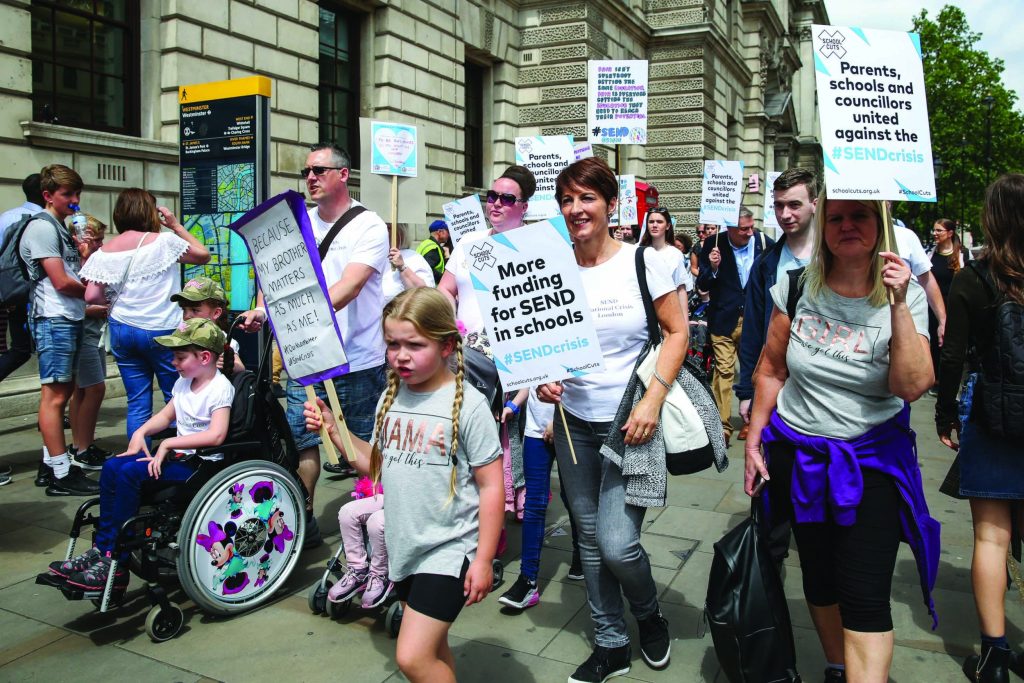
A protest in London in May 2019 to demand action to address the crisis in education for young people with special educational needs and disabilities. Photo: Dinendra Haria | Lightrocket via Getty Images
The soaring number of EHC plans in the UK is the result of a “perfect storm” says Ben Bryant, a lead researcher on a CCN report about the Send situation published in July 2024. “It’s not just one single factor that has driven this, it’s a confluence of factors,” he tells me. Among them, experts say, are societal influences, such as a cohort of children who experienced social isolation and home-schooling during the pandemic, changing parenting practices and children’s exposure to technology and ‘screen time’ at a young age.
Also influential, however, are policy changes that have placed a greater emphasis on academic achievement in education, in particular, reforms introduced in 2014 by then-education secretary Michael Gove. These changes to the curriculum and the Office for Standards in Education (Ofsted) have encouraged schools to focus on a narrow range of criteria for success, particularly exam-based achievement in academic subjects and behavioural standards. Government data shows that nearly 90 percent of primary school age permanent exclusions since 2019 have been of children with Send. “We’ve found ourselves in a situation where our curriculum is based around constant assessments in subjects like maths and phonics and it doesn’t leave room for children to learn in other ways or grow skills in other areas,” says Orchard-Rowe. “Schools have to push and strive for these academic results, because they are targeted to do so by Ofsted and so what tends to happen is that children with additional needs get left behind.”
With a growing number of children struggling to have their needs met in mainstream education, more parents have turned to EHC plans, which can only be issued after a formal Send assessment. “The issue, I think, is the way we have constructed the system has… basically made it harder for schools to be inclusive and undermined the confidence that a child [with Send] will be able to thrive in mainstream education,” says Bryant. “And the only response available to that, in this current system, is to get more support through diagnosis and an EHC plan.”
Both a greater awareness of Send and changing diagnostic practices may also be contributing to the rise in EHC plans. Data from the European Agency for Special Educational Needs and Inclusive Education shows stark differences between countries. While the number of Send diagnoses increased by 40 percent in the UK and 34 percent in France between 2016 and 2020, in Germany and Italy they only rose by 18 percent and in Spain they fell by two percent.
Meanwhile, more than 80 percent of the increase in EHC plans in the UK between 2015 and 2024 can be accounted for by a rise in just three categories of need – autism spectrum disorder; social, emotional and mental health; and speech, language and communications needs. A 2019 study, carried out by researchers from the universities of Copenhagen and Montreal, found that the measurable difference between autistic people and the general population has shrunk substantially over the last 50 years. This finding suggests that a wider range of behaviours are now being considered to fall within the parameters of the autistic spectrum than previously were.
“What all of this shows is that nothing objective sits behind the definition of Send,” says Bryant. “In a sense it’s subjective. Evidence suggests that needs, broadly, don’t differ substantially over time or between places, but how we conceptualise and categorise them varies. When you look at the proportion of young people in the population identified with Send in England pre-2014 and today, and when you compare England to other European nations, it tells you something has changed [in this regard].”
With the system overloaded, the number of appeals brought by parents and carers to the Send tribunal have risen more than threefold in the last ten years, reaching 20,102 in 2024. The legal proceedings, widely seen as a barometer of dissatisfaction with the Send system, are costly for all parties. According to think-tank Pro Bono Economics, legal wrangling over Send provision costs the public sector around £90 million per year, with parents and carers paying their own legal costs.
“I’ve spoken to families that have spent in excess of £60,000 fighting local authorities. It’s bankrupting families just to get the right provision in place for their children,” Orchard-Rowe says. The fact that local authorities overwhelmingly lose cases – around 98 percent of tribunal rulings find in favour of families – only stokes ill-feeling between parties. “When you hear those sorts of statistics your sympathy runs out for local authorities… It creates the impression that local authorities think that if they say no to five families seeking an EHC plan, only four will come back and push for one. So in that way they can save money, even if that fifth child is deserving too.”
Jeni Houghton, an education consultant with a specialisation in Send, warns that the current system sets all parties up for confrontation and often compounds problems for children: “[The tribunal process] just fosters really unpleasant relationships and [because of a backlog of cases] there’s a massive time lag, it can take up to two years, and while all this going on you have a child in limbo, a child who doesn’t have the right provisions in place and may even be out of school altogether. I think it’s easy to forget that amid all the acrimony between schools, local authorities and parents, are real children who are suffering real consequences.”
After a two-year fight, the tribunal ruled against the local authority and in Sophia’s favour. “In one sense it’s a victory because you walk away with your EHC plan. But at what cost? Because your family is broken by that point,” says Harding. “I think that what needs to be understood is that parents who embark on this fight are already starting from a bad place – they have a child in crisis, otherwise you wouldn’t do it.”
Three years on from leaving infant school, Sophia has still not returned to a formal education setting. She is now mostly home-schooled after the judge in her case ruled that there isn’t a suitable placement for her. Her parents believe that this is, in part, due to the two years Sophia had without appropriate provision for her needs while waiting for the tribunal decision.
“If you delay support, for one month, two months, a year or even two years, as was the case for Sophia, that causes damage and trauma to a child who is already struggling and that can be very hard, if not impossible, to undo,” says Harding.
Sir Keir Starmer and education secretary Bridget Phillipson speak with children at Perry Hall primary school in Orpington during the first day of the new school year, 2nd September 2024. Photo: Richard Pohle / Getty Images
In November 2024 education secretary Bridget Philipson pledged to carry out a programme of “bold reform” to Send provision. “Let me be clear: the direction of that reform is inclusive mainstream,” she told the Confederation of School Trusts.
Philipson’s comments follow the release of a damning National Audit Office report in October 2024, which found that mainstream schools lack incentives to be inclusive. “The current system is set up in such a way that if you are a parent or carer of a child that needs extra support… and a mainstream school says it doesn’t feel able to meet your child’s needs then a special school may feel like the only option because you know that they will feel valued there… and you won’t get a phone call every day at 10am saying ‘Can you come and pick your child up because we can’t cope with them,’” Bryant says. “But these things aren’t inherent to a special school; they could actually be provided in mainstream schools if we had a different conception of education and support. Inclusion has to be at the heart of all education. We can’t just say schools are ‘inclusive’, we need to rethink our curriculum and assessment performance measures. It’s how we [physically] build schools, train staff, deliver funding, offer targeted support. We need a more inclusive architecture in education.”
From a policy perspective, reducing the number of pupils in special schools appears to make financial sense too. Because state-funded special schools are at capacity, local authorities placed 29,802 Send children in private special schools in 2024. With state places costing £25,000 per year and private ones £58,500, these placements make up a substantial chunk of local authorities’ Send spending deficit – in comparison, a ‘high needs’ child receiving Send support in a mainstream setting requires an £8,200 top-up on local authority funding. According to Department of Education data, since 2014 the number of children in special schools has risen by 60 percent in the state sector and 132 percent in the independent sector.
Freeing up special school place funding could also allow more money to be spent on early intervention and improving Send provision in mainstream settings, enabling local authorities to reduce costly EHC plans with their individualised funding. “By having a stronger, more inclusive education system that meets the needs of more, we should be in a place where [EHC] plans are at a higher threshold of need… [and are] for children that really can’t find their place in that more inclusive system and still need some additional support,” says Bryant. “Essentially the system we have at the moment is caught in a vicious cycle where we are not meeting identified needs early, which is increasing the pressure for statutory provision so more and more resource provision is going into EHC plans and the bureaucracy around them, to special school places and so on, and fewer and fewer resources are available for non-statutory early preventative action.”
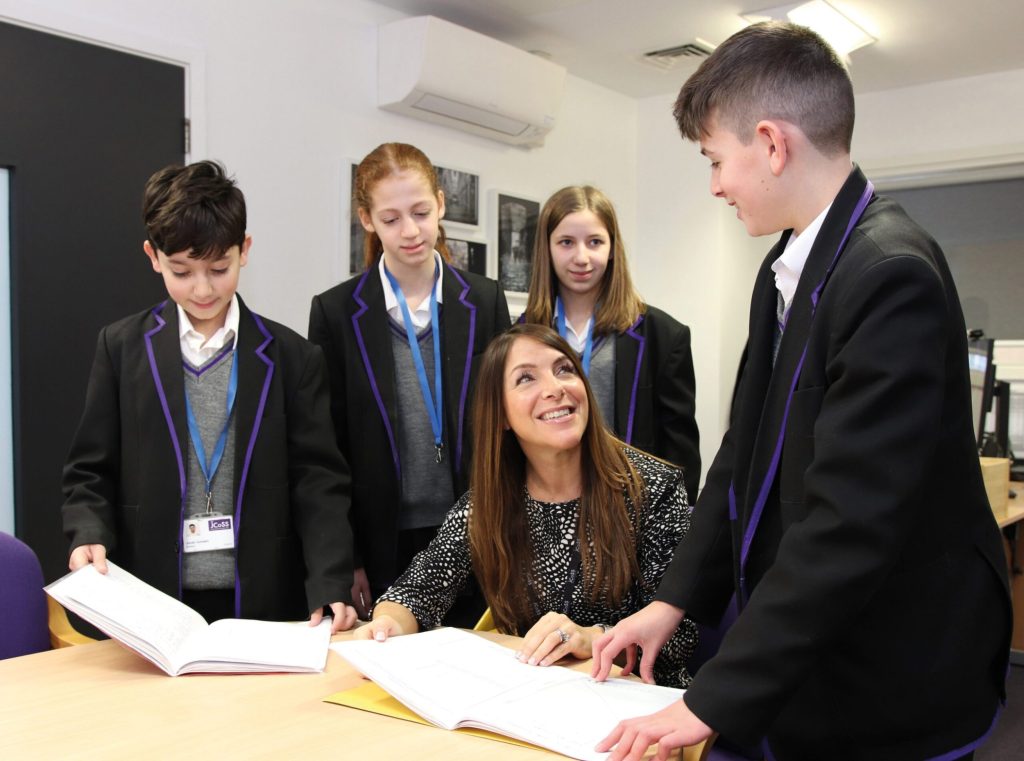
However, those already working within the “inclusive mainstream” model warn that improving schools’ capacity to meet the needs of more Send children will be costly. At the Jewish Community Secondary School (JCoSS) in northeast London, children with EHC plans make up around ten percent of the main school’s pupils, around triple the national average for a mainstream setting. In addition, a specialist autistic provision on the school site accommodates another 52 children with a higher level of need. These students at the provision also attend mainstream classes either to study for GSCEs or for social interaction and skill development.
JCoSS’s set-up, a specialist provision next to a mainstream school, is one Phillipson is pushing to be more widely used. But the school’s head, Dr Melanie Lee, warns the inclusive model shouldn’t be seen as a panacea for local authorities’ Send deficit. “We are under huge financial pressures. We are already running at a deficit that is only going to grow in the next few years and the reason for that is we have so many children with EHC plans that need specific support, which just isn’t covered by the notional funding provided by the local authorities,” she says.
“If you’re going to put children with severe needs and EHC plans in a mainstream school… and bury your head in the sand about what these children need then, of course, on the surface, it’s going to show it’s a cost-saving exercise. But if you want an alternative provision that can integrate with the mainstream school it’s the opposite of cost-saving – for example, many of the children from the provision need one-on-one support to attend mainstream classes, which is a big expense,” she tells me.
Parents and carers also have reservations about Send policy being overly focused on mainstreaming. “We would love to see Sophia thriving in a mainstream school that could meet her needs, I mean, god, what parent wouldn’t?” says Harding. But she’s also aware how much would have to be done. “EHC plans are a lifeline for children like Sophia… they are based on expert advice about a child’s needs. For a parent to voluntarily give one up and therefore also the legal protection it provides – it’s hard to imagine any parent being able to take that leap of faith in local authorities right now.”
Slow Journalism in your inbox, plus infographics, offers and more: sign up for the free DG newsletter. Sign me up
Thanks for signing up.
More stories...

“A 19th century war, with 20th century tactics and 21st century technology”
A conversation with Ukrainian historian Serhii Plokhy as the war with Russia entered its fourth year

Jane Goodall: 1934-2025

Marianne Faithfull, 1946-2025
Musician and producer Rob Ellis on the life and career of the 1960s icon


