Jane Goodall: 1934-2025
Explorer and TV presenter Dr Mireya Mayor talks about her friendship with Jane Goodall, the renowned British primatologist who died in October 2025 at the age of 91
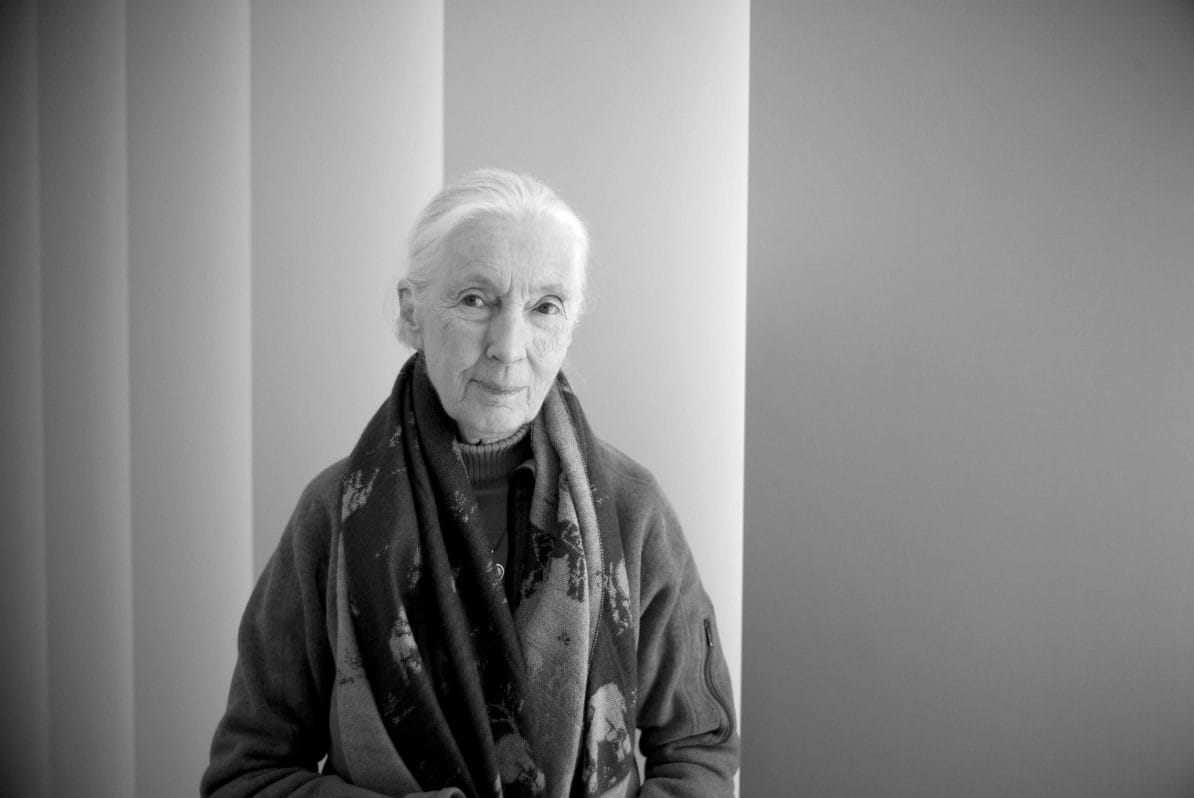
Jane Goddall photographed in 2016. Photo: Anthony Wallace AFP via Getty Images
1st October 2025 (Taken from: #61)
Dr Mireya Mayor had one shot, and she nearly blew it. It was 2010 and she was sitting at a science conference in Ecuador where world famous primatologist Jane Goodall had just spoken to an enraptured crowd.
Like Goodall, then a sprightly 76, Mayor was also a primatologist who had defied convention and the scientific establishment to make a mark in her field. Goodall had become the world’s leading expert on wild chimpanzees in her twenties, travelling to Tanzania in 1960 to observe the animals. She had no formal scientific education, yet she revolutionised how we saw our closest living relatives.
Mayor was raised in Florida by a protective Cuban immigrant mother and grandmother. She spent four years as a Miami Dolphins cheerleader before completing an anthropology degree and then, like Goodall, leaving for Africa, where she discovered the world’s smallest primate before she turned 22. By 2010 she had become the first female National Geographic wildlife TV correspondent, known for her fearless expeditions.
Goodall was Mayor’s hero when she was growing up, and there she was, standing in front of her, surrounded by dozens of people all clamouring for a moment of her time. “I wanted to talk to her so much but I felt embarrassed to be part of the fangirling that was going on,” recalls Mayor of the first time she met Goodall. “And then suddenly I got brave enough to approach. I remember – and this has never happened to me before – struggling to speak… Even though she was actually quite tiny she had this huge presence about her.” Mayor finally pulled herself together. “I blurted out: ‘Would you write the foreword to my book?’ I was thinking ‘There’s no way she’s going to agree to this.’” But she did. Goodall asked Mayor to send her the manuscript for what would become Pink Boots and a Machete: My Journey from NFL Cheerleader to National Geographic Explorer.
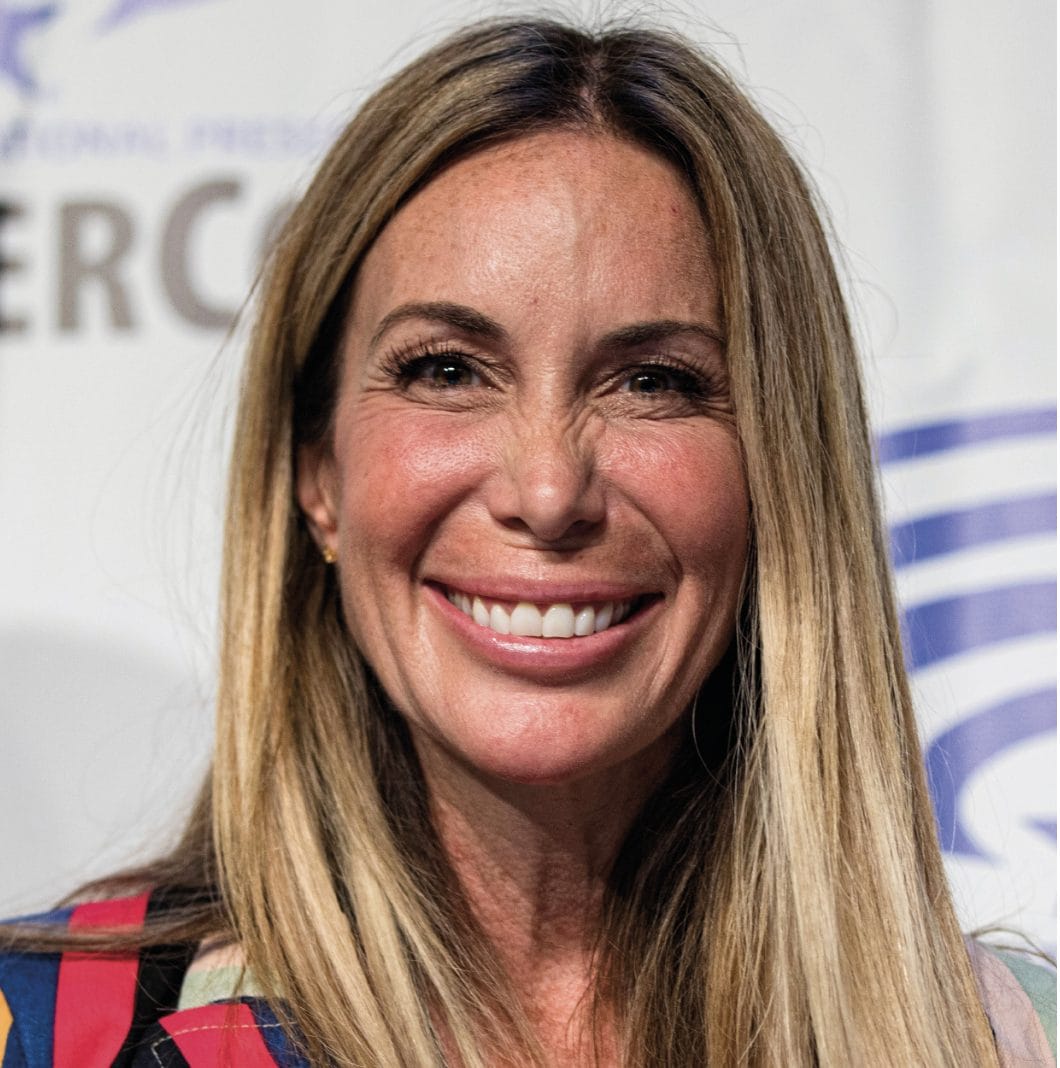
For most scientists, it’s all about the science. For her it was about the storytelling and outreach” — Dr Mireya Mayor
Everyone knows you should never meet your heroes. But for Mayor, Jane Goodall was everything she hoped she would be, and more. “The foreword, to this day, is maybe the most treasured thing ever given to me,” she says. “She starts it by writing: ‘Dr Mireya Mayor reminds me a little of myself.’ It was the biggest compliment you could ever pay me.”
It was the start of a friendship that would last to the end of Goodall’s life. Mayor had read everything Goodall had written, from the scientific papers to her international bestsellers about primatology, and knew her life story by heart. Born in London in 1934, Goodall was raised by her mother, grandmother, sister and two single aunts after her parents’ divorce. She idolised Tarzan growing up, and loved animals. After leaving school she worked as a waitress to raise enough money to buy a one-way boat ticket to Kenya and in 1957, when she was 22, she headed off for Nairobi to stay with the family of an old school friend. But what she really wanted was to come face to face with African wildlife. So she pitched up at the office of Professor Lewis Leakey, curator of Nairobi’s natural history museum. The meeting would change the course of her life.
Leakey was a palaeoanthropologist who was convinced that the roots of human evolution would be found in Africa’s apes, an idea which was then still hotly debated in scientific circles. He hired Goodall as a secretary and soon recognised her talent for meticulous observation and her deep, self-taught knowledge of African wildlife, which made her an ideal candidate to undertake fieldwork. He began mentoring her and, in 1960, sent Goodall to Gombe in Tanganyika, now Tanzania, to observe chimpanzees up close, something that had rarely been done before. At the insistence of the British government she was chaperoned by her mother: Tanganyika was still a colonial possession and the authorities that controlled Gombe thought it was too dangerous for a woman to be alone in the jungle. It was in Gombe that Goodall made her groundbreaking observations of chimpanzee behaviour, of their strong family bonds, their tool-making skills and their ability to wage war. On her return in 1962, Leakey sent her to Cambridge to undertake a PhD; she was one of the few people ever to be accepted by the university without an undergraduate degree.
In what was then a male-dominated field, Goodall’s findings from Gombe were initially dismissed by a scientific establishment which viewed tool-making in particular as a quintessential human trait. She also named her chimps, which was revolutionary at the time. “Up until then, you didn’t name your study animals,” explains Mayor. “You numbered them. She talked about their personalities. She talked about their emotions, stuff that we now know and accept.”
In 1963, National Geographic magazine ran its first cover story on Goodall and her research on the chimps of Gombe. Two years later it released a documentary about Goodall and her work called Miss Goodall and the Wild Chimpanzees. It was voiced by Orson Welles and transformed her into a global star. She had connected with a wider, non-scientific audience and helped pioneer a new approach to conservation, one that placed storytelling front and centre. “If one wants to change attitudes, you have to reach the heart,” Goodall said later in life. “You can reach the heart by telling stories, not by arguing with people’s intellects.” Mayor recalls Goodall telling her, “I’m a storyteller first and a scientist second.” That, she says “is a very brave thing for a scientist to say because for most scientists, it’s all about the science. For her it was about the storytelling and outreach.”
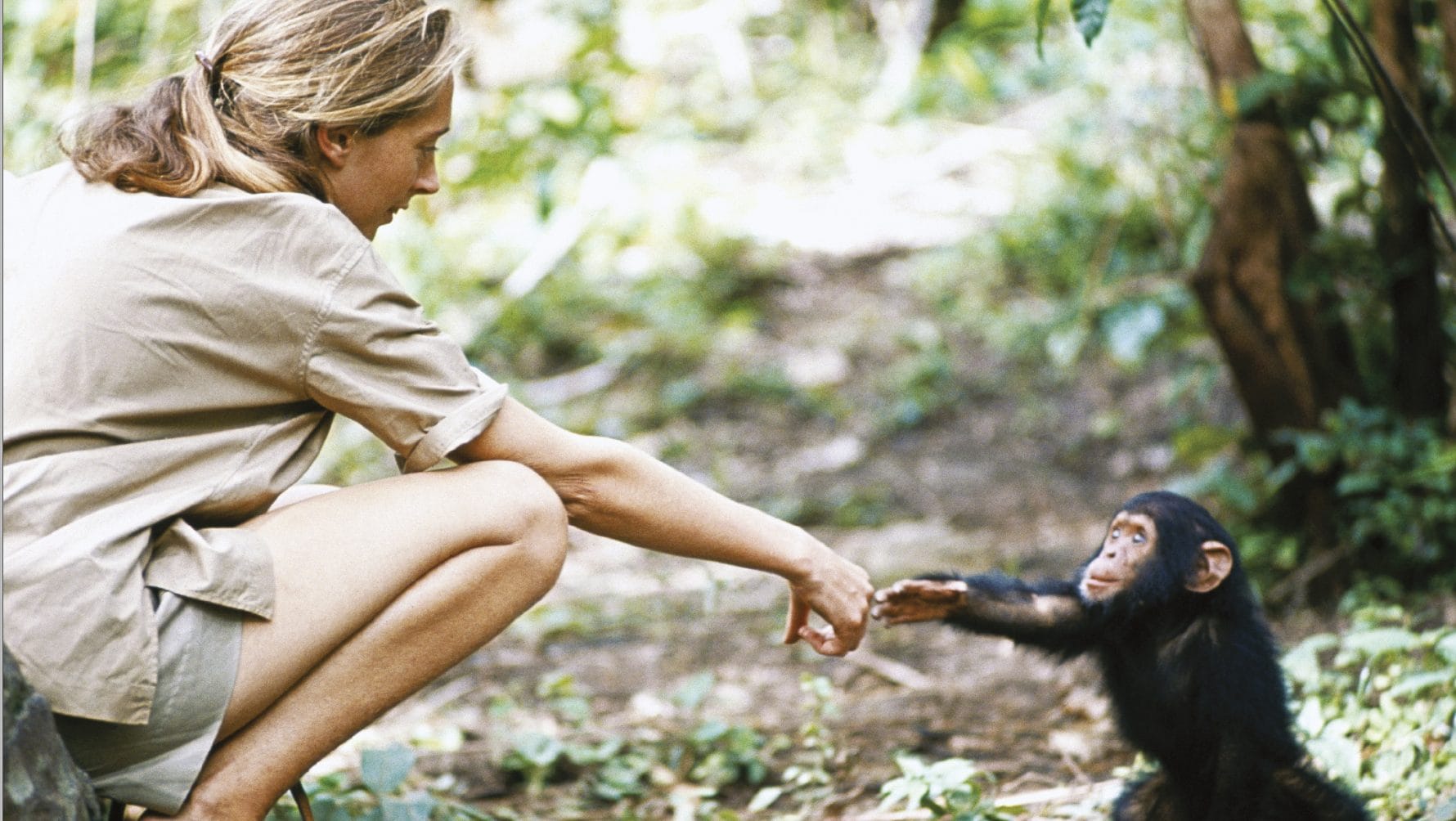
Jane Goodall with baby chimpanzee Flint at Gombe Stream Research Center in 1964
Goodall spent the next 25 years observing the chimps of Gombe, which the now independent Tanzania declared a national park, and in 1977 set up the Jane Goodall Institute, with the aim of encouraging collective action to save the natural world. Along the way she became concerned about the global impact of deforestation and in 1986, after publishing The Chimpanzees of Gombe: Patterns of Behaviour, she switched from research to activism and advocacy. She travelled the world on a seemingly endless tour of lectures, festivals and symposiums, as well as accepting invitations to meet heads of state, royalty and pop stars
After Goodall and Mayor became close friends they stayed in regular email correspondence about developments in science. They would meet up and Goodall would offer advice, but it wasn’t until Mayor invited her to speak at the Florida International University, where she is director of exploration and science communication, that she truly understood how surreal her friend and mentor’s life could be. “We were in her hotel room and Jane poured me a glass of whisky. She had a very particular way. Glenlivet and two ice cubes. It was this very procedural thing,” says Mayor. “She started talking to me about meeting Michael Jackson. And I was like, ‘Wait, what? Why did you meet Michael Jackson?’ And she said ‘Well, because of his pet chimpanzee, Bubbles’.”
In the early 2000s Jackson was worried that Bubbles was depressed and didn’t know how to cheer him up. So he invited Goodall to the Neverland Ranch to ask for advice. “She said he was almost like a child… truly wanting to understand what was wrong with his pet. And so he walked her into this mansion, took her straight to his bedroom where he had this enormous bed and she lay on one end. He lay on the other. And they watched videos of chimpanzees. And she talked to him about how chimps are not pets. They belong in the wild.” In 2003, shortly after Goodall spoke with Jackson, Bubbles was sent to a trainer and then an ape sanctuary in Florida. Bubbles is still there and is now 43 years old. Goodall had many other stories too, like going to the Playboy Mansion to see Hugh Hefner and, on another occasion, meeting Mikhail Gorbachev. “She was this enigma who could talk to anybody from any walk of life in any sort of situation,” says Mayor. “She was perfectly at ease and made them feel perfectly at ease too.”
Mayor was at home when she heard the news of Goodall’s death. “It was shocking because she was one of those people who seemed invincible,” she says. Goodall died on the road, during a speaking tour in LA. “At 91 she was still the same person she was in her 20s, she still had the same curiosity, the same passion,” says Mayor.
There was to be one final act. After Goodall’s funeral, Netflix released a posthumous interview she had given in March 2025. Goodall had left instructions only to air it once she had died. In it she lamented the state of the world, and expressed a desire to load a rocket with Elon Musk, Donald Trump and Benjamin Netanyahu, among others, and blast them into space. But it still ended on a hopeful tone. “Don’t give up,” said Goodall. “There is a future for you. Do your best while you’re still on this beautiful Planet Earth that I look down upon from where I am now.”
The interview was, says Mayor, a fitting farewell: passionate, principled and hopeful. “The thing I’ve come to understand after Jane’s passing, which I didn’t grasp when she was alive, was that she spoke so much about hope, and hope can seem like such a passive word,” says Mayor. “You ‘hope’ something happens. I realise now that, the way that Jane talked about hope, without it you cannot enact change. It’s actually a very active word. You need hope to care enough to create change.”
Slow Journalism in your inbox, plus infographics, offers and more: sign up for the free DG newsletter. Sign me up
Thanks for signing up.