All at sea
In May 2025 the UK signed an agreement to give Mauritius sovereignty over the Chagos Islands. The deal sparked heated political debate, with opponents characterising it as an unpatriotic surrender. But it also exposed deep divisions within the Chagossian diaspora, the exiles who were forcibly deported from the archipelago by Britain more than 50 years ago, and their descendants. We spoke to Chagossians on all sides of the debate about a deal that might change everything
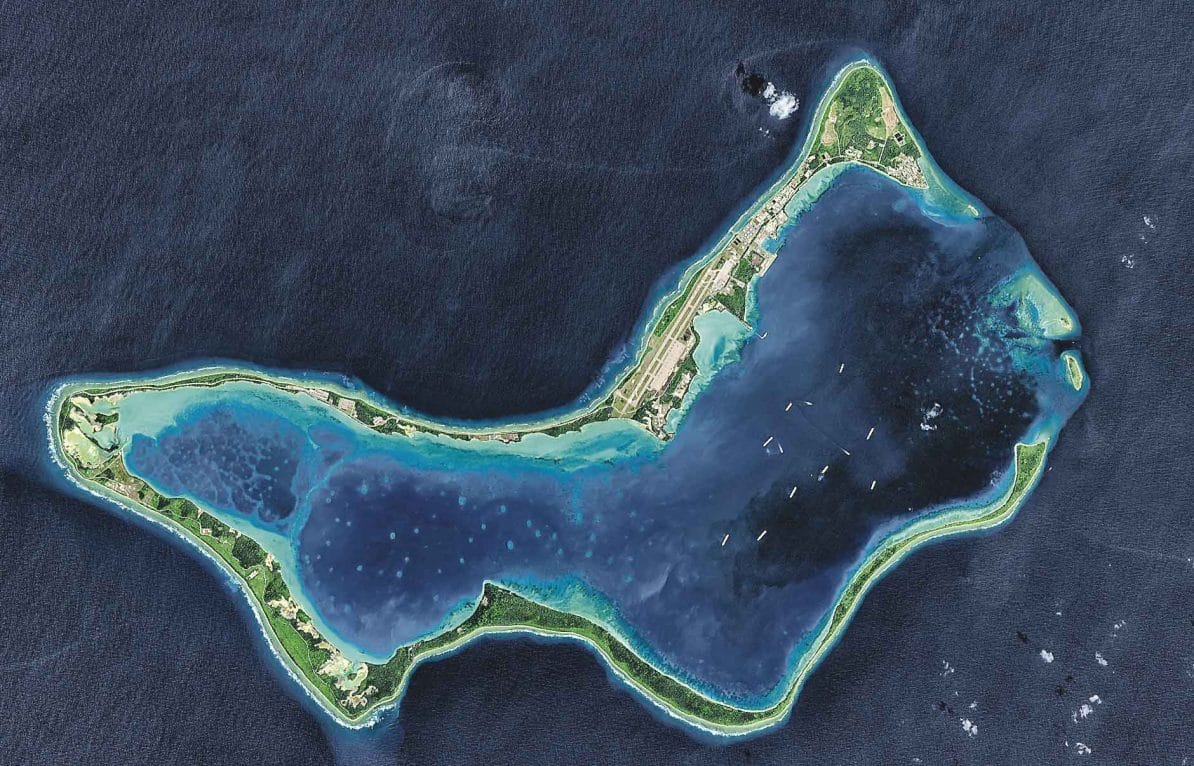
A satellite view of Diego Garcia. Photo: USGS/NASA Landsat data/Gallo Images/Getty Images
Published Sep 2025 (Taken from: #59)
There were fireworks in Port Louis on 22nd May 2025, the day Sir Keir Starmer signed an agreement to hand sovereignty of the Chagos Islands to Mauritius. At their headquarters in the Mauritian capital, members of the Chagos Refugees Group (CRG) danced and waved their flag, its orange, blue and black horizontal stripes representing the sun, the ocean and the pain of exile respectively.
For CRG leader Olivier Bancoult, it was a victory more than 40 years in the making. His long battle to return to the island from which he was forcibly deported by the British government at the age of four appeared to be over. Mauritius has pledged to help Chagossians resettle the islands of the archipelago, with the exception of the largest – and only inhabited – island, Diego Garcia, home to a joint UK-US military base. “We have been in a struggle for many years,” Bancoult tells me. “But we never stopped fighting.”
The British government’s initial announcement last October that it planned to voluntarily surrender sovereignty of the Chagos Islands had been met by a wave of criticism. While the prime minister insisted that the deal was necessary to secure the long-term future of the Diego Garcia base, which under the terms of the new agreement will be leased from Mauritius for £101 million a year for an initial period of 99 years, the Conservatives described it as an “act of national self-harm”. Reform leader Nigel Farage, meanwhile, called the deal a “strategic disaster” and “not far short of an act of treachery”. But opposition didn’t just come from right wing politicians seeking to land a blow on the Labour government. Many Chagossians, the exiled inhabitants of the islands and their descendants, several thousand of whom live in the UK, were furious.
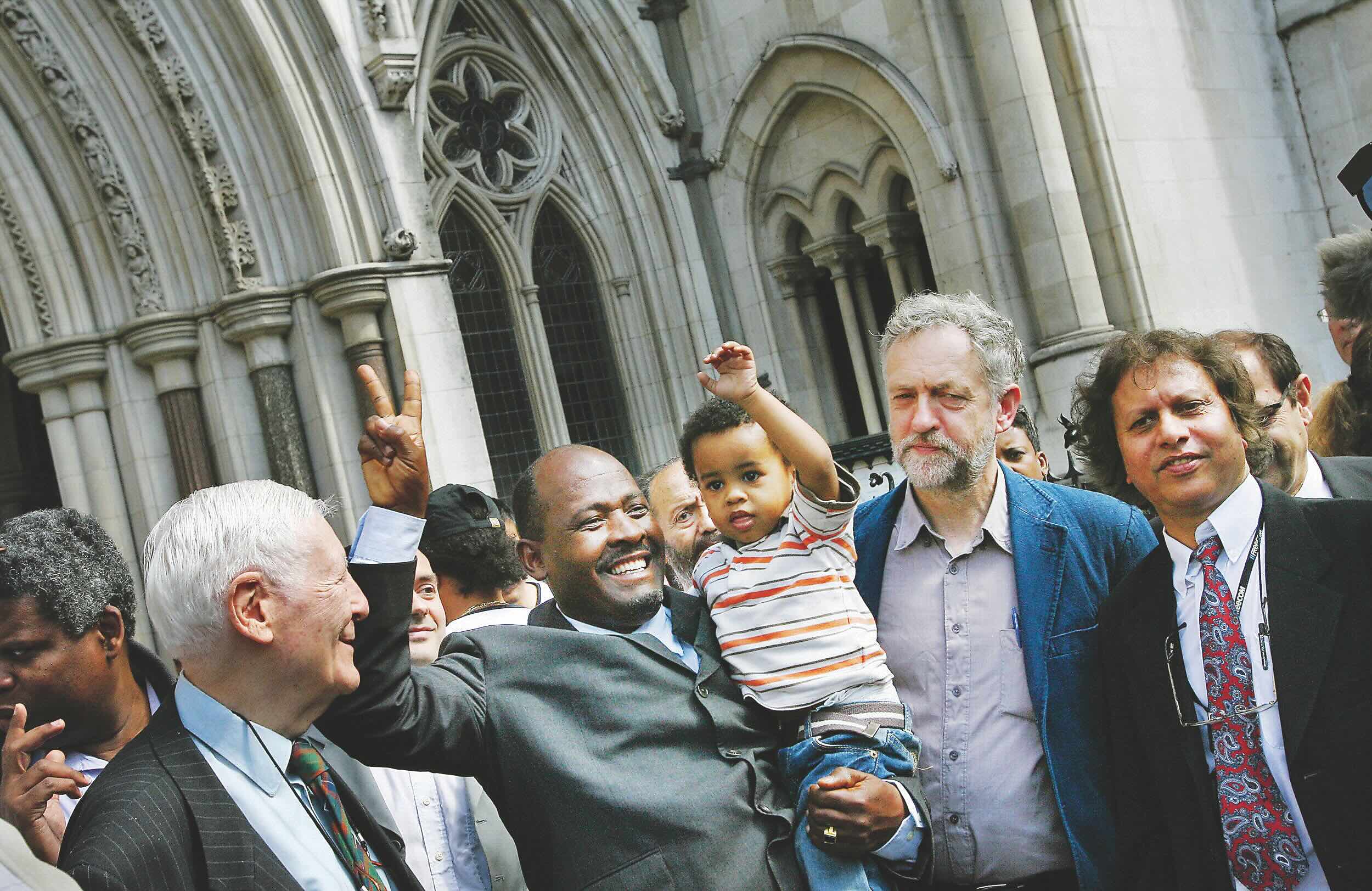
Olivier Bancoult celebrates with family and supporters including Jeremy Corbyn at the high court after winning the right to return to the Chagos Islands, May 2007. The House of Lords overturned the ruling the following year
“What we needed was the support of a country”
Olivier Bancoult has recently returned to Mauritius from the Vatican, where the new pope told a Chagossian delegation he was “delighted” with the sovereignty deal. Faith is important to the CRG leader, an electrician by trade. When he visited the uninhabited island of Peros Banhos in 2022 on the first heritage trip to the archipelago organised by the Mauritian government, he knelt in prayer as soon as he stepped onto its shores. Wearing a T-shirt inscribed with the words “Everybody has the right to live on his birthplace”, he led his group to Saint Sacrement, the chapel where he was christened and where he attended his grandfather’s funeral shortly before his deportation. Its roof had collapsed and branches of palm trees grew through what used to be its windows. The exiles cleared debris from the chapel floor while on the beach Mauritian officials installed a concrete base, sang the national anthem and raised the country’s flag for the first time.
When I ask why he backed Mauritian sovereignty over the island of his birth, Bancoult explains how history has taught him that the British cannot be trusted. First came the original sin, the forced deportation of the entire population of the Chagos Archipelago, between 1,000 and 2,000 people, between 1968 and 1973. After making a secret deal with the US to allow the building of an Indian Ocean military base on Diego Garcia, the foreign office fulfilled an American request to, in the infamous words of an internal memo, “sanitise” the islands of a “few Tarzans or Men Fridays”. In exile in Mauritius in the early 1980s, Bancoult began the fightback, a lengthy legal tussle with the British government that would dominate his life for decades.
“The first judgement in our favour was on 3rd November 2000,” says Bancoult, recalling the false dawn of a high court ruling that Chagossians could return to the islands of the archipelago, with the exception of Diego Garcia. “But the UK government kept denying us our fundamental human rights.” The UK used the royal prerogative to block the return in 2004, Bancoult won an appeal in 2007, the government won an appeal against the appeal in 2008, and a pattern of victory followed by disappointment was established. The turning point, Bancoult says, “was when we were approached by the Mauritian government. It was a great opportunity for us. As an individual, or as a group, we don’t have access to the United Nations general assembly. What we needed was the support of a country.”
When Mauritius gained independence in 1968, it was agreed that Britain would retain control of what’s officially, for now at least, called the British Indian Ocean Territory – lying around 1,300 miles from Port Louis, and 5,800 miles from London – and it was also agreed that the UK would hand over the territory when it was no longer required for defence purposes. In 2010, with the permanence of the base hardly in doubt during the US ‘war on terror’ (it was reportedly used as a CIA ‘black site’ for interrogating terror suspects), Mauritian prime minister Navin Ramgoolam launched a legal challenge against British sovereignty in the international courts. He said that as long as Chagos was British, the decolonisation of Africa was incomplete.
A key moment in that legal challenge came in 2019 when Liseby Elysé, a colleague of Bancoult’s at the CRG, gave her testimony to the judges of the International Court of Justice (ICJ) in The Hague. She was 20 years old, newly married and pregnant when she was forced onto the Nordvaer cargo vessel by the British and, after a hellish four-day journey, dumped with the other Chagossians on the docks of Port Louis where they were left to fend for themselves. Her baby was stillborn shortly afterwards. The ICJ judges issued an advisory opinion, endorsed by the UN general assembly, that the British claim to the Chagos Islands was unlawful. When the UK ignored the verdict, Mauritius went to the UN’s special international maritime court, which also ruled in its favour.
The first judgement in our favour was on 3rd November 2000. But the UK government kept denying us our fundamental human rights”
“The Mauritian government clearly made an alliance with Chagossians to take their case to the ICJ,” says David Vine, a US academic who has been researching and writing about Chagos for decades. “I’m not sure they would have won [sovereignty] without the Chagossians’ testimony, which was very powerful.” With both the ICJ and the UN calling for an end to British administration of the Chagos Islands, in November 2022 the Conservative government agreed to open negotiations with Mauritius. Although then-foreign secretary James Cleverly seemed keen to reach a deal, his successor David Cameron suspended the talks and angered Chagossians by stating that their return was “not possible”. However, when Labour came to power in July 2024, then-foreign secretary David Lammy restarted the negotiations – if Starmerism means anything it’s a commitment to international law – and soon finalised the handover. As well as giving sovereignty of all the islands to Mauritius, the UK will pay £40 million into a trust fund to help Chagossians.
We never saw ourselves as being Mauritian. We were British Overseas Territories citizens, always”
“Having watched the Chagossian struggle for almost 25 years, I think the deal is the biggest advancement – and the biggest victory – since their expulsion,” says Vine. “But it is imperfect. It’s outrageous that the Chagossians are facing a continued ban on living on Diego Garcia… The base only takes up a third of the island; there is no military justification for continuing to deny Chagossians their fundamental human right to live on their homeland.”
“I’d rather die than see my island go to Mauritius”
On 9th September 2025, I join a group of Chagossian activists in the viewing gallery of the House of Commons, where the business of the day is the future of the Diego Garcia base. The 40 or so members of the BIOT Citizens group wear their flag on their T-shirts – but it isn’t the stripes of the CRG. It’s the flag of the British Indian Ocean Territory (BIOT), featuring a palm tree and crown, with a Union Jack in the top-left corner. Upon entering Westminster Hall, the group had been greeted by shadow foreign secretary Dame Priti Patel, who applauded the bravery of their opposition to the sovereignty agreement, and a couple of hours later they watch her lambast Luke Pollard, a defence minister, over what she calls the government’s “surrender deal”. The Chagossians sitting by me nod their heads in agreement.
Misley Mandarin, who runs BIOT Citizens with his sister Vanessa Calou, tells me that he felt distraught when he first heard about the sovereignty deal. “Words can barely explain how I felt. I’d rather die than see my island go to Mauritius,” he says. The siblings came to Britain in 2002 with their father, who was born on Peros Banhos. “He was 12 when he was deported with his family,” says Mandarin. “They went to the slums of Port Louis, they had nothing, they begged for accommodation.”
Mandarin joined the British army shortly after his arrival in the country, but his loyalty towards the UK predated his military service. “We never fitted in in Mauritius. We were always thinking about the Queen, how our country was Britain… We never saw ourselves as being Mauritian. We were British Overseas Territories citizens, always.”
I ask how this sense of allegiance to the UK can sit alongside the knowledge that the country committed the crime of forced displacement against his own family. “They did, but it was in complicity with Mauritius,” he replies. “It was to their benefit too, for their independence… The treatment of the Chagossians by Mauritius is worse than what the British did to us… So many of the [Chagossian] natives who were deported to Mauritius died in abject poverty. They were treated as second-class citizens there.”
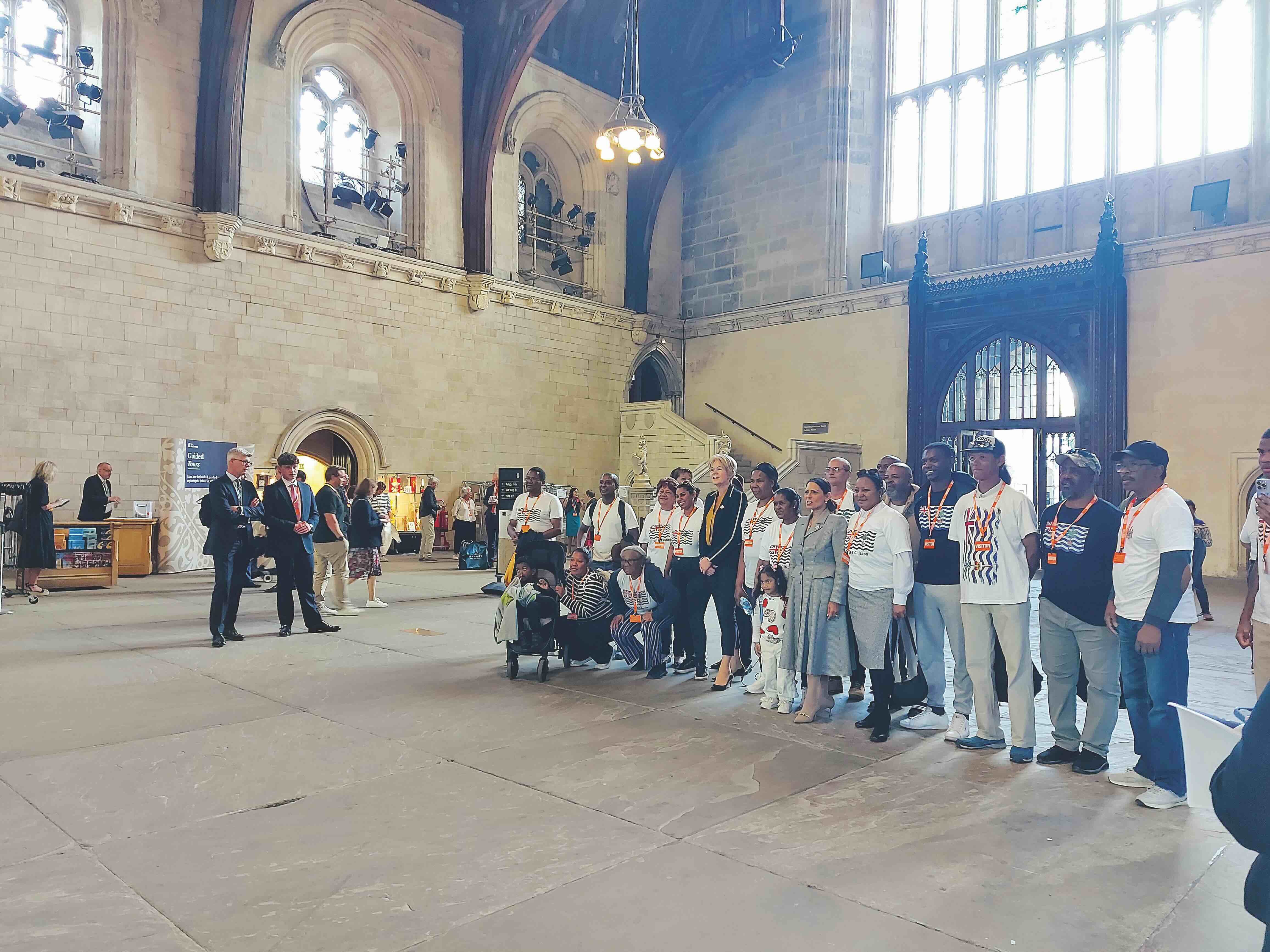
A group from BIOT Citizens, an organisation that opposes the transfer to sovereignty of the Chagos Islands to Mauritius, poses with shadow foreign secretary Priti Patel in Westminster Hall, September 2025. Photo: Matthew Lee
One reason Mandarin co-founded the BIOT Citizens group was because he wanted the world to know that “what Mr Bancoult is doing is only one side of the story”, and he insists that the Chagossian British community is overwhelmingly opposed to the sovereignty deal. “Olivier Bancoult sold our population to the Mauritian government,” Mandarin says. “He’s part of the Mauritian establishment, he’s a Mauritian politician. He has stabbed us in the back.”
Mandarin says that since the deal was announced last year he’s made regular trips to Heathrow airport to welcome and offer support to new arrivals from Mauritius. In July 2025, Hillingdon council said that more than 400 Chagossians had arrived at Heathrow in the past year, with over 100 arriving in a single week in May, when the deal was announced. It has made an urgent appeal for government funding, saying that since Chagossians are British citizens they don’t qualify for the support received by refugees and asylum-seekers, and that many didn’t have any accommodation.
Mandarin claims to have personally arranged the migration of around 4,000 Chagossians from Mauritius over the past few years. Some of them, he says, are now sleeping rough; he blames the government. “I’ve got so many people saying to me, ‘Misley, I don’t want to live in Mauritius, I’m British, I want to come to England,” he says. “They’re fleeing the country.”
Mandarin’s outspoken opposition to Starmer’s deal has earned him the support of the shadow foreign secretary, as well as friends further to the right. A charismatic speaker, he’s regularly featured in the pages of the Telegraph, where one columnist hailed him as a “hero” and evoked comparisons to Mahatma Gandhi, and he has been interviewed on GB News several times, including by Nigel Farage, who has a show on the right wing network.
He is confident that Farage will be the next prime minister and scrap the Chagos deal. And like many critics of the agreement he had hoped that Donald Trump would torpedo it. Due to the base on Diego Garcia, the US has always had an outsized influence on British decision-making on Chagos, and secretary of state Marco Rubio had criticised the deal, echoing Tory concerns that it could give China, which has a good relationship with Mauritius, a foothold in the Indian Ocean. But in April the US president surprised many by giving Downing Street the green light to sign the agreement.
Mandarin has been pinning his hopes on right-wing populists who call for mass deportations of illegal migrants. Is he, a representative of migrants – albeit legal ones with British citizenship – comfortable with his choice of allies? “The reason we are on the right is because Labour has never been good for Chagossians,” he replies. “First of all, Labour prime minister Harold Wilson deported the Chagossians. Then Labour [former foreign secretary] David Miliband created a marine protection area [around the Chagos archipelago in 2010, which some argued effectively barred Chagossians from returning]… And now under Labour Keir Starmer is giving our island away.”
The BIOT Citizens co-founder is currently working with the Great British PAC (GB PAC), a US-style political action committee that raises funds to help support campaigns and causes that align with its values. It is chaired by Ben Habib, a former deputy leader of Reform, who also runs Advance UK, a party that has been publicly endorsed by far right activist Tommy Robinson and Tesla CEO Elon Musk. On their website GB PAC say they “want to deliver a truly patriotic government” with “no more surrender to the globalist agenda”, which, in their minds, is precisely what the Labour government’s Chagos deal represents, a capitulation to the UN and the ICJ. Backed with funding from GB PAC, Mandarin has now launched a judicial review which accuses the government of acting unlawfully by failing to consult with Chagossians before entering negotiations with Mauritius. While Mandarin refutes my suggestion that his relationship with Great British PAC may be a marriage of convenience, he acknowledges that his strategy is to work with groups most likely to help him advance his goals.
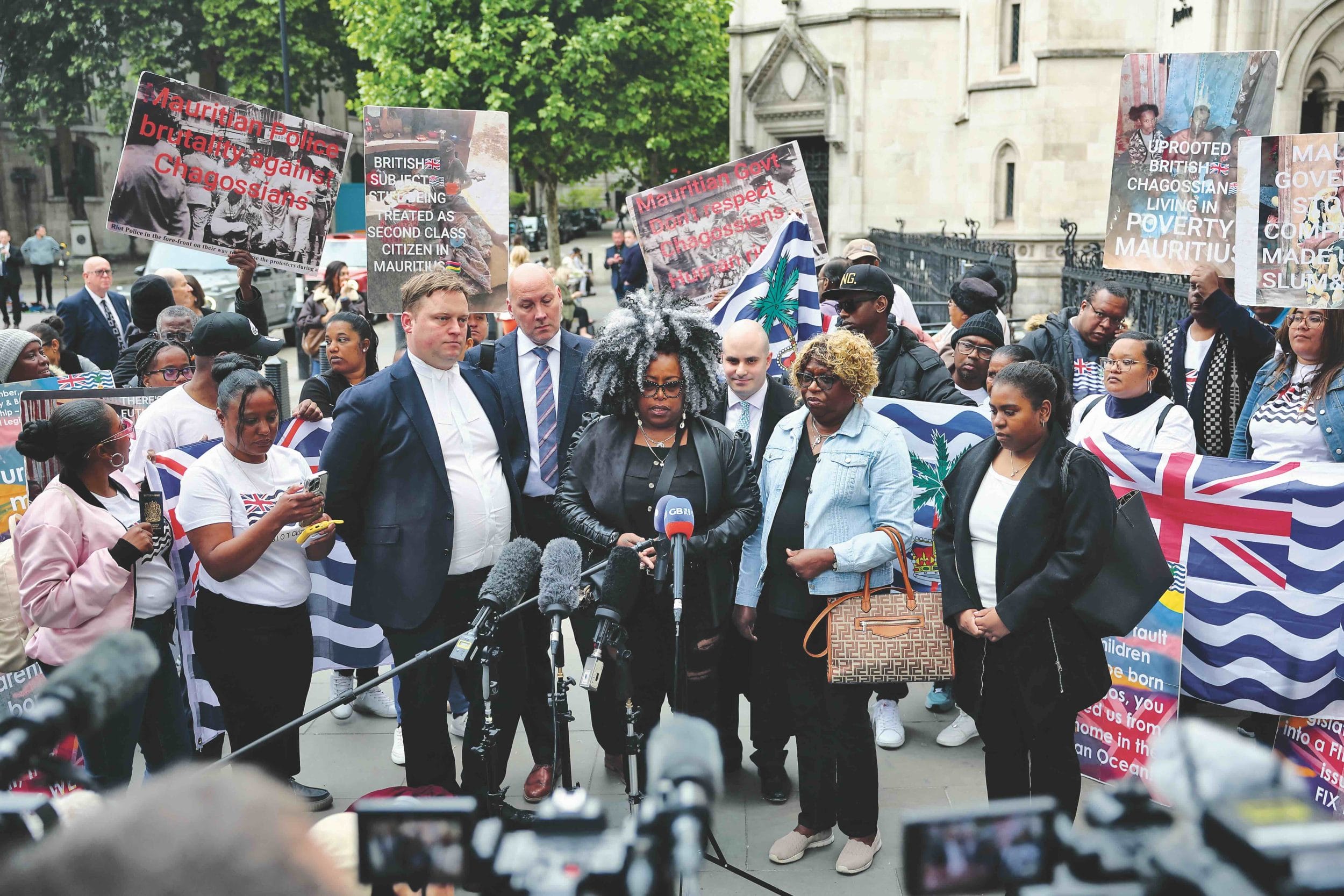
Bertrice Pompe (centre) and Bernadette Dugasse (centre right), who filed a last-minute legal challenge to attempt to block the deal, make a statement outside the high court in London, 22nd May 2025. Photo: Getty Images
The judicial review is not GB PAC’s first attempt to stop the Chagos agreement in the courts. On 22nd May, the day the UK and Mauritius confirmed the signing of the deal, the British prime minister awoke to bad news from government lawyers. At 2.25am a high court judge had issued an injunction to block the deal after two Chagossians, Bertrice Pompe and Bernadette Dugasse, had filed a last-minute emergency legal challenge, supported by GB PAC. The judge said the agreement couldn’t go ahead until the Chagossians’ case was heard in the high court, but a different judge dismissed the ruling later in the day. Mandarin, who supported that case but wasn’t directly involved, is confident that his judicial review will have more success. “I’m a very determined man,” he says. “I will do everything in my power to stop the deal from happening.”
“We will still be colonised, but by a different power”
I meet Maxwell Evenor of Chagossian Voices in a cafe in Crawley, home to the largest Chagossian community in the UK. He’s furious about the deal, but he’s also upset about how the community’s legal case against it collapsed. Pompe and Dugasse, the women who fronted the case, had been members of Chagossian Voices, but Evenor says that the group split when they joined forces with GB PAC. “We don’t want to be involved with a far right organisation. We are not left wing or right wing,” says Evenor. He says that his group had been working on a different legal strategy with pro bono lawyers, which was aborted after GB PAC got involved.
While Bancoult and the CRG are pro-Mauritian, and Mandarin and BIOT Citizens are pro-British, Evenor and Chagossian Voices aren’t in either camp. “This deal isn’t about decolonisation [as argued by Mauritius and some supporters of the agreement]. Our colonisation is being passed onto Mauritius,” he says. “We will still be colonised, but by a different power.” For him it’s clear – the Chagossians are an indigenous people who are entitled to the right of self-determination, independent of either the UK or Mauritius if that’s their preference.
My grandma used to tell us stories about life on the islands. She said that they were healthy, that life was peaceful and beautiful”
He is angry about how the negotiations between London and Port Louis took place behind closed doors. “We were never consulted by anyone. We had one tokenistic meeting with the FCDO (Foreign, Commonwealth & Development Office) on the day [the deal was announced]. The government of Mauritius only talks to the CRG, and if they talk to Chagossians in the UK, they only talk to the UK branch of the CRG.”
Evenor was born in Mauritius, but his father and grandparents were born on Peros Banhos. “My grandma used to tell us stories about life on the islands,” he says. “She said that they were healthy, that life was peaceful and beautiful… She told me about being deported from the island on the Nordvaer. There was lots of screaming and crying, and people who didn’t want to leave jumped overboard. She told us how one lady gave birth on the boat – that baby now lives here in Crawley. I coach his son at the Chagossian football club I run.”
Evenor moved to the UK at the age of 20, and five years ago helped set up Chagossian Voices, which campaigns for the community living in the UK while pushing for the right of return. He has little faith that Mauritius will honour its commitments to Chagossians. Scrolling though the agreement on his phone, he pauses on Article 6. “There’s nothing there that holds Mauritius to account if they don’t do anything for the Chagossians,” he says. “It says that Mauritius ‘is free to implement a resettlement programme’, but that’s for Mauritius to decide. I lived there for 20 years, I know how they treat us,” he says. He is also frustrated with the British for extending the ban on the resettlement of Diego Garcia.
He doesn’t expect to see any of the £40 million in the new trust fund reach the broader diaspora. “Do you know who the president of the trust fund is? It’s Bancoult… Of course the CRG are happy about the deal, because they will benefit from it, not the Chagossian people.” [Bancoult describes the claim that he is president of the fund as “ridiculous” and says that the Chagossian representative on the fund committee will be chosen in a future election.]
Evenor says that he knows many Chagossians who don’t like Bancoult. They have “suffered under him,” he says. “He’s setting off fireworks while we’re struggling. There’s nothing for us in this deal.”
“We took an opportunity that was given to us”
“Did we have any other choice?” says Olivier Bancoult when I ask him why he has chosen Mauritian
sovereignty over Chagossian self-determination. “If there was another choice, let’s go to that other choice. But we had only this choice.”
“The UK would never give us self-determination,” he argues. “What we will have now, in collaboration with the Mauritian government, will be some autonomy, a mini parliament where we can have our say. Instead of having nothing, we preferred to take an opportunity that’s been given to us. Instead of the decision-making happening over our heads, we are now stakeholders.” Bancoult acknowledges that the deal is “not 100 percent satisfactory” and pledges to never give up on fighting for the right to return to Diego Garcia.
I want to show my children, and the children of all Chagossians, where we lived in the past, where life was wonderful”
Bancoult tells me that when his son was in primary school he asked him where in Mauritius he was born. “And I said, ‘I was not born in Mauritius, but in Peros Banhos.’ He said, ‘Dad, one day you need to take me to Peros Banhos.’ And it’s not just the cries of my son. Everyone wants to know about their roots. I want to show my children, and the children of all Chagossians, where we lived in the past, where life was wonderful, where we have our traditions and culture… Let’s not forget, our grandparents are buried in cemeteries [on the Chagos Islands]. Their graves have been abandoned. On Diego Garcia there is a cemetery for military dogs that is better maintained. This is my question to all those who oppose [the deal] – we want to pay tribute to our parents and grandparents, what is so wrong with that?”
“All those talking [against the deal] like Misley Mandarin and Chagossian Voices, ask them where they were born,” Bancoult continues. “Are they not Mauritian? They are more Mauritian than me. Consideration needs to be given to those suffering from the wrong of being uprooted from the motherland. Who has suffered the most? The second generation or those who were born there?”
Misley Mandarin is preparing for a fight in the UK courts later this year, and hopes that either a future prime minister Farage or a U-turning Trump will sink the deal. Maxwell Evenor feels very pessimistic about the next decade or two but is hopeful that future generations of Chagossians will pick up the struggle for self-determination, this time against Mauritius rather than Britain. Bancoult, meanwhile, has been attending resettlement workshops, making plans for a return to Peros Banhos. “Of course, of course, of course!” he replies when I ask whether he will be personally making the move. “And not only me and my family. I can assure you that Chagossians in the UK will want to live there.”
He insists that now is the right time for Chagossians to turn the page. “For how many years have we been challenging the UK?” he says. “Let me tell you something. The youngest Chagossian born on the Chagos Islands is now 52. The oldest will soon be 100. How much longer should we have to fight?”
Chagos timeline
Key dates in the islands’ history
1783 Enslaved African workers are brought to the uninhabited islands by the French. In 1814 France cedes Mauritius and its dependencies, including Chagos, to the UK. The Chagossians remain on the islands after emancipation in 1833.
Mar 1968 The UK grants Mauritius independence but as part of the agreement retains sovereignty over the Chagos Islands. The UK had made a secret agreement with the US in 1966 to build a joint military base on the island of Diego Garcia.
1968-1973 The entire population of the three inhabited islands of the Chagos archipelago – Diego Garcia, Peros Banhos and Salomon – is forcibly removed to Mauritius and the Seychelles by the British foreign office, at the request of the US.
Nov 2000 The British high court rules that the Chagossian people have the right to return to the Chagos Islands. However, the victory for Olivier Bancoult and the Chagos Refugees Group is blocked, and a lengthy legal tussle ensues.
Feb 2019 The International Court of Justice rules that British occupation of the Chagos archipelago is unlawful. The UK ignores the advisory opinion, but in 2021 a UN court reaches the same conclusion, adding to the pressure on the government.
Oct 2024 After 13 rounds of negotiations the UK agrees to hand the Chagos Islands to Mauritius, although Diego Garcia will be leased back to the UK and the military base will be kept open. The deal is signed on 22nd May 2025.
Slow Journalism in your inbox, plus infographics, offers and more: sign up for the free DG newsletter. Sign me up
Thanks for signing up.