Picking up the pieces
On 11th August the first of three funerals was held for the young victims of a stabbing attack in Southport that triggered riots across the country. It gave the residents of the Merseyside coastal town an opportunity to grieve and begin to heal. But what does it take for a community to recover? Three months after the attack Matthew Lee reports from a town struggling to process a catastrophe
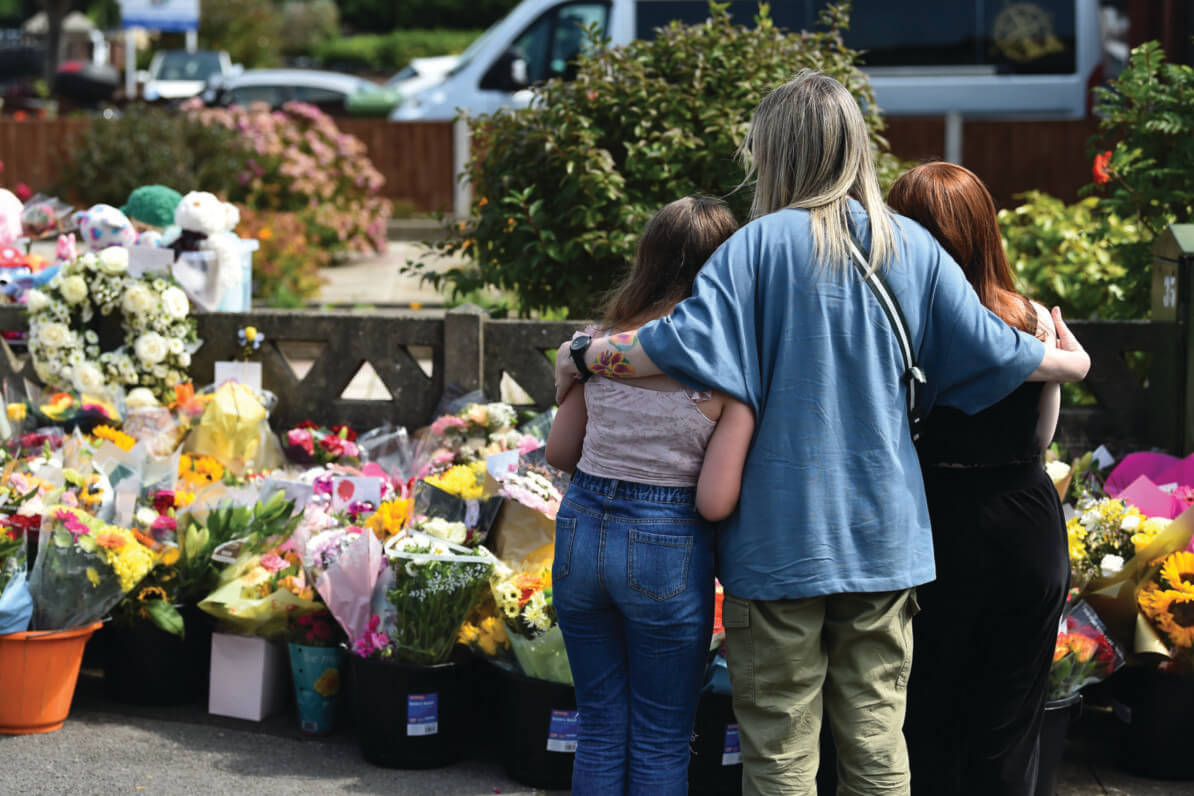
Southport residents stand next to floral tributes for Elsie Dot Stancombe, Alice da Silva Aguiar and Bebe King on 31st July, two days after the girls were killed in a deadly knife attack at a Taylor Swift-themed dance class. Photo: Peter Powell/AFP via Getty Images
11th August 2024 (Taken from: #56)
In the last photo taken of Alice da Silva Aguiar, shared by her family on the day of her funeral, she is standing next to a life-sized cardboard cut-out of Taylor Swift. Not long afterwards, nine-year-old Alice and two other young girls, Elsie Dot Stancombe, aged seven, and Bebe King, aged six, were fatally stabbed at the Hart Space studio on Hart Street in Southport.
Liverpool Echo reporter Ben Roberts-Haslam had just gone for his lunch break on Monday 29th July when he received a call from his father, who runs a business close to where the attack took place, a mile outside the centre of Southport. “He said ‘Ben, something’s happened – there’s fire engines, police and ambulances behind the shop,” recalls Roberts-Haslam. He ran back to the Echo’s offices to relay what he was learning from his dad, who had walked over to Hart Space and spoken to the parent of an injured child. Shortly afterwards Roberts-Haslam headed to Southport to begin reporting, working until late at night making phone calls and speaking to local residents.
Alongside the children who died, eight other children and two adults were injured in the knife attack, which took place at a Taylor Swift-themed dance class. Shortly after the attack a 17-year-old boy from a nearby village was arrested on suspicion of murder and attempted murder.
The next day Roberts-Haslam, who grew up in Southport and still lives there, attended the vigil for Alice, Elsie and Bebe at the Atkinson cultural centre, sandwiched between Southport’s town hall and its main public library, where a book of condolence continues to collect signatures. “I went as a member of the community and to be there if work needed me,” he says. “The vigil was raw, it was difficult, it brought the community together and it was needed.”
But while most of the community came together, others had different agendas. Following the vigil Roberts-Haslam went to the Blue Anchor pub, close to Hart Space. “We could see all these men gathering, wearing dark clothes and face masks, ordering pint after pint, gearing themselves up for what was clearly going to be a horrible evening.”
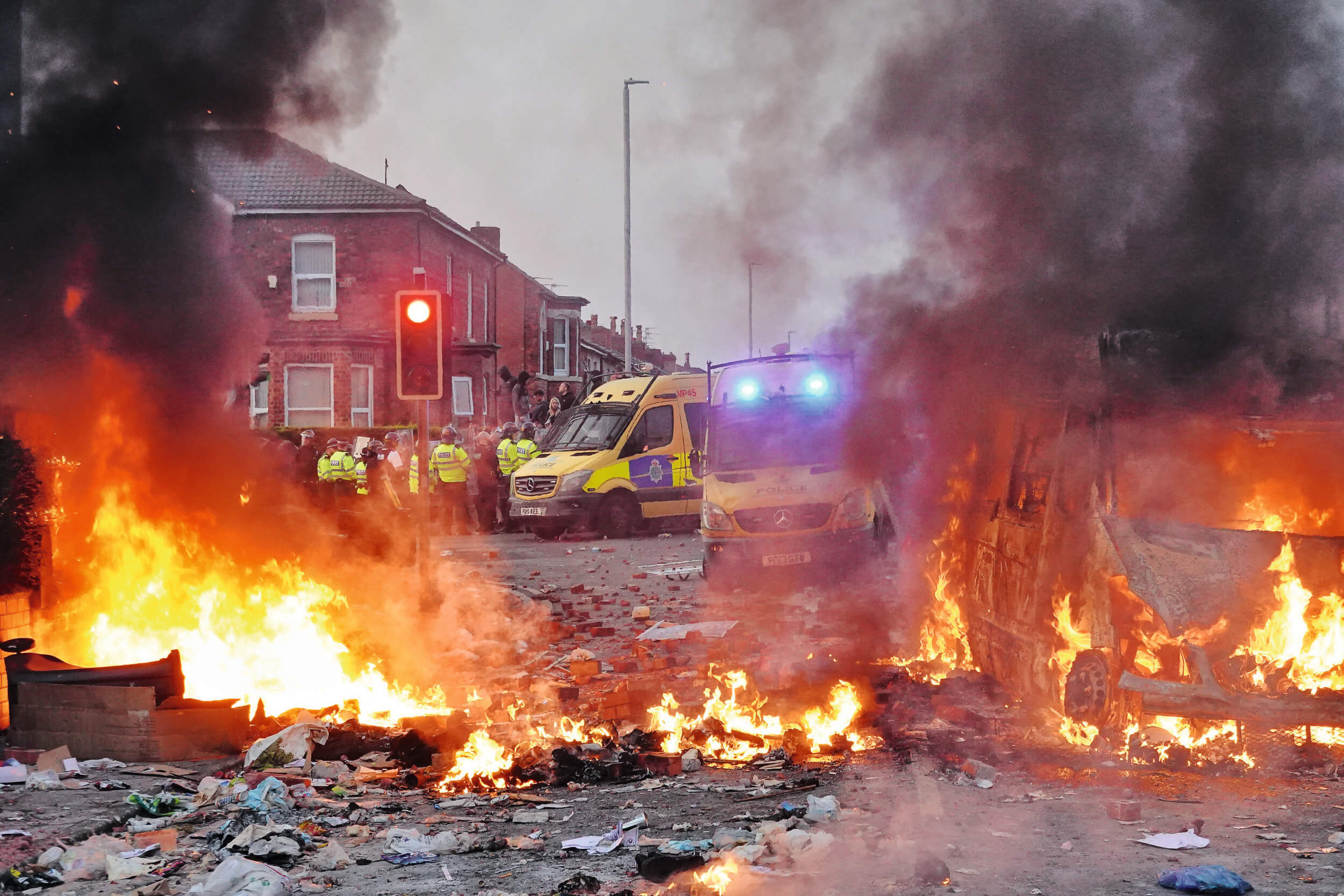
Riot police hold back far right protesters while a police vehicle burns in Southport on 30th July 2024. Photo: Christopher Furlong/Getty Images
That night hundreds of far right protesters rioted close to the site of the attack. They injured more than 50 police officers, caused damage and threatened worshippers at a mosque. Local residents peered through their windows to see around 300 masked men throwing bricks at police and trashing the area.
Roberts-Haslam watched the violence unfold with horror. “I saw people I knew there [among the rioters], people I went to school with,” he says. The situation became more concerning after dark. One of his Echo colleagues was attacked by rioters, their equipment stolen and their glasses broken. The clashes triggered a torrent of anti-immigrant rioting that spread throughout the UK.
The violence had in part been triggered by rumours, spread online, that the suspect in the murders was an asylum seeker named Ali Al Shakati. He’d arrived in the country illegally on a small boat, it was claimed on Telegram, X and elsewhere, and witnesses had seen him shout “Allahu akbar” at the scene. But this was not true.
There were reporting restrictions in place because the suspect who had been arrested was just 17 years old. It would be several days before a Liverpool crown court judge lifted the anonymity order and the public learned what Roberts-Haslam and other journalists already knew, that the boy suspected of the attack was Axel Rudakubana, who had been born in Cardiff to a Christian family. But by that stage it was too late. Roberts-Haslam says it was an “absolute nightmare” seeing misinformation on the identity of the suspect spread when he knew it to be false.
“Walking around after most of the people had dispersed, I saw bin fires and vehicle fires, the burned-out remains of a police riot van, bricks everywhere, people’s homes wrecked – and for what?” he says. “These local people were grieving, they were hurt. To add even more upset and misery… It was heartbreaking.”
The darkest day in Southport’s living memory had been followed by arguably its second darkest. Shocked, angry and overwhelmed with grief, a community reeled.
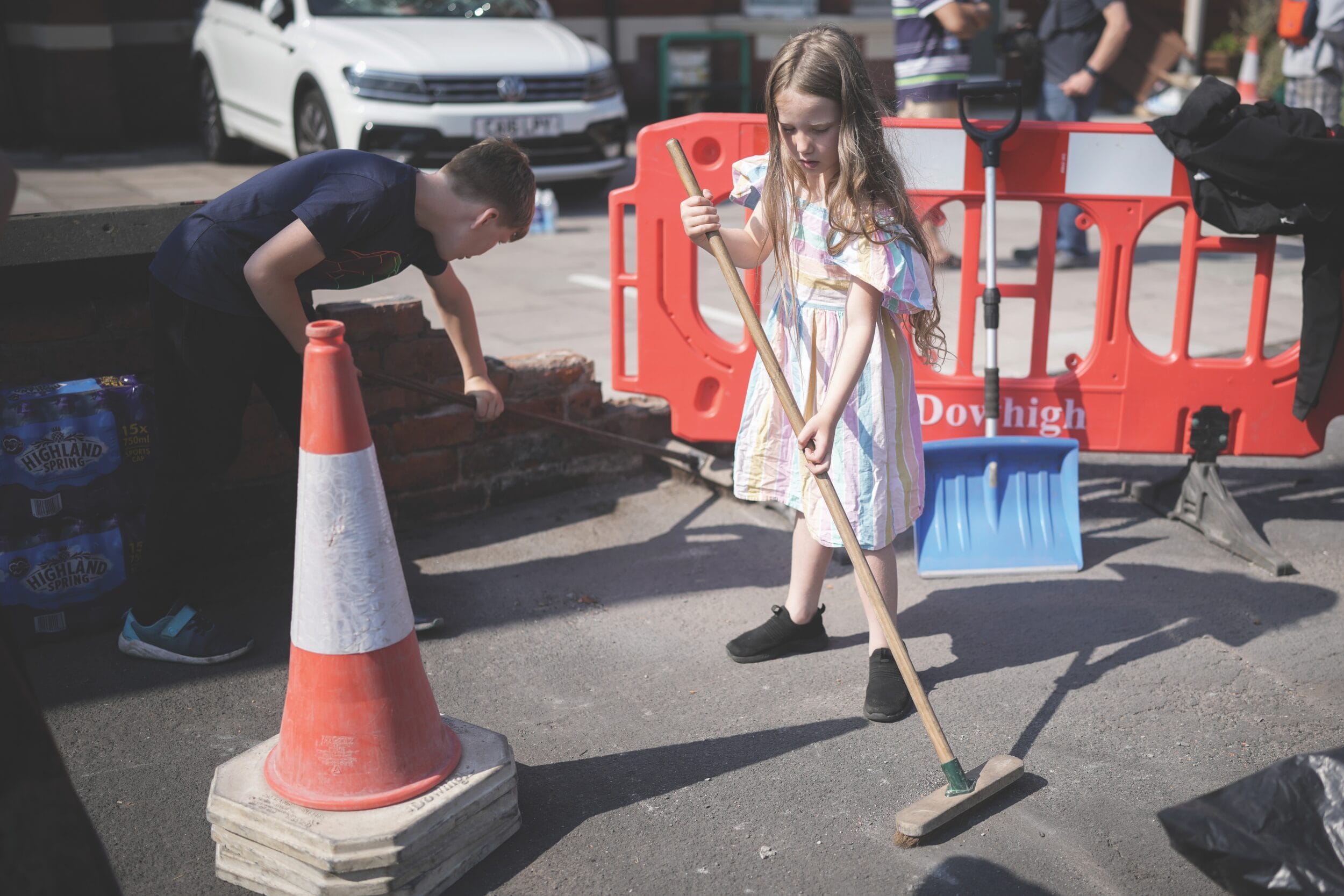
Local children sweep the streets outside Southport Mosque in the Meols Cop district of Southport, the morning after clashes between far right groups and police. Photo: Christopher Furlong/Getty Images
After the storm
On 31st July, Southport awoke to the smell of smoke rising from a burned-out police van in front of a boiler repair shop on St Luke’s Road. The vehicle was surrounded by bricks, bottles and rubble, and then, as the morning progressed, by locals carrying brushes, shovels and spades, there to clean up the mess. The volunteers swept up the broken glass outside the Windsor Mini Mart, smashed up and looted by rioters, and began to rebuild a wall at the mosque, which had been torn down.
Over on Lord Street, next to the site of the previous day’s vigil, the local council also began the work of recovery. “There’s all sorts of emergency planning training… but every emergency is different and we’ve never faced – and few ever have to face – what happened on the 29th July, and the 30th too,” says Phil Porter, the chief council executive of Sefton, a borough of Merseyside that stretches along the coast from Bootle, three miles north of Liverpool city centre, to the northern districts of Southport. “It has been a steep learning curve.”
For the first few days the emergency services took the lead, but after a formal handover Sefton Council became responsible for Southport’s recovery. A four-person team coordinates the response in key areas: children and families, working with a partnership of local schools; psychological well-being, bringing in clinical expertise to help affected residents; community resilience and social cohesion, focusing on tackling racism and Islamophobia after the riots; and the local economy.
The 2008 economic crash hit Southport really badly, as did austerity and then the Covid lockdowns” — Andrew Brown, co-founder, Stand Up For Southport
Then there are the countless jobs that land on the council’s desk because there’s nowhere else for them to go. These include arranging barriers and printing guidance on psychological support for the vigil; helping prepare for the visits of prime minister Keir Starmer, King Charles and other politicians and royals; and arranging for landmarks across the UK, including the House of Commons, to be lit pink in solidarity with the girls. There has also been the challenge of finding an extra half a million pounds for the initial emergency recovery fund when the council’s budget is already under enormous financial strain.
On the day of the volunteer clean-up near the mosque, the most urgent task at town hall was quelling false rumours on social media that a second far-right riot was imminent, this time on Lord Street. Local businesses shut their doors and sent their staff home early, while the communications team at Sefton was inundated with messages asking whether the rumours were true that a riot was taking place. Even when they replied to insist that there was no unrest they found some residents more willing to believe gossip on social media than reassurance from a council employee who was standing on Lord Street observing a perfectly peaceful scene.
Lucy Easthope, a leading expert on disaster recovery who worked on the aftermath of the 2005 bombings in London, the Manchester Arena attack, the Salisbury poisonings and the Grenfell Tower disaster among others, has been working with Sefton Council on its response and helping it prepare for the challenges ahead. She points out that unlike with Grenfell, when a lot of the responders commuted in from outside the area, key members of the recovery team are local residents. “They have kids at local schools, they’re really feeling it and that can make a difference,” she says.
We’ve never faced — and few ever have to face — what happened on the 29th July, and the 30th too” — Phil Porter, chief executive, Sefton Council
Easthope grew up in nearby Liverpool and Southport was the seaside town she would visit with her family as a special treat. Her interest in community recovery was shaped at a young age by the Hillsborough disaster in April 1989, when 97 Liverpool fans were crushed to death – she had classmates who were at the stadium that day, and she saw the unbearable pain it caused in her hometown.
She has warned Sefton Council’s recovery team that theirs will often feel like a thankless task with scant reward. She says that during the recovery process they “will face a series of difficult, troubling decisions… And while they’re used to making difficult decisions they should understand that there are no really good moments in disaster recovery. If something goes well the best you can hope for is quiet and a lack of distress.”
Easthope has been taking part in local events and forums, including a panel discussion held by Sefton Council and Southport BID (Business Improvement District) at which local businesspeople heard about her experiences helping to revive local economies after disasters. She stresses the importance of “putting your lights back on, having your events, seeing hotels buzzing again.” “I’ve been quite blunt about the fact that some places don’t come back from tragedy,” she says. “You see this quite often with American disasters, the places [where the disasters happen] just turn into truck stops along the road. You really want to stop yourself from becoming a truck stop.”
A town on the brink
July and August is peak season for tourism in Southport. In a typical year around nine million tourists visit the town of 90,000 people, and more than 6,500 jobs in Southport are directly dependent on the industry. According to Phil Porter of Sefton Council, as much as 40 percent of the local economy is based on tourism. But this year was far from typical. An unseasonably cold and wet June and July was followed by a month of communal grieving. The combination piled more pressure on a place that was already feeling on the back foot.
On 29th July Andrew Brown, the co-founder of news website Stand Up for Southport, was in Ainsdale, a village outside Southport, with the judges of the Britain in Bloom gardening competition. He remembers how the atmosphere on a “warm sunny day, with beautiful blue skies” transformed when news came in of a stabbing incident. “The names started coming through, who was attacked, the schools they were at… and it was just utter, utter, shock,” he says.
Brown set up his website in 2020 as a response to “all the people talking the town down”. A tireless cheerleader for Southport who appears to know almost everyone in it, he only covers news stories on his website if they’re positive. For a long time, he says, there’s been a sense of negativity around his hometown, and in the months before the awful events of July its tourism economy had already taken some blows: the sudden closure of the seafront Pontin’s holiday camp, with hundreds of employees reportedly notified of their job losses by text message; the demise of the town’s last standing department store, Beales; and news that the fate of the iconic pier, the second-longest in the UK, shut for two years now due to “serious health and safety fears”, would remain in limbo due to Sefton Council being £10 million short of the funds needed to fix it.
“The 2008 economic crash hit Southport really badly, as did austerity and then the Covid lockdowns,” says Brown. But he insists that it’s not all doom and gloom. There have been plenty of exciting new openings, including the cafe where our interview takes place, a co-working space in the Wayfarers arcade set up to “counter the trend of creatives leaving Southport for employment and opportunities.” There are plans for a £73m multipurpose events centre and a new “light, sound and water show”, the Light Fantastic, to be built over the town’s Marine Lake.
While understanding the need for a period of mourning and reflection, Southport Pleasureland owner Norman Wallis describes the summer as disastrous for the local economy and fears that the threat to Southport is nothing short of existential. “What happened [on 29th July] was absolutely unbelievable,” he says, describing his shock at the stabbing attacks. And its economic impact, he says, “has destroyed the town. Not only my business, but hotels, restaurants and retailers… The other day I spoke to a business owner who said he wanted to move to another town, but nobody will buy his Southport business because of the situation we’re in here.”
The terrible weather of early summer was followed by weeks of tourists cancelling their trips and locals staying at home. Wallis says he would have been better off keeping his amusement park closed in August, but he stayed open to keep his staff in work. He believes that one key to business recovery is promoting Southport as a “wholesome place, safe for families”, but that will require disassociating its name with the violence of July. It is particularly painful for locals that the phrase ‘Southport riots’ has in some quarters become an umbrella term for the far right violence that followed in Sunderland, Hull, Manchester, Leeds, Liverpool and other cities.
Wallis says that without funding from central government, “visionary leadership” and the diversification of the local economy so it’s not as seasonal and dependent on tourism, Southport will become the kind of truck stop of which Easthope warns. He worries that without swift action it is heading for “complete resort failure”, turning into a seaside town that “dissolves into obscurity”. He talks about his plans for a new aquarium, and complains about red tape and bureaucracy slowing everything down. Next year, he says, it is make or break. Another bad summer is simply unthinkable.
Lucy Easthope believes that Southport “carries a lot of hiraeth”, a Welsh term loosely translating to a sense of nostalgia and deep longing for something forever lost. In Victorian times it was the jewel of Merseyside, a prosperous town and the second most popular seaside resort in the UK. Lord Street is still lined with heritage buildings from this period, from the neoclassical Atkinson centre to the 125-year-old Wayfarers shopping arcade with its beautiful glass dome. Phil Porter promises that the local authority has “real ambition” and after the events of the summer will redouble its efforts to turn things around. He and his colleagues want to help put on events, finally fix the pier, improve the poor rail connections and bring in investment from the private sector. “We all agree that we need to make next year special,” he says.
Return to Hart Street
In late October there are more Halloween pumpkins than pink ribbons outside the semi-detached houses of Hart Street, although a few of these tributes – placed in threes, for Alice, Elsie and Bebe – cling defiantly to lampposts, next to missing cat notices and the council’s weather-worn printed advice on where to turn for psychological help.
On the door of the nearby Windsor Mini Mart there’s a poster thanking local residents “for their immeasurable kindness and generosity in the darkest of times.” Its Sri Lankan owners, Chanaka and Thanuja Balasuriya, fled their business during the riots and watched via CCTV at home as it was looted and destroyed. Local businesses helped fix the windows and the interior damage, and around £15,000 was raised by wellwishers online.
Southport mosque, meanwhile, has taken on security guards for the first time in its 30 years in the community. There’s also a replacement front door, far sturdier than the old one and a network of new security cameras. A new split-screen surveillance monitor sits near the upstairs room where Imam Ibrahim Hussain and seven other members of his community hid in fear for their lives while far right protesters shouted anti-Muslim slogans and threw bricks through the windows on the night of 30th July. The riot police lined up in front of the building were able to keep those inside protected, and after the rioters had left the scene the imam and his fellow worshippers were escorted to safety by officers.
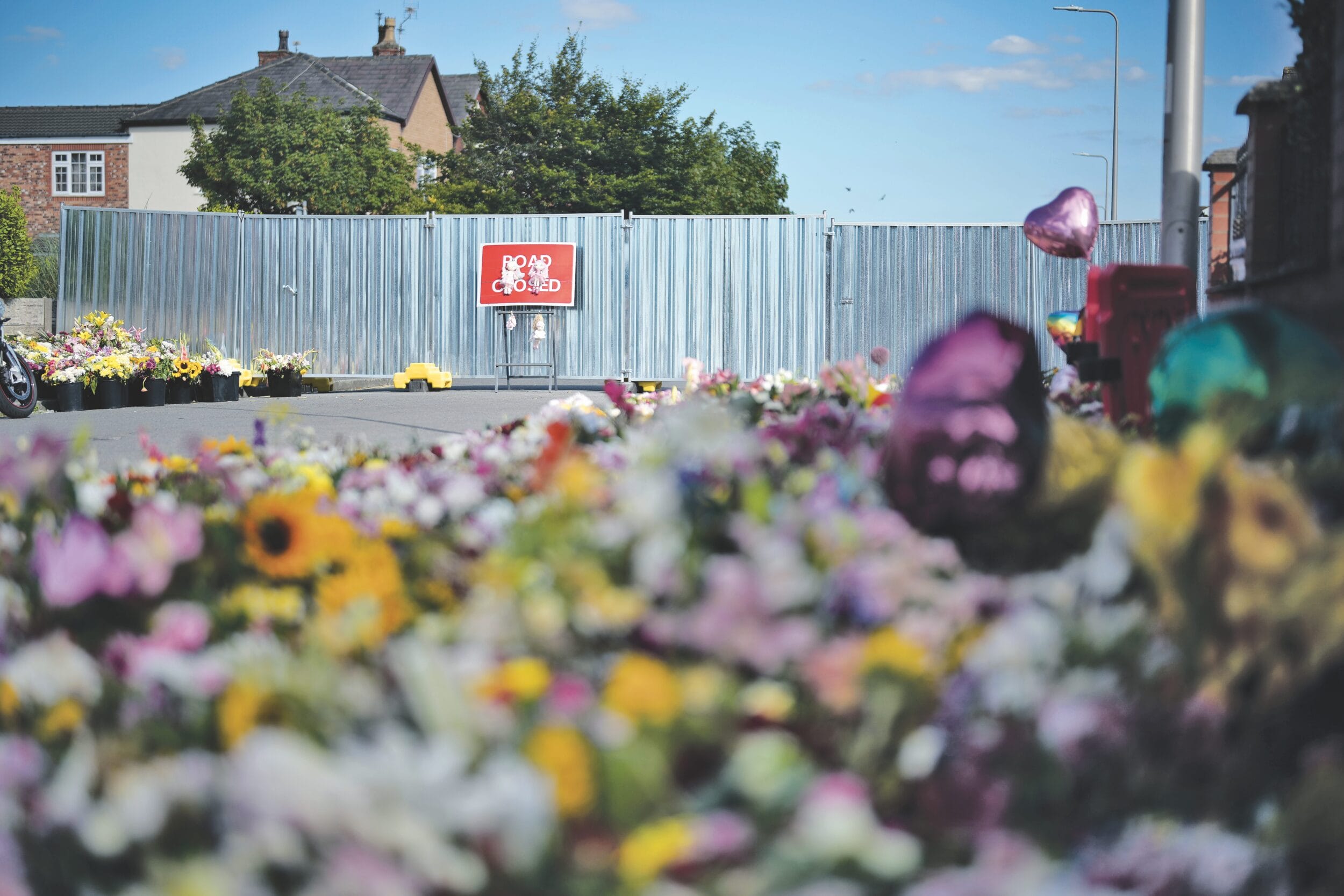
Flowers line the approach to a fence cordoning off the site of the 29th July knife attack in the Meols Cop district of Southport. Photo: Christopher Furlong/Getty Images
Hussain says that he still has trouble sleeping. He often wakes up during the night thinking about that evening in July and he recently asked his GP for sleeping pills. “My whole being was shaken by it,” he says of the riots. “It affects you in many ways. All of us are affected. Some of us have young families, and when you think you are never going to see them again it’s hard.”
But like the Balasuriyas around the corner, the imam was also overwhelmed by the kindness of local residents after the riot. “I turned up the following morning and found hundreds of people helping, sweeping up, and when they saw me they said, ‘We’ll do whatever you need us to do and we’re so sorry about what happened to you’.”
As part of the council’s work to promote social cohesion, Hussain has been on a series of ‘unity walks’ in Southport with community leaders, including rabbis from the local synagogue. On 10th September he was part of a multi-faith religious blessing at the Hart Space studio. It had been cordoned off for weeks after the attack, and although it has now closed permanently – its owner, Jenie Scholes, is working with the council to reopen at a new location – it briefly opened its doors.
“Once more our community is coming together to support each other, regardless of faith, religion or beliefs,” wrote Scholes about the blessing on the Hart Space’s Facebook page. “It was incredibly moving and focused on love, support, community and healing.”
I turned up the following morning and found hundreds of people helping, sweeping up” — Ibrahim Hussain, imam, Southport mosque
A transitional state
An early opportunity for solidarity and healing came with the three funerals for the murdered girls. On 11th August, a horse-drawn carriage carrying Alice’s coffin arrived at St Patrick’s Catholic Church. Six days later, thousands of people lit a candle for Bebe as her family and friends attended a private service. And 23rd August was Elsie’s ‘special day’ – her family didn’t want it to be called a funeral – when mourners wore bright colours to the church in Birkdale to celebrate the seven-year-old’s life “with positivity, hope and love.” Throughout the month a sea of flowers covered the gardens outside the town hall.
Nobody working on recovery in Southport uses the r-word lightly. To recover fully would be to restore a previous condition, a return to normal, and that’s not on the cards, especially not for the bereaved families.
The adults and children injured in the attack have been healing, though. On 8th August police confirmed that the last of the other eight children attacked at Hart Space had been discharged from hospital. Leanne Lucas, the teacher of the Taylor Swift-themed yoga class, who shielded children from the attacker, was severely wounded but in November she was able to join family members of the victims in the public gallery at Liverpool crown court for a trial preparation hearing. However, physical recovery is not the same as psychological recovery, and Lucy Easthope always stresses that the social care commitment to those affected needs to be long-term.
Sefton Council has been in touch with residents of Newtown, Connecticut, where 26 people, including 20 young children, were killed in a mass shooting at Sandy Hook Elementary School in 2012. They have given Southport advice on dealing with survivor’s guilt and post-traumatic stress disorder. Years after the Sandy Hook shooting the father of a six-year-old victim killed himself; at least two survivors have also died by suicide.
The harm done to the community by the rioting is also still playing out. People are still being sentenced for violent disorder; by October, 78 rioters in Merseyside had been sentenced to a total of 164 years and five months in jail. Nationally, nearly 400 rioters had been jailed for their part in the rioting by the same stage. Those imprisoned for rioting in Merseyside include a gardener, a handyman and a worker at the Hinkley Point nuclear power station in Somerset. A 12-year-old boy who threw stones at police officers outside Southport mosque appeared in court to be handed a referral order. Among the jailed rioters are local parents, and as a consequence Sefton Council has yet more families to support with social care services.
What we’re trying to do is give this event its rightful space and place in the community,
but so that things can carry on alongside it” — Lucy Easthope, disaster recovery expert
Easthope says that it’s important to understand that recovery isn’t a linear process. There will be slumps, when the unity and camaraderie of the early days are replaced by exhaustion and disillusionment. Fresh hurdles can appear out of the blue: the 29th October news that the teenager accused of killing Alice, Elsie and Bebe had been found to have had an al-Qaeda training manual rekindled anxiety at Southport mosque, even though Merseyside Police haven’t established a motive and therefore cannot declare the 29th July attack a terror incident.
By late October most of the temporary tributes to the girls attached to benches and lampposts throughout town had been taken down. After hearing from the families that it was causing them emotional distress to see them, the local council began the removal process, and requested that private properties and businesses also take down any tributes on display. There are now plans to build a permanent memorial to the girls in the town centre. Liverpool Echo reporter Ben Roberts-Haslam says that the public reaction to the council’s request to take down tributes was mixed – “a lot of people say they aren’t ready yet, and others think it’s time to move forward. That shows where the town is at right now.”
Three months after the violence, Southport finds itself in a transitional state, the point at which a town in mourning begins the process of moving on. But it’s hard to move on when there are still so many unanswered questions. The atrocity at Hart Space was both inconceivable, and, with no known motive, inexplicable. When Axel Rudakubana goes on trial in January 2025, it may result in a conviction and a sentencing, which would offer some solace to those affected. But the trial is also likely to bring a series of new shocks to the community.
Whatever happens, there is a collective understanding in Southport that the top priority is to take care of the families of Elsie, Alice and Bebe. The town will never forget the three young girls who went to a dance class and never came home. “What we’re trying to do is give this event its rightful space and place in the community, but so that things can carry on alongside it,” says Easthope.
Her disaster recovery priorities haven’t fundamentally changed since she was ten years old, seeing Hillsborough devastate her hometown. “The most important thing is to take care of the bereaved, and to walk alongside them.”
A week of riots
How the violent disorder sparked by the Southport attack spread through the UK
30th July
False information about the identity of the perpetrator of the Southport attacks spread online by rightwing figures including Tommy Robinson and Andrew Tate triggers rioting in the Merseyside town.
31st August
More than 100 people are arrested at an ‘Enough is enough’ protest in London. A police car is set alight in riots in Hartlepool.
2nd-3rd August
A mob in Sunderland ransacks a police building and sets fire to a shop and cars. Far right rallies and counter-protests take place in Leeds, Nottingham, Stoke-on-Trent, Blackpool, Belfast, Hull and other cities.
4th-5th August
Rioters attack and try to set fire to a Rotherham hotel housing more than 200 asylum seekers. There are riots in Plymouth and hundreds of Muslims gather at a Birmingham mosque due to rumours of a protest.
7th August
Shops are boarded up, immigration advice centres closed and thousands of anti-racism protesters gather in cities across the UK due to rumours that dozens of far right rallies will take place that day. In the end, perhaps due to swift arrests and the mobilisation of over 6,000 riot police, the far right protests don’t materialise. By 29th October 1,590 violent disorder arrests have been made nationally, including of more than 250 children.
Head here for an interview with writer Matthew Lee about the process of writing this article
Slow Journalism in your inbox, plus infographics, offers and more: sign up for the free DG newsletter. Sign me up
Thanks for signing up.