Inside DG #56: Picking up the pieces
A Q&A with the writer of our story about the Southport stabbing attack and riots from issue 56 of Delayed Gratification
Screenshot
The 56th issue of Delayed Gratification features an article by associate editor Matthew Lee about the English seaside town of Southport, where in July three young girls were killed in a stabbing attack at a Taylor Swift-themed dance class – a tragic event which triggered far right rioting across the UK. Matthew talks to Rob Orchard about visiting the town three months later and meeting the people spearheading its attempted recovery
Rob Orchard: Why did you want to write about the Southport attack for Delayed Gratification?
Matthew Lee: Earlier this year I wrote a Delayed Gratification story about the aftermath of a similar incident in Ireland. On both occasions, in Dublin and in Southport, a stabbing attack on young children triggered far right rioting close to the scene of the crime. And in both cases the anti-immigrant rioting was in part a consequence of false information circulating online about the identity of the perpetrator. My Ireland story was principally about how online disinformation was helping the far right mobilise support in a country that has never really had a far right presence.
While it was fascinating it was hard to shake the feeling that the far right had hijacked the story – three children had been stabbed (by a naturalised Irish citizen) and so much of the media coverage that followed was about immigration and the far right. In the case of the Southport attack, which triggered first local, and then nationwide, anti-immigration and anti-Islam rioting despite the alleged perpetrator being a teenager raised as a Christian in Cardiff, the sense of the far right exploiting a tragedy felt more pronounced. Indeed, Keir Starmer said that the rioters “hijacked” the grief of the community in Southport.
With this in mind for the Southport story I wanted to focus on community grief and healing, and not on Elon Musk or Tommy Robinson, or whoever was fanning the flames online. It’s not officially a part two to the Ireland story, but in my mind the two are very closely related – for me as a journalist it was about telling a story from an entirely different angle.
Was Southport still in mourning when you visited in October?
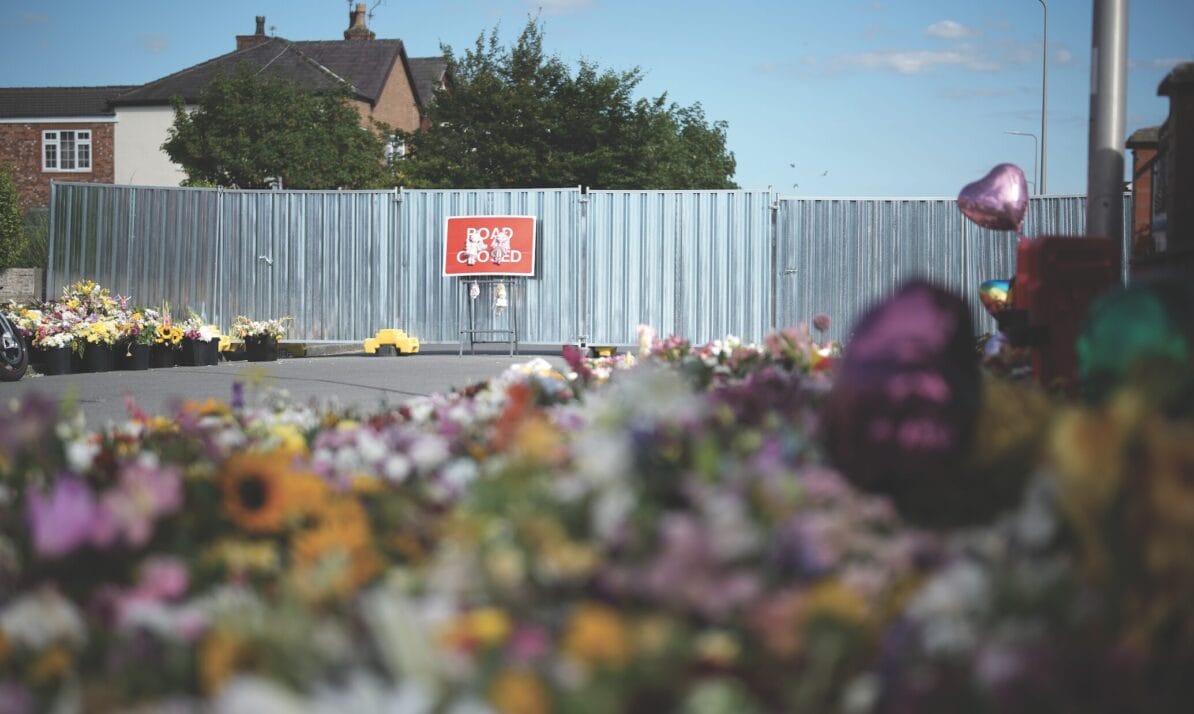
No, but it wasn’t quite back to normal either. It had been three months, and while I was there the council was taking down the tributes to the three girls killed, and I had this strong sense of being in a kind of liminal space, at the border of this awful summer and a return to normal. There are people in Southport saying “we have to move on” and others who don’t feel ready yet. The attack itself, and the subsequent riots, happened in a residential area about a mile outside central Southport and of course it’s a different situation round there. There’s still, of course, a lot of trauma in that neighbourhood.
Who did you speak to when you were there?
I decided early on not to approach anybody who was directly affected by the stabbing attack – the families of victims, survivors, witnesses etc. People who went through hell, who had journalists from around the world asking them questions while they were going through that hell, and whose healing process is unlikely to benefit from a journalist turning up three months later to ask them how they’re doing. Instead I spoke to people whose job it is to work towards community recovery, whatever that may entail.
The team working on recovery at Sefton Council were really open with me and happy to meet and talk about their work. They’re Southport locals on the whole, so they feel the pain the community is experiencing, and they’re desperate to see Southport return to being a fun family seaside town, while being sensitive to the needs of the victims. The council is doing lots of work with schools, mental health professionals, and social cohesion projects with religious groups such as the local Islamic centre, which was targeted in the riots that took place the day after the stabbing. I spoke to the imam at the mosque who was inside the building while rioters outside threatened to burn it down, and a Southport-based journalist who was there watching it all happen.
It can feel a bit jarring talking about business after such a horrific incident, but it was pretty clear that at this stage of the recovery process, three months in, it’s what a lot of people in Southport are talking and thinking about. People are deeply worried about the local economy in a town highly dependent on tourism. They had a disastrous summer, with barely any visitors in August and September, and one business owner I spoke to believes that the threat to Southport is existential, that it will effectively die as a resort without an injection of investment.
Do you feel hopeful that Southport can recover?
I should point out that there’s an understandable wariness about using the term ‘recovery’ in relation to those directly affected by the stabbing at the dance class because of course for some people life will never be the same. In terms of economic recovery, I think Southport can turn things around. There’s this legend that the town inspired Napoléon III’s rebuilding of Paris and while it may not be entirely true, the main thoroughfare, Lord Street, is this grand, spacious, tree-lined boulevard, full of heritage buildings. All its Victorian splendour feels a bit ignored and unloved these days but it’s still present, and I think it makes Southport distinctive and unique.
Less than two weeks before the stabbing attack, Which? ranked Southport the twelfth worst seaside town in the UK, 112th out of 124. And in 2024 it lost its Pontins holiday camp and its last remaining department store – both big employers – while its pier remains closed for health and safety reasons. There was already a feeling that Southport was unfairly maligned, down on its luck, and then this inexplicable and awful event happened. The town’s name is now associated with not only the stabbing attack, but the week of far right riots that came after it, and so the challenge of reviving the local economy is even harder.
What Southport has in its favour though is a sense of togetherness and community spirit. The way the community came together at the vigils, the funerals and the clean-up outside the mosque the morning after the far right riots has generated a sense of local pride and belonging that perhaps wasn’t there before, and while I’m not sure we can talk about silver linings in a situation like this, there’s definitely a feeling of defiance among many in the community – they’re going to look after each other, reject hatred and division, and work on making Southport a place to be proud of.
You can read the full feature by Matthew Lee in issue 56 of Delayed Gratification, available from our online shop here.
Slow Journalism in your inbox, plus infographics, offers and more: sign up for the free DG newsletter. Sign me up
Thanks for signing up.