Inside DG #55: Lords of the ring
A Q&A with the writer of our story about Saudi Arabia's investment in boxing from issue 55 of Delayed Gratification
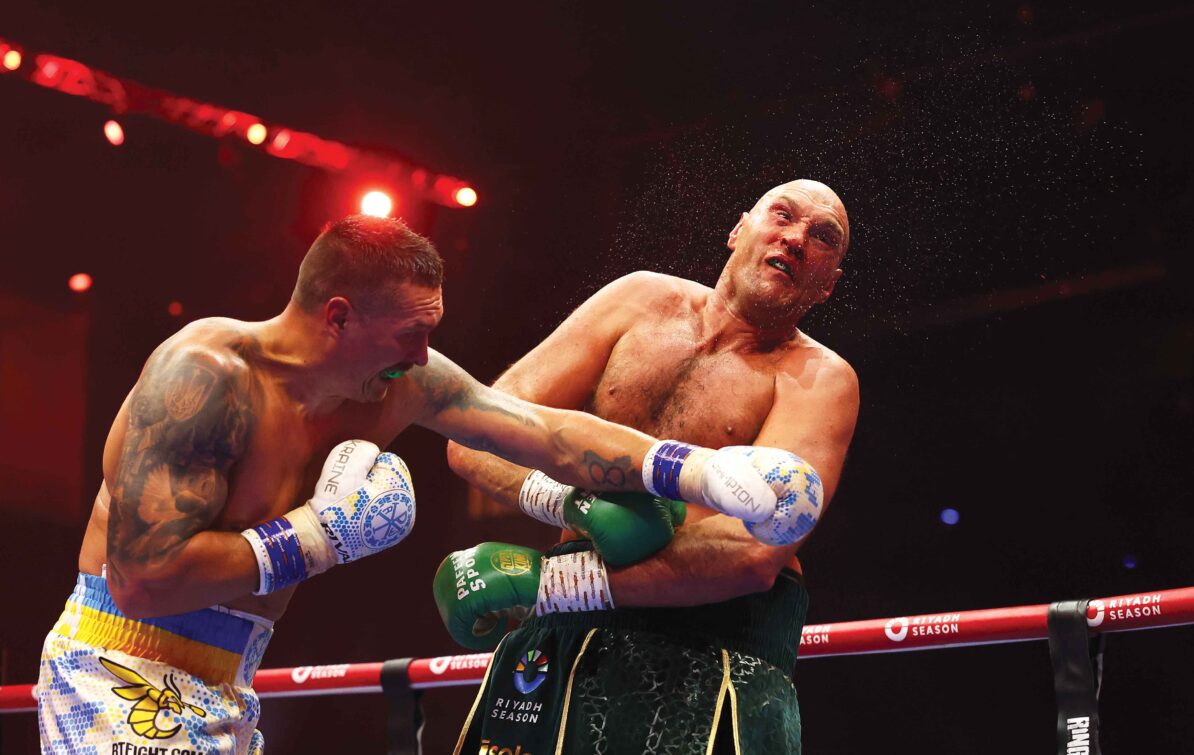
Oleksandr Usyk punches Tyson Fury during their fight in Riyadh. Photo: Richard Pelham/Getty Images
The 55th issue of Delayed Gratification features an article by associate editor James Montague about Saudi Arabia’s huge investment in boxing, which saw the Kingdom stage the much-hyped clash between Tyson Fury and Oleksandr Usyk in May. Here, Delilah Hodgkinson speaks to James about the use of sport as a political strategy and his experience of visiting Saudi Arabia for one of the biggest fights in recent boxing history.
Delilah Hodgkinson: What is ‘sportswashing’ and why is it being used by the crown prince of Saudi Arabia, Mohammed bin Salman?
James Montague: I actually hate the term ‘sportswashing’! It’s often used to describe when sport is a diversion or a cover for a regime’s human rights violations. It’s a form of reputation laundering; if people are associating your country’s brand with football and success, they’re not necessarily associating it with executions and political persecutions. But I think it’s much, much more complicated and clever than that. It’s about embedding yourself in a country so that you become part of the cultural furniture, and also so that you’re indispensable politically. So we’ve seen a situation where once Saudi Arabia owns Newcastle United, they have influence politically at the local level and at the national level – influence within English football, and within English politics.
DH: Why did you decide to write about this topic?
JM: I am writing a book about Saudi Arabia but I’ve been fascinated by the influence that the Middle East, and especially the Gulf, has had on Britain and its sport for a long while. Saudi Arabia has the most money, the most power, of these countries and is going about it the most aggressively. I also wanted to write about the murder of Jamal Khashoggi, which was such a turning point in the branding of the country. The reason I was in Riyadh for Fury vs Usyk was to see how Saudi Arabia was getting involved in boxing, a sport in which very few questions are asked. In terms of how the business of boxing is done it’s basically whoever has the money can call the tune. And also this was a totemic moment, a historic moment for the sport – the first unified heavyweight bout for 25 years.
DH: What was it like watching the spectacle of the fight? Did you feel uncomfortable knowing that it was part of Saudi Arabia’s rebranding efforts?
JM: Of course, but at the same time, as a journalist you want to tell the story of the world the way it is and not the way you want it to be. What you see in that spectacle is the perfect buffed-up version of Saudi Arabia. The actual fight itself was mesmeric. We didn’t have great seats because actual journalists aren’t given many privileges when covering events in Saudi Arabia. When we went to the press conference it was full of YouTube influencers. That’s who they want covering these events because they don’t have a code of conduct to follow and everything’s brilliant because they’re being paid to be there. The subtext to all of this is that if anyone has any moral qualms, they’re easily overcome by money, in most cases. And you see that not just in boxing but also in tennis, in golf, in other sports. It happens with surprising and disappointing ease. But the fight itself didn’t disappoint. It was incredible.
DH: Journalists in Saudi Arabia are at risk of being imprisoned or executed for criticising the regime. What was it like visiting the country as a journalist?
JM: I have white European privilege in that respect as a visiting journalist. If they were monitoring me, I didn’t notice it. I wasn’t restricted in anything I wanted to do. But if you’re a Saudi journalist or a Saudi activist, then you are under a very different set of rules and expectations. Doing half the stuff I did, asking half the questions I asked or tweeted about or wrote on social media, would get you a jail sentence.
You can read the full feature by James Montague in issue 55 of Delayed Gratification, available from our online shop here.
Slow Journalism in your inbox, plus infographics, offers and more: sign up for the free DG newsletter. Sign me up
Thanks for signing up.