Quincy Jones, 1933-2024
Few producers in music history have had the impact of Quincy Jones, the man behind some of the biggest records of all time, who died on 3rd November aged 91. Steve Lukather, best known as one of the founding members of Toto, was Jones’ go-to guitarist in the ’80s, contributing to his crowning achievement, Michael Jackson’s Thriller. He remembers his friend and collaborator, the man he called ‘Q’
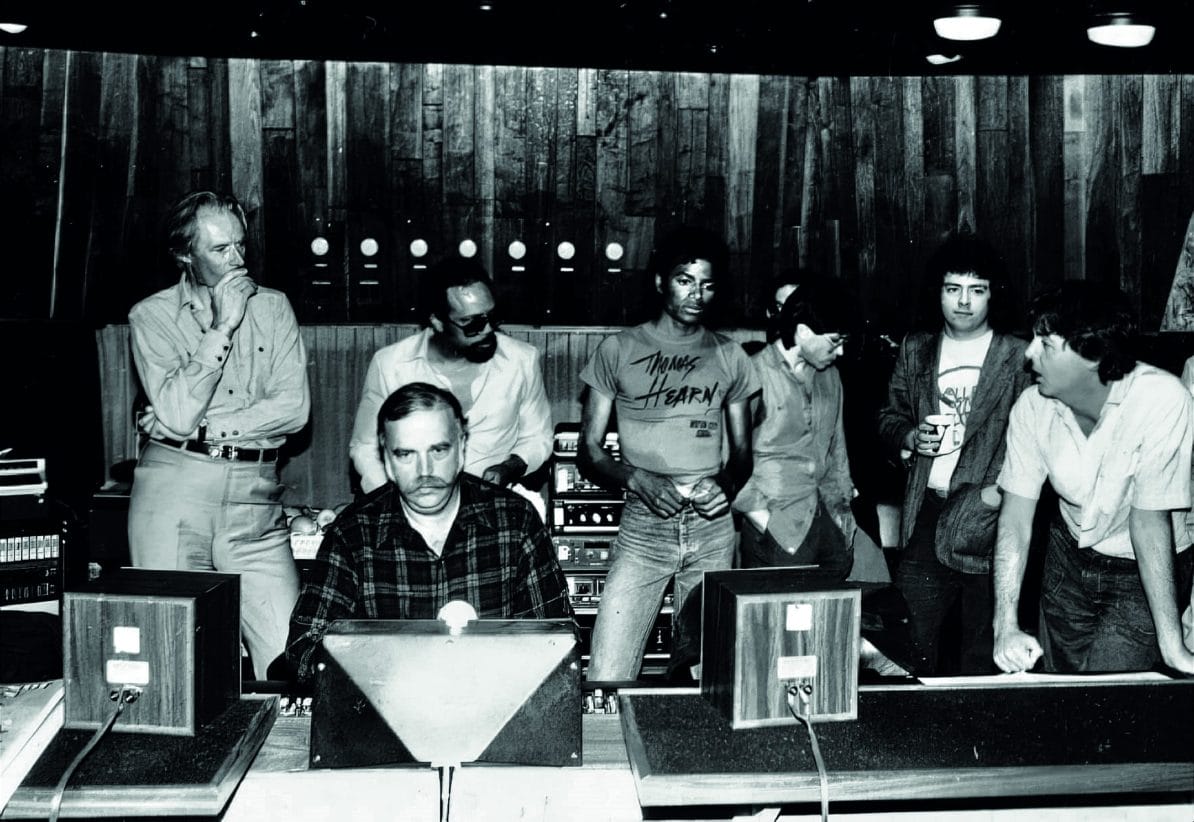
(l-r) George Martin, recording engineer Bruce Swedien, Quincy Jones, Michael Jackson, Jeff Porcaro, Steve Lukather and Paul McCartney during the recording sessions for Thriller, April 1982
3rd November 2024 (published spring 2025) (Taken from: #57)
Steve Lukather nearly missed out on his part in the biggest-selling record of all time. “Because Q recommended me, Michael [Jackson] wanted me to play on Thriller,” says the guitarist, who was a successful session musician before finding fame with Toto. “I got a call at eight in the morning. This was in 1982 and in 1982 I was enjoying myself… So I’d been out all night and was just getting into bed to grab a couple of hours’ sleep when the phone rings and the person calling says [breaking into a pitch-perfect Michael Jackson impression], ‘This is Michael.’ I replied, ‘Yeah, fuck off’ and hung up. I thought it was one of my knucklehead friends calling just to mess with me.” The then-23-year-old American guitarist hung up on the King of Pop three or four times. “Eventually Quincy calls me,” says Lukather. “He says, ‘That really was Michael. You should call him back.’ When I did, Michael just laughed. He said, ‘Don’t worry, it happens all the time.’ Then he asked me about playing on some stuff.”
His first experience of playing on that “stuff” was a less literal wake-up call. “The first track we cut for Thriller was ‘The Girl is Mine’,” he says. “I looked around the studio and there was Q and Michael, plus Paul McCartney, who was duetting on the track; George Martin was there, Linda McCartney, Jeff Lynne… Talk about a galaxy of stars. I thought ‘What am I doing here?’ but that was the beauty of Q. He didn’t care who you were, just as long as you could bring it. So I thought ‘I’d better bring it.’”
Lukather and Jones had first worked together on Jones’ 1981 solo album The Dude. “Q was the only person who can put out a solo record where the person whose name is on the sleeve doesn’t sing on it, doesn’t play a note on it, but it still sounds like them and them alone. That’s because of his incredible ear for songs and because of how he could bring different people together to create the sound that was in his head. He was like the casting director that knows the right actors to be in their film. He put it together like alchemy.”
Lukather believes that one of the reasons Jones was such a good producer was that he began his career as a musician. Jones had a tough childhood, growing up in Chicago in the 1930s. His mother was admitted to a psychiatric institution when he was young and his father worked as a carpenter for the Jones Brothers, one of the city’s most feared crime syndicates. Young Jones believed he and his brother were destined for a life of crime themselves. “You want to be what you see, and that’s all we ever saw,” he said in the 2018 documentary, Quincy. But a chance encounter would change his course. After Jones, who described himself as a “street rat”, had his hand nailed to a fence by a rival gang at the age of seven, his father moved the family to Washington state. There, during a break-in at a community centre, Jones spotted a piano. “I touched it and every cell in my body said, ‘this [music] is what you’ll do [for] the rest of your life’,” he recalled in a 2016 interview on BBC Radio 4. “It changed my life… I would have been dead or in prison a long time ago.”
I looked around the studio and there was Quincy, Michael Jackson, Paul McCartney, George Martin… Talk about a galaxy of stars. I thought ‘What am I doing here?’”
Music took over. Jones moved to Seattle and learned the trumpet at high school, becoming a prodigious talent. By 14, he was playing the city’s nightclubs alongside heavyweights including Billie Holiday, Count Basie and Dizzy Gillespie. When Elvis Presley made his first TV appearance in 1956, Jones was in his band and soon he was touring the world with jazz legend Lionel Hampton, not just as a trumpeter but as an arranger.
Jones started working with Frank Sinatra, arranging his 1964 version of ‘Fly Me to the Moon’, which five years later would become known as the first song heard on the moon, when, according to legend, Buzz Aldrin played it on a portable cassette player as he stepped onto the lunar surface.
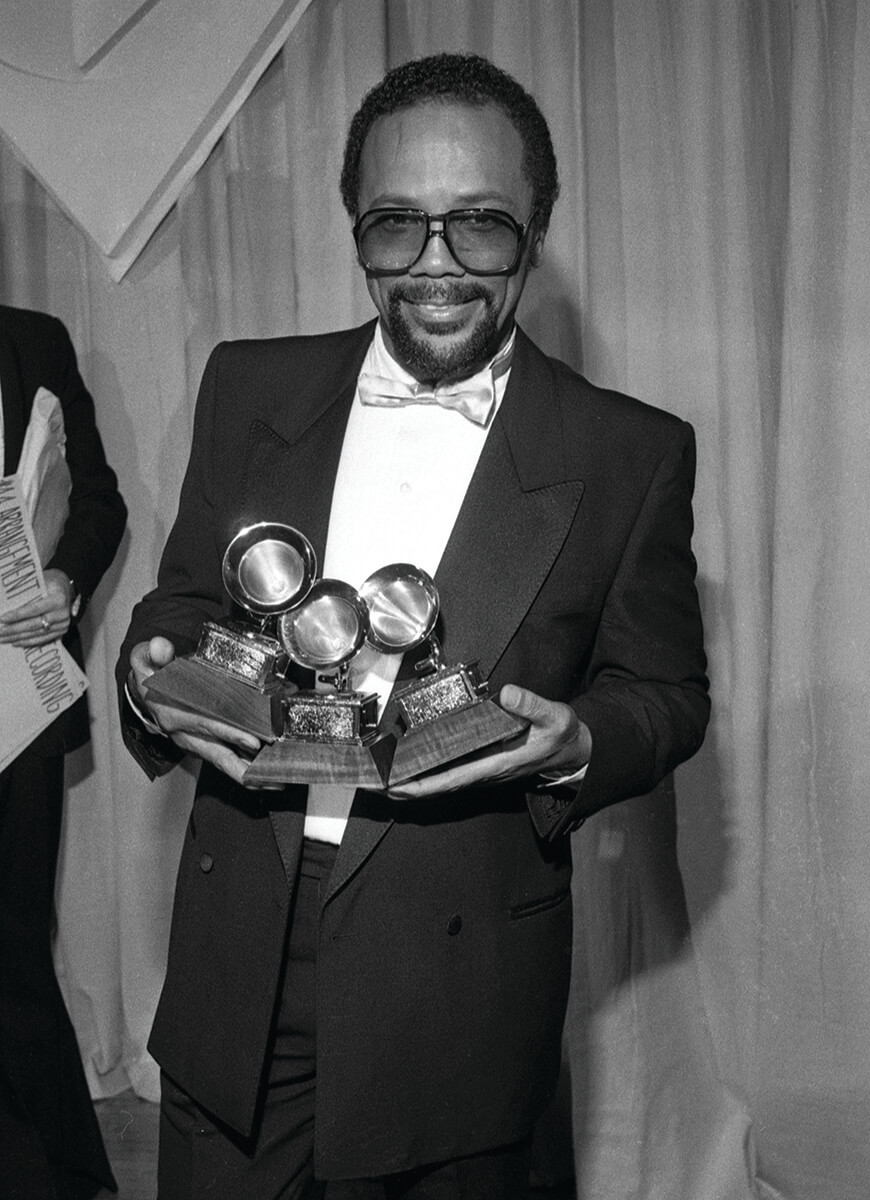
Quincy Jones at the Grammy awards in 1982. Jones won five Grammys that night and 28 over the course of his career
Jones had escaped from the life of crime he feared would lead to a premature death, but he nearly had his life cut short at the age of 41 when he suffered two brain aneurysms in 1974. Doctors gave him a one percent chance of surviving surgery and a memorial was arranged with some of the world’s biggest entertainers. When Jones defied the odds, the event went ahead and the musician got to hear legends including Sinatra, Ray Charles, Marvin Gaye and Sidney Poitier give their planned eulogies in person. “I basically attended my own funeral,” Jones said in 2018.
With doctors advising him never to play the trumpet again, in case he disrupted the metal clips used to knit his skull together after his operation, Jones focussed on producing – and created a streak of hit records with stars including Donna Summer, Herbie Hancock and Patti Austin alongside his solo records. “In the 1980s Jones was on a run,” says Lukather. “He did four, five, six albums that were all smash hits.” The reason for this success, Lukather believes, was down to the producer’s trust in the musicians he worked with. “Q wasn’t prescriptive,” he says. “We didn’t sit there and just play something he’d written note for note. We were supposed to come up with our own parts, which we did. He would sketch out the song and we filled in the blanks. He was interested in the stuff that’s not on the paper. The little flourishes. It was a collaboration, but he put it all together – this weird little gumbo.”
Lukather’s playing was an ingredient Jones would return to time and time again. “Me and JR [John Robinson] the drummer, are pretty much all over Q’s records from The Dude onwards. We did all those records. Boom. Boom. Boom. It was just a great time and we spent a long time in a room with that man. We had a lot of laughs.”
A less funny moment took place when a tape engineer accidentally destroyed the original version of Michael Jackson’s ‘Beat It’. In an era before digital recording, everything was captured on analogue tape, meaning that editing mistakes were often irreversible. “We had a perfect vocal take from Michael on one tape, and the engineer tried to splice in Eddie Van Halen’s new guitar solo,” Lukather recalls. “But he accidentally cut the sync code.” The sync code was a crucial piece of data that allowed multiple tape machines to run in perfect time. “The entire song was out of sync – it was a disaster,” says Lukather.
Jones, in the middle of mixing ‘Billie Jean’ in a different studio, called Lukather in a panic. “I need you and [drummer] Jeff Porcaro to come fix this,” he told them. The two musicians rushed to the Sunset Sound studio in Los Angeles and, working from the faint ghost of the erased instruments bleeding through Michael’s headphones on the vocal take, they painstakingly rebuilt the rhythm section – drums, bass and guitars – from scratch. “I put a shitload of guitars on there. I went all out, ran the guitar through a stack of Marshall amps, because I knew Eddie was on it and he’s a rock guy,” says Lukather. “I sent it to Quincy, and he went, ‘It’s great, but it’s too much. I want this to be played on R&B radio, I want it to be on pop radio.” Over the phone Jones then talked Lukather through what he wanted, explaining how the guitars should be stripped back and the tone adjusted to create a track with crossover appeal. Jones was right. The final version became one of the defining rock-pop anthems of the 1980s, winning a Grammy (one of 28 garnered by Jones), going eight-time platinum in the US and topping charts worldwide. “That was the genius of Quincy Jones,” says Lukather with a laugh. “He could make a hit record when he wasn’t even in the room.”
The last time Lukather and Jones played together was with other members of Toto at a special concert at the Hollywood Bowl celebrating the producer’s 80th birthday in 2011. “We surprised him,” says the guitarist with a smile. “We came out and played on [Thriller track] ‘Human Nature’. When he looked around we were there.” Not that Jones was fazed, even at 80. “You’d have to work harder than that to throw Q off,” laughs Lukather. “He was cool, you know. He wasn’t called ‘the Dude’ for nothing.”
The facts and figures behind Quincy Jones’ remarkable life and career
1
Percentage chance given by doctors that he’d survive surgery for brain aneurysms
in 1974
9
Billboard number one singles produced for Michael Jackson including ‘Billie Jean’, ‘Smooth Criminal’ and ‘Thriller’
28
Grammy Awards. He also won a Tony, an Emmy and was nominated for seven Academy Awards
46
Artists who appeared on ‘We Are the World’, the charity song co-produced by Jones which raised over $60 million
50+
Movies and TV shows produced including The Color Purple, In the Heat of the Night and The Fresh Prince of Bel-Air
Slow Journalism in your inbox, plus infographics, offers and more: sign up for the free DG newsletter. Sign me up
Thanks for signing up.