Moment that mattered: Hassan Nasrallah is assassinated by Israel
In issue 56 we spoke to Lebanese political commentator and writer Ronnie Chatah about the assassination of Hezbollah leader Hassan Nasrallah
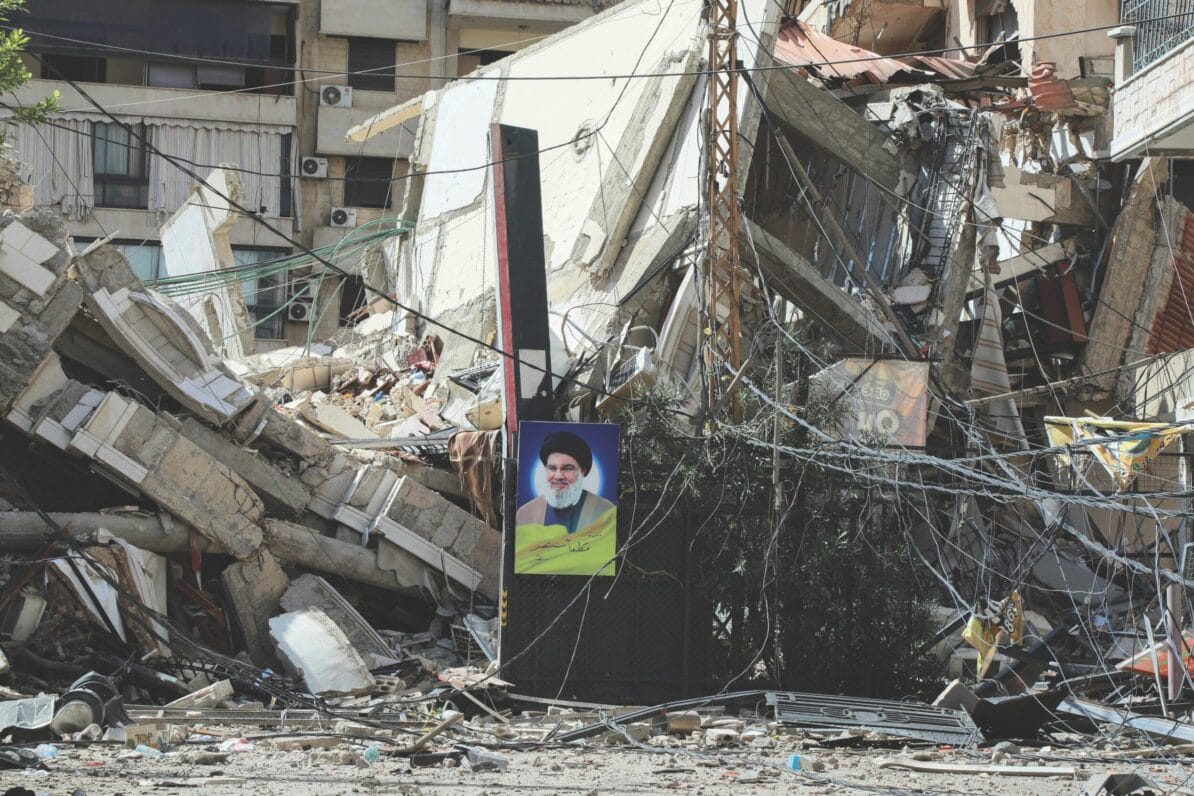
A portrait of Hezbollah’s slain leader Hassan Nasrallah hanging on the rubble of a building destroyed in an Israeli airstrike in southern Beirut
27th September 2024 (Taken from: #56)
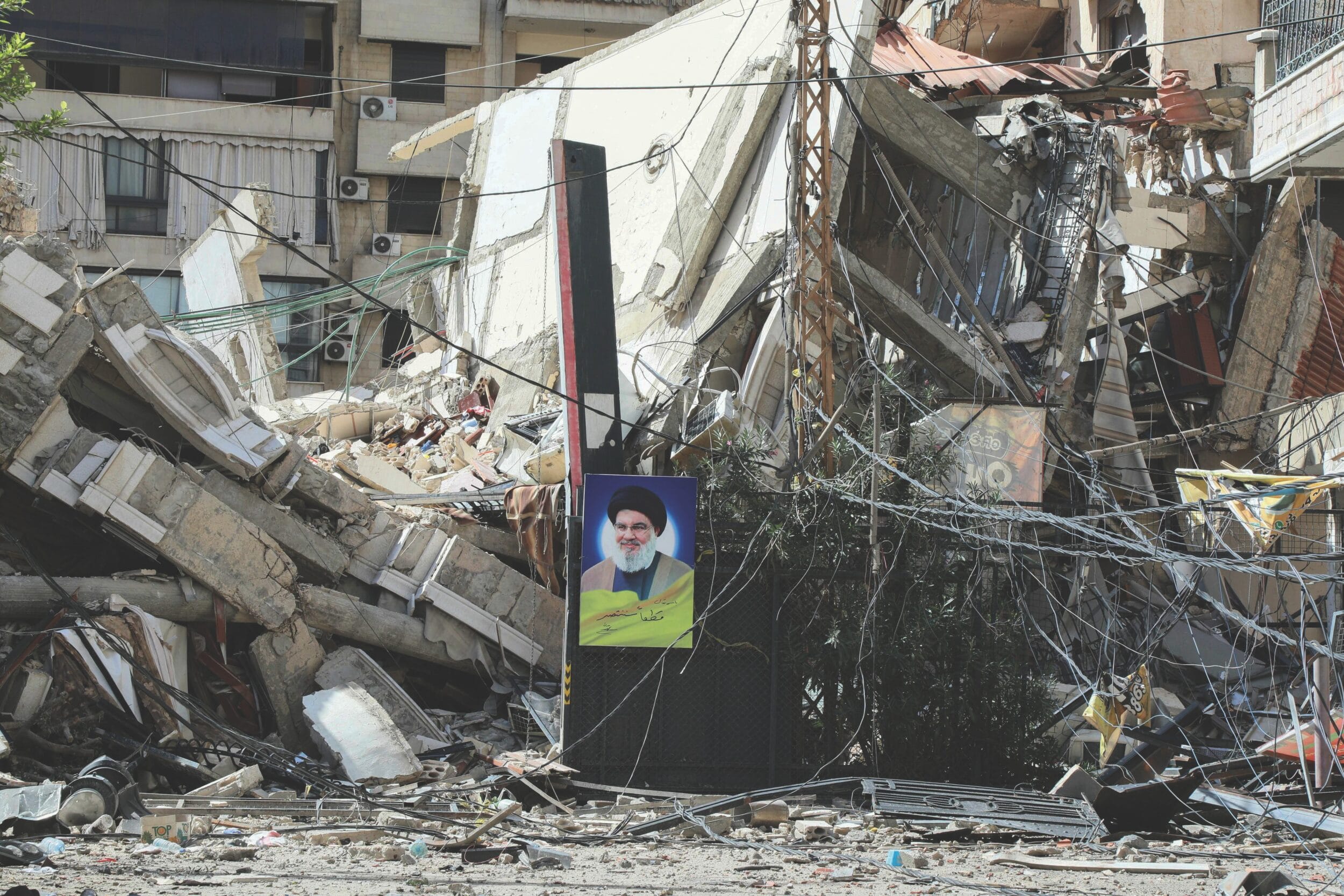
A portrait of Hezbollah’s slain leader Hassan Nasrallah hanging on the rubble of a building destroyed in an Israeli airstrike in southern Beirut
From his viewpoint in the hills to the north of Beirut, Ronnie Chatah looked out at the sun setting over the city. It was a moment of tranquillity – but then he saw a dark grey pillar of smoke rising over the skyline. “Before I saw the news, I saw the cloud,” the writer and host of the podcast Beirut Banyan tells me. For almost a year Hezbollah, an Iranian-backed Lebanese militia group, had been exchanging cross-border fire with Israel. The conflict between the two long-time enemies was reignited in October 2023, when Hezbollah launched missiles into Israel in solidarity with Palestinian militant group Hamas. The blasts in Dahiyeh, a suburb of southern Beirut, on 27th September 2024 looked to be much larger than previous strikes, however. Towering hundreds of metres into the sky, the mushroom-shaped plumes loomed ominously over the buildings below. “I could see Beirut in the distance and the cloud of debris rising,” says Chatah.
The explosions, he would soon learn, were caused by up to 80 bunker buster bombs that flattened six buildings and left behind a 30-metre-deep crater. Rumours swirled online that the strike’s target was Hassan Nasrallah, Hezbollah’s secretary general. “At that moment, I was just scrolling and scrolling [on my phone] trying to find out if it was true or not,” says Chatah. But it wasn’t until nearly 24 hours later that Hezbollah confirmed its leader had died in the attack, along with 90 civilians.
Fears of assassination had meant that Nasrallah had rarely appeared in public for 20 years, leaving his supporters to watch his distinctive black beard turn grey via their television screens. Yet, despite this, the militia group leader – who always wore a signature black turban – developed an almost cult-like status in Lebanon with supporters avidly following every word of his lengthy speeches. “There’s an element of awe, if you will. It’s almost outrageous that someone like him could be killed,” Chatah says. “The psychological blow of killing Hassan Nasrallah, this is an immense achievement by the Israelis.”
There’s an element of awe, if you will. It’s almost outrageous that someone like him could be killed”
Born in 1960, Nasrallah was the eldest of nine children. He grew up in Bourj Hammoud, a mostly Christian-Armenian neighbourhood in east Beirut, where his father ran a small fruit and vegetable stand. As a young boy he developed a reputation for being serious and stern; while his friends played football, Nasrallah busied himself with Islamic texts.
In 1975, when civil war erupted, his family fled Beirut and returned to their ancestral village near Tyre in south Lebanon. Within a year, the then 16-year-old Nasrallah joined Amal, a Lebanese Shia militia group and political party, and travelled to study at a famous Shia seminary in Najaf in Iraq. It was the first step on a journey that would ultimately transform the greengrocer’s son into one of the most powerful men in the Shia Muslim world. Following Israel’s invasion of southern Lebanon in 1982, Nasrallah left Amal and joined a breakaway offshoot, Islamic Amal. The Iran-backed militia became one of the core fighting groups in the nascent Hezbollah’s battle against Israel’s invasion of Lebanon’s Shia-dominated south. A charismatic cleric and a skilled orator, Nasrallah quickly rose through Hezbollah’s ranks. In 1992, then 32, he became the group’s secretary general, succeeding Abbas al-Musawi, who had been assassinated in an Israeli helicopter strike.
As Hezbollah’s leader, Nasrallah put the group on the map as a paramilitary force to be reckoned with, taking credit for Israel’s withdrawal from southern Lebanon in May 2000. “That’s when Nasrallah emerged in the region as someone who could challenge the Israelis,” says Chatah. “No regional army had really put up a fight, yet this smaller guerrilla group was able to poke at the Israelis repeatedly from the 1980s into the 1990s.”
At Hezbollah’s helm, Nasrallah transformed the group from an underground guerrilla militia to a hybrid organisation with a powerful political wing. In 1992, the group stood in the first elections to be held in Lebanon for a decade, winning six seats. By 2005 it had increased that number to 14 and entered government for the first time as part of a six-party alliance. Over the last two decades, using both its political and paramilitary clout, Hezbollah has established and maintained its own state-like apparatus. As well as running schools, hospitals and other social services, it also controls sections of Beirut’s ports and international airport, and runs its own security and intelligence services, monitoring both state and civilian institutions.
Hezbollah is not just a state within a state, it’s a paramilitary organisation, it’s the world’s most sophisticated terrorist group and it’s also a political party”
Chatah, however, dismisses the oft-used description of Hezbollah as a “state within a state”. “I think this diminishes Hezbollah’s role in Lebanon. It makes it seem easy to deconfigure and disarm. It’s not just a state within a state, it’s a paramilitary organisation, it’s the world’s most sophisticated terrorist group and it’s also a political party with a heavy presence in Lebanese politics,” he says. “Hezbollah has limited what the state could do in its own territory… and it has kept Lebanon a battlefield for a very long time.” Indeed, attempts to dislodge the group’s stranglehold over Lebanon have repeatedly been met with violence, including a string of assassinations targeting political opponents. Among them was the 2005 killing of Lebanon’s former prime minister Rafic Hariri and, in 2013, Chatah’s own father Mohammad Chatah, former finance minister and an outspoken critic of Hezbollah. In May 2008, clashes broke out between Hezbollah and pro-government militia after attempts to shut down the militia’s telecommunications system. Up to 110 people were killed in a week of violence.
Yet while Hezbollah may have successfully used strong-arm tactics to maintain a grip on power, its popularity has dwindled as a result. In 2012 the group took a major hit, particularly among Sunni Muslims, when Hezbollah fighters were sent to Syria to help prop up the minority Alawite regime of President Bashar al-Assad, in a civil war that has cost nearly half a million mostly Sunni lives. Another blow came in 2020, when more than 2,500 tonnes of ammonium nitrate stored in part of the port of Beirut controlled by Hezbollah exploded, killing at least 220 people and injuring 6,500. An investigation into the blast has stalled, allegedly under pressure from the militia. “When Hezbollah turned its weapons inwards and launched a civil war-like campaign against its opponents, I think this is when Hezbollah’s fate was sealed and they became blamed for the continued paralysis of this country,” says Chatah. A survey by the Arab Barometer conducted in April 2024 found that only 30 percent of respondents had trust in the group.
Hezbollah has also been caught on the back foot on the battlefield. In September 2024, thousands of handheld pages and walkie talkies used by its members for communications simultaneously exploded. Israel later admitted responsibility for the attack which killed 12 people and maimed 2,750. Meanwhile, up to half of the group’s weapons stockpiles, caches of which are scattered across Lebanon, are thought to have been destroyed in Israeli airstrikes. In October, Hezbollah elected Naim Qassem to replace the slain Nasrallah after his expected successor, Hashem Safieddine, was also assassinated by Israel. On 26th November, US president Joe Biden announced that a ceasefire between Israel and Hezbollah to end 13 months of fighting had been agreed.
Whether or not Hezbollah survives and in what form hangs in the balance. “I think in some ways, Hezbollah will not recover from the death of Hassan Nasrallah, but that said they’re still a capable fighting force,” says Chatah. “So clearly the group is not over and I do not agree with Israeli claims that they can defeat Hezbollah. They may be able to handicap, degrade and stun Hezbollah, but in terms of totally defeating this group, I don’t see that as possible.”
Slow Journalism in your inbox, plus infographics, offers and more: sign up for the free DG newsletter. Sign me up
Thanks for signing up.