Summoning the energy
One of Sir Keir Starmer’s five missions for government is to make Britain a ‘clean energy superpower’. There are glittering prizes to be won if he can fulfil his pledge – but the pathway to achieving near-100 percent zero-carbon electricity by 2030 is liberally scattered with obstacles
Originally published spring 2025 (Taken from: #57)
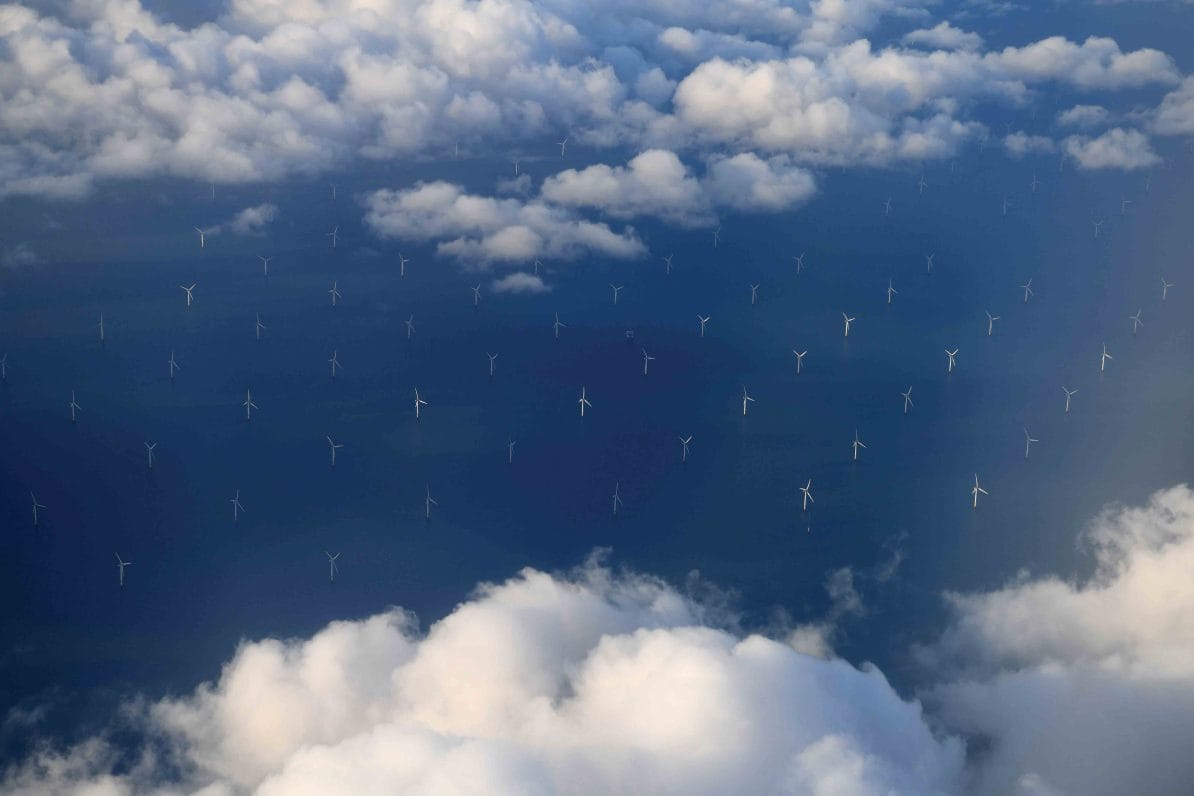
Aneurin Bevan, hero of Labour’s post-war government, once described the UK as an island “made mainly of coal and surrounded by fish.” To these attributes he could have added a third: it is also swept, in its territorial waters, by strong winds that rip their way across the North Sea with remarkable consistency. It was this blustery natural resource that led Boris Johnson, during his premiership, to claim that the UK could become a ‘Saudi Arabia of wind’, producing near-limitless clean electricity from offshore turbines.
The growth in ‘clean’ power sources – which includes renewables like wind and solar, as well as nuclear power – was an often unheralded success story of the 14 years of Tory administration that began in 2010. In that period, the UK moved from generating 20 percent of its electricity from clean sources to 51 percent, and became the European nation with the greatest offshore wind capacity. In the same period, electricity production through the burning of fossil fuels fell from 75 percent to 35 percent. In a symbolic moment on 30th September 2024, in the second month of Sir Keir Starmer’s time in office, the UK’s final remaining coal-fired power station, Ratcliffe-on-Soar in Nottinghamshire, was shut down. In March 2025 it was reported that the UK’s greenhouse gas emissions in 2024 were at their lowest level since 1872.
However, even with this decent starting position the Labour government’s mission on energy is strikingly ambitious. The previous administration was aiming to largely decarbonise electricity generation by 2035, but Starmer and his team intend to bring that forward to 2030. To get from 51 percent to the target of 95 percent “clean” power in five years (with the remaining five percent from gas), official estimates are that onshore wind capacity will need to go from 14 to 27 gigawatts and offshore wind capacity from 15 to as much as 50 gigawatts. With average outputs of six megawatts for new onshore turbines and 15 for offshore, the country will need to have installed and connected somewhere around 4,500 turbines to hit these targets, an unprecedented leap forward.
In a symbolic moment on 30th September 2024, in the second month of Sir Keir Starmer’s time in office, the UK’s final remaining coal-fired power station, Ratcliffe-on-Soar in Nottinghamshire, was shut down”
It’s a task that will involve some pretty heroic feats of engineering. In the cold and choppy waters as much as 120 miles off the British coastline, the seabed, in some cases almost 60 metres below the surface, will need to be surveyed and massive hydraulic hammers brought in to install foundations. Then the turbine shafts – ranging from 190 metres (a shade taller than the Gherkin building in London) to 250 metres and typically weighing a thousand tonnes each – will have to be hoisted and bolted into place. The blades, which can be as much as 115 metres long, will be gingerly manoeuvred into position by cranes operating from vessels jacked up off the seabed. Then separate installation ships will need to make their way slowly back to the mainland, burying miles of cables as they go, to bring the power ashore.
Despite the herculean size of the job, energy secretary Ed Miliband, for one, is bullish about the outlook for the government’s energy mission. Three days after he took office the de facto ban on building new onshore wind farms – introduced by David Cameron in 2015, and which allowed a wind turbine application to be blocked by just a single objection – was cancelled. At an auction of infrastructure projects in September, Miliband’s department awarded nine new offshore wind contracts, an impressive uptick on the zero contracts awarded the year before under the Tories, an increase driven by a major boost in government funding.
On 5th November 2024 Miliband wrote an opinion piece for the Guardian entitled “A rebuke to those who said clean power by 2030 was unachievable: they were wrong, we were right”. In it he highlighted a report that had just been delivered by the National Energy System Operator (Neso), the new independent public body in charge of running the electricity system. The report, he said, showed that “clean power by 2030 is not only achievable but also desirable, because it can lead to cheaper, more secure electricity for households, it breaks the stranglehold of the dictators and the petrostates, and it will deliver good jobs and economic growth across this country in the industries of the future.”
It’s a once-in-a-generation opportunity to rewire our energy system”
Miliband’s triumphalism comes with caveats. While Neso’s report said that the 2030 goal was possible, it was on the basis that it would be “immensely challenging” and that “several elements must deliver at the limit of what is feasible.” One of the most crucial of these is an exceptionally ambitious plan to rework the UK’s ageing electricity grid.
Built in the 1950s and 1960s, the National Grid was a masterful piece of design. It was created to bring in electricity at high voltage from large coal-fired power stations built near mines in regions like Wales and the Midlands, convert it and channel it to the areas of highest demand – big cities and the crowded south-east region of England.
While it has served the country well for decades, it is ill-equipped to deliver us to the Milibandian utopia. “What we’re seeing as part of the transition to a low carbon energy system is that you have new sources of generation operating in new places all around the country, and offshore [that have to be connected],” says Rob Salter-Church, director of regulation for the electricity transmission business of National Grid plc, the privatised company in charge of the network that links power sources to businesses and consumers. To build what he describes as “Super Grid 2.0”, vast new amounts of infrastructure will have to be installed to channel the new clean electricity to the places it is needed.
The transition comes with a hefty price tag. “National Grid is going to be investing about £30 billion over the next five years,” says Salter-Church. “We’ll be doubling the capacity of the system to flow electricity across it. We’ll be doubling the amount of connection points in England and Wales that we built in the previous five years, we’ll be connecting 35 gigawatts of generation. That’s twice the rate that we did in the previous five years.” He is optimistic about the potential benefits of the new infrastructure, which he describes as “a collective national endeavour”. “It’s a once-in-a-generation opportunity to rewire our energy system in the UK,” he says.
A separate part of National Grid is pursuing another ambitious project, of connecting the rejuvenated energy system with those of other European countries to enable the sharing of electricity. The UK grid is currently connected to those of France, Belgium, the Netherlands, Norway and Ireland. A new link with Denmark, known as ‘Viking’, was the latest to go live, in December 2023, and additional links are on the way. These international hook-ups help tackle one of the biggest criticisms of the move to clean energy: what to do when the wind doesn’t blow and the sun doesn’t shine, a phenomenon known by the gloomily evocative German term ‘dunkelflaute’ (‘dark doldrums’). “Being more interconnected with our European neighbours makes a positive contribution to our overall energy security,” says Salter-Church. “Recently we had the dunkelflaute… and you saw the Viking Link playing a really important role in importing electricity from the continent to help meet our needs.”
If and when everything is put in place with the new grid, Salter-Church can see huge potential benefits for the country. “It’s not just about the transition to decarbonisation,” he says. “It’s also about the transmission system becoming an engine for our country’s growth objectives linked to developing AI data centres and new industries of the future.”
For all his positivity, however, Salter-Church is not blind to the challenges. One is getting hold of the huge amounts of kit, from pylons to high voltage cables, needed to rewire the nation. “Lots of countries are seeking to decarbonise their energy systems and that’s putting pressure on the supply chain,” he says. On this, though, there is optimism: Salter-Church describes National Grid’s supply chain programmes as “among the most forward-thinking in the world”, and highlights its recent partial award of a multi-billion-pound High Voltage Direct Current (HVDC) supply chain framework. Another issue is skills – National Grid plans to increase its transmission business workforce by more than half in the next six years, and will need government help to make sure there are enough STEM-educated graduates moving through the system to take the work on.
There are tricky practical points too – overhauling the grid is going to require turning bits of it off to work on at times, while never stopping the flow of electricity to customers, a delicate technical dance. And bringing in the huge amounts of investment needed is not a given either. “There are many choices for investors in large infrastructure linked to decarbonisation,” says Salter-Church. “They might go to different countries. We need to make sure that we’ve got a framework with a fair balance of risk and reward that enables us to attract that capital.”
Even if the UK gets the kit, people, plans and cash to create Super Grid 2.0, that still leaves the knottiest problem – what Salter-Church describes diplomatically as “the combination of securing planning consent and ensuring that we maintain community acceptance for this infrastructure.” Translation: what to do about those opposed to parts of the new grid popping up in their area – who are sometimes pejoratively referred to as ‘nimbys’ (‘not in my back yard’).
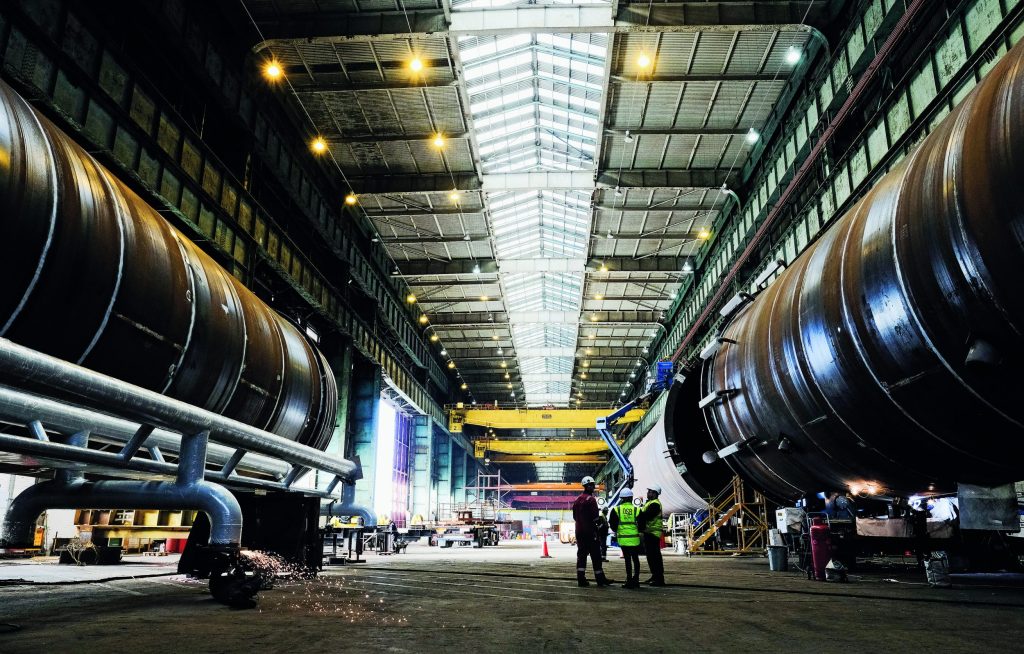
Offshore wind farm transition pieces – which link the foundations of turbines with their towers – at the Offshore Structures Britain wind farm facility at Stockton-on-Tees in 2017
Ralph Fiennes strides along the sand dunes at Covehithe on the beautiful Suffolk coast, where he grew up. He talks about the incredible resource of wind power that lies off the coast, which he says is vital for combatting climate change, and which the UK’s North Sea neighbours – Denmark, Belgium, Germany and the Netherlands – are also capturing through ever-growing throngs of offshore turbines.
He turns to face the camera, fixing it with his trademark mournful intensity. “Just one country, this country, has decided to bring this vital clean, green energy into the grid by building on land, on greenfield sites as opposed to brownfield sites, creating acres of steel and concrete in areas of profound natural beauty, protected birdlife and cultural heritage that supports thousands of jobs and livelihoods,” he says.
Fiennes’ short film, Coast, about the potential impact of infrastructure planned for the newly reworked grid was created for Suffolk Energy Action Solutions (SEAS), an organisation set up in 2019 by local resident Fiona Gilmore. It campaigns against the creation of a new energy ‘superhub’ on the Suffolk coast, where electricity from offshore wind farms would be brought ashore, pooled and converted for distribution.
“This is potentially the biggest energy hub in Europe, at Friston, where the substations would be, and Saxmundham, where the converters would be,” says Gilmore. “In their totality that represents over 80 football pitches of concrete and steel towers. Each concrete, monolithic converter station is 26 metres high, towering over the church steeples.” The proposed development, she says, “is vast and it represents, if it goes ahead, a total, profound, seismic shift in the cultural identity and the essential character of what is a deeply rural place. And it will never, ever return.”
Fiennes, Gilmore and their fellow campaigners are clear that the UK has to move towards clean power (“Yes, yes, yes to green power, a million times over, the planet is lost without it,” says Fiennes in his film). Their suggestion, however, is that the UK should follow Belgium and the Netherlands in creating “offshore grids” which pool wind farm energy at sea, meaning fewer cables need to be brought on to land, and less substation infrastructure is needed onshore. They believe that the cables should be brought ashore and the substations constructed at previously developed ‘brownfield’ sites rather than at “Friston, a medieval village, Saxmundham, a historic market town and Aldeburgh, a nature tourism destination next to one of the RSPB’s oldest reserves.”
They also point out the effect of years of construction and the resulting traffic on visitors. “Over 90 percent of our tourists – it’s our main economy here – are daytrippers,” says Gilmore. “If they look at the roads and the gridlock that the A12 is now facing, they are going to say, ‘D’you know, I think I would prefer to go somewhere else for my day trip. I really can’t be bothered to make the trek. And anyway, when I get there I’m going to be disappointed now because it’s no longer that beautiful place I remember.’”
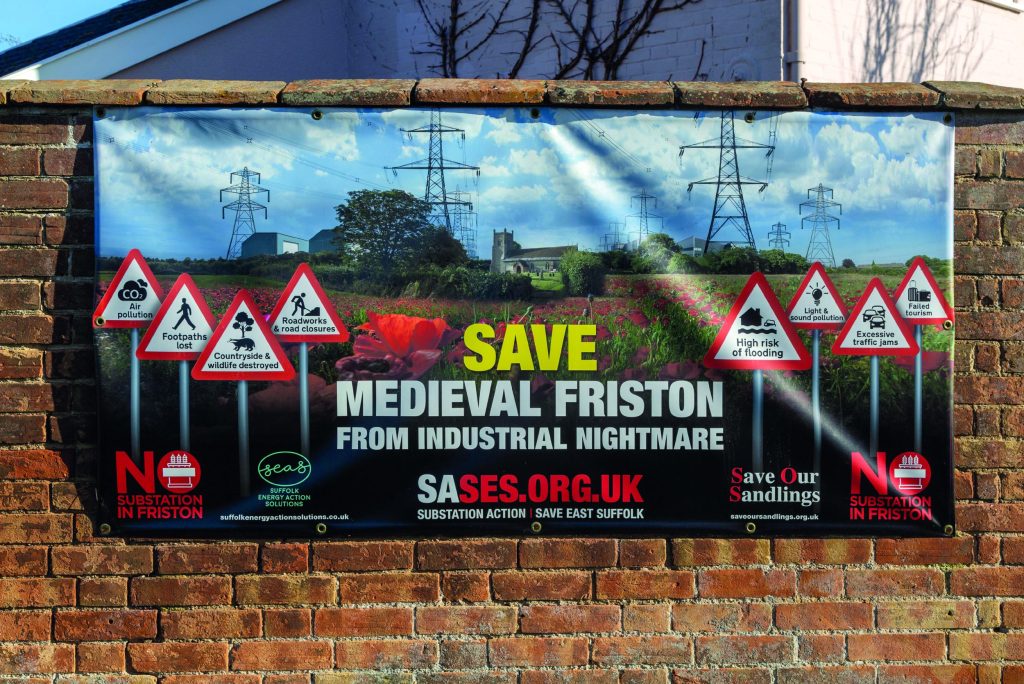
A protest campaign banner against a proposed electricity substation at Friston in Suffolk, East Anglia
Salter-Church recognises the depth of feeling in communities that will be affected by the development of the new grid. “You can’t just force infrastructure through,” he says. “What we do at National Grid is work very closely on the ground with local communities to understand their perspectives and views on new infrastructure. We’re making some difficult trade-offs between national and local, and we work really hard to be able to take into account their views when developing the right approach.”
National Grid has said that an offshore option will be more expensive than its proposed solution in East Anglia, not just in construction but also in opportunity cost. “Time is a really important factor to consider,” says Salter-Church. “If you’re a generator connected to the system, but there’s not enough capacity in the transmission network to get your power away, then you get ‘constrained’ off the system and you get paid for not generating. Constraint costs run into billions of pounds every year.” With more and more wind farms being brought online in the next five years, these constraint costs could escalate rapidly. “It’s been a key part of our conversations in East Anglia, looking at both the direct project costs, but also thinking [about] the constraint costs we can save by delivering by a certain time,” says Salter-Church.
We’re all nodding our heads, saying ‘These bloody nimbys, why are they blocking it?’ But the fact of the matter is that the devil is in the detail”
The stand-off between SEAS and National Grid is just the most prominent of several that are beginning to emerge as the reality dawns about the extent of the new grid infrastructure and its effects on the landscape. Based on the prime minister’s speech on 5th December, however, in which he reaffirmed his commitment to the clean energy mission, campaigners are unlikely to find a sympathetic ear in Number Ten. Addressing himself “To the nimbys, the regulators, the blockers and bureaucrats… The alliance of naysayers…”, Starmer had a clear message. “We say to them – you no longer have the upper hand… Britain says yes.”
Gilmore says that she’s fed up of people trying to push through their plans while paying what she sees as lip service to local concerns. “I can predict what all of these people are going to say in their speeches,” she says, “because it’s cliché after cliché after cliché. ‘We want to minimize the societal impacts and the environmental impacts but for energy security reasons we have got to go and do this, and this is the only way.’ It sounds very plausible and we’re all nodding our heads, saying ‘These bloody nimbys, why are they blocking it?’ But the fact of the matter is that the devil is in the detail.”
Gilmore argues that if the detail of the proposal she backs for a new offshore grid is taken seriously, it could have broad benefits for the country. “We’re saying that you only need two more years to do what we’re talking about,” she says. “And in the midterm this will be faster because you won’t need to build a substation for each wind farm in the future, so you’ll reduce your onshore infrastructure by over 50 percent. It’s cheaper in the mid-term too because if [publicly-owned renewable energy investment body] Great British Energy owns the offshore platforms and the subsea cables, it can charge commission to the wind farm developers for using them. You have then got something for Britain that we can own, which is in our interests, instead of it always being owned by someone else. And what we’re saying is, don’t throw East Anglia under the bus. With just two more years you can save East Anglia from catastrophe, you can do it the right way.”
Slow Journalism in your inbox, plus infographics, offers and more: sign up for the free DG newsletter. Sign me up
Thanks for signing up.