A foreign field
On 27th June 2024 British volunteer combat medic Peter Fouché lost his life while working on the front line in Ukraine. Nearly 400 international humanitarians and fighters have died in the conflict with Russia since 2014. But what motivates someone to risk everything in a fight for a country that isn’t theirs?
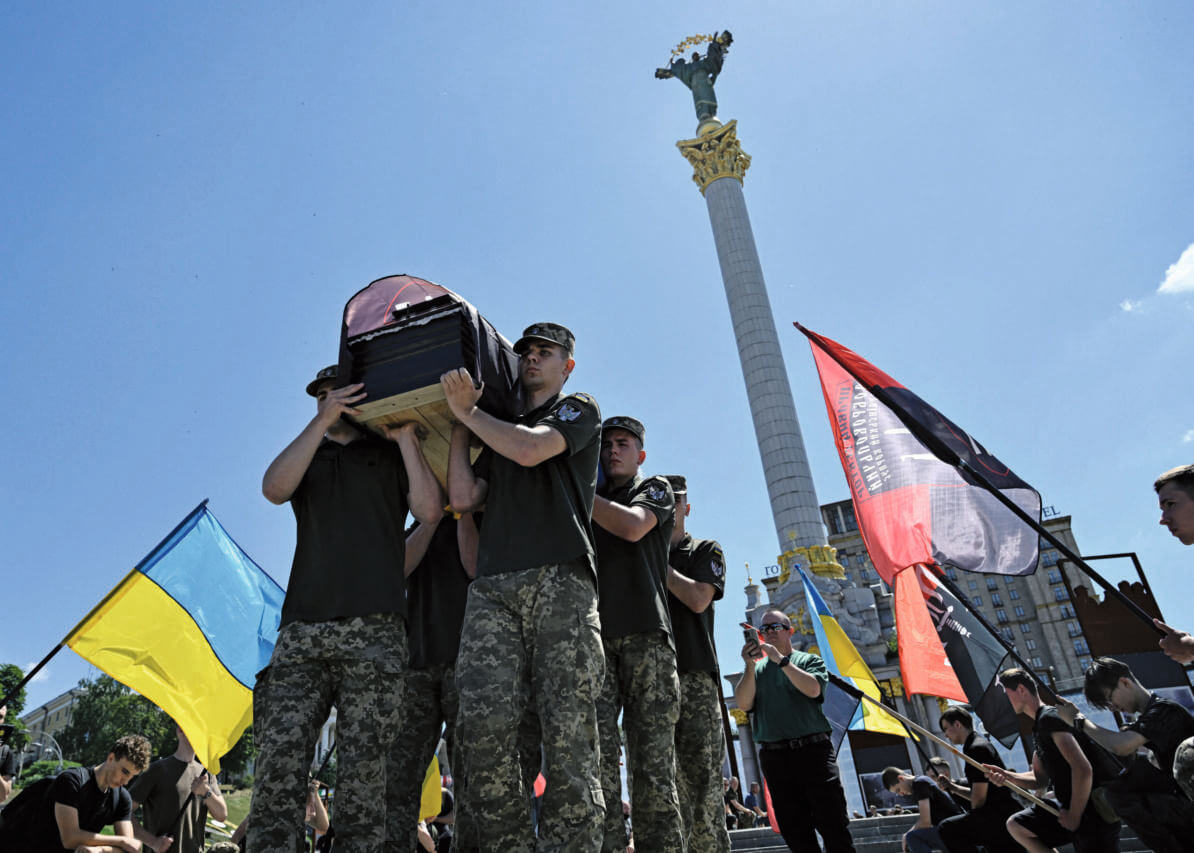
People kneel as servicemen of the Ukrainian honour guard carry out the coffin containing the body of Peter Fouché during a ceremony at Kyiv’s Independence Square, 6th July 2024
27th June 2024 (Taken from: #55)
In February 2022, Peter Fouché, a 49-year-old taxi driver from west London, made a momentous decision. Russia had just launched its full-scale invasion of Ukraine and Fouché, a former police officer in an elite unit in his native South Africa, was horrified by what he saw.
“Russian invaders were murdering children. I’m a father, I have a 15-year-old daughter. My love for my child ignited a volcano inside me and also my instinct as a police officer is to protect innocent people,” he says in a documentary about his work in Ukraine. Before he left Fulham, Fouché, who moved to the UK in 2006 and was naturalised as a British citizen, went to talk to his daughter, then aged 13, about his decision to go. “I said: ‘I’m going to go to Ukraine as a medic and I’m going to help the Ukrainian army to defend Ukraine,’” explains Fouché. “And she said: ‘Go daddy. Go there, be safe and come back.’”
In the documentary, released in April 2024, Fouché sits for an interview with journalist Olga Butko on a camping chair in a clearing in a wood. He’s dressed in military fatigues and his face is bristly with several days’ stubble. For the last two years, he has worked relentlessly on the front lines in Ukraine, risking his life for a country that isn’t his own. “My desire to go was so strong, so powerful, no one could stop me,” says Fouché. His only regret, he continues, is not being present in his daughter’s life. “My daughter is growing up without a father and it kills me every day to think about how angry and disappointed in me she might be.”
When Fouché first arrived in Ukraine in 2022, he joined a territorial defence unit, where his skills from his days in the police, driving rapid response vehicles and carrying out medical evacuations, were quickly put to good use. “One day my commander came to me and handed me a rifle and a set of ambulance keys and said ‘You guys are going to the front,’” he says.
Alongside Tatyana Millard, a Ukrainian-British dual citizen and fellow combat medic, Fouché went on to save some 200 Ukrainian soldiers’ lives. On one occasion, Fouché recalls, he had to cut still-smoking pieces of white phosphorus out of a Ukrainian soldier’s leg without anaesthetic, while Tatyana drove the ambulance along under Russian mortar fire.
Together, Fouché and Millard also founded Project Konstantin in 2022. The not-for-profit organisation was named after their colleague Konstantin Vyazovsky, who was killed in the battle for Kherson. It raises money for non-lethal military supplies including generators, cars and medical kits, and encourages donors to sponsor Starlink internet subscriptions for soldiers in the field.
But in October 2023, tragedy struck when Millard was killed in a car crash while delivering a Land Rover adapted for medical evacuations to the front line. “Losing Tatyana was unbelievably painful because we had been through so much together, she was my connection to Ukraine,” says Fouché. “She was my foundation, my rock.”
Shortly after Millard’s death, Fouché joined the Ukrainian army as a combat medic. Tragically, less than a year later, Project Konstantin announced that Fouché too had been killed, on 27th June 2024. He died, the organisation said in a statement, having been injured “in combat against Russian forces… a hero in the battlefield.”
The war in Ukraine is the deadliest conflict to take place in Europe since the second world war. In August 2023, US officials estimated that as many as 70,000 Ukrainian soldiers had been killed since February 2022. Yet, despite the risks, Fouché is only one of thousands of foreigners who have flocked to Ukraine, either to fight or to volunteer in other capacities on the frontlines. Many have lost their lives.
As of August 2024, Memorial International, an organisation which keeps track of and commemorates foreign fighters and humanitarian volunteers who have been killed in the Ukraine conflict, has recorded the deaths of 392 internationals from 53 countries. Among them are 50 Americans, 12 Canadians and 18 Britons – with Fouché the most recent to be added to the list.
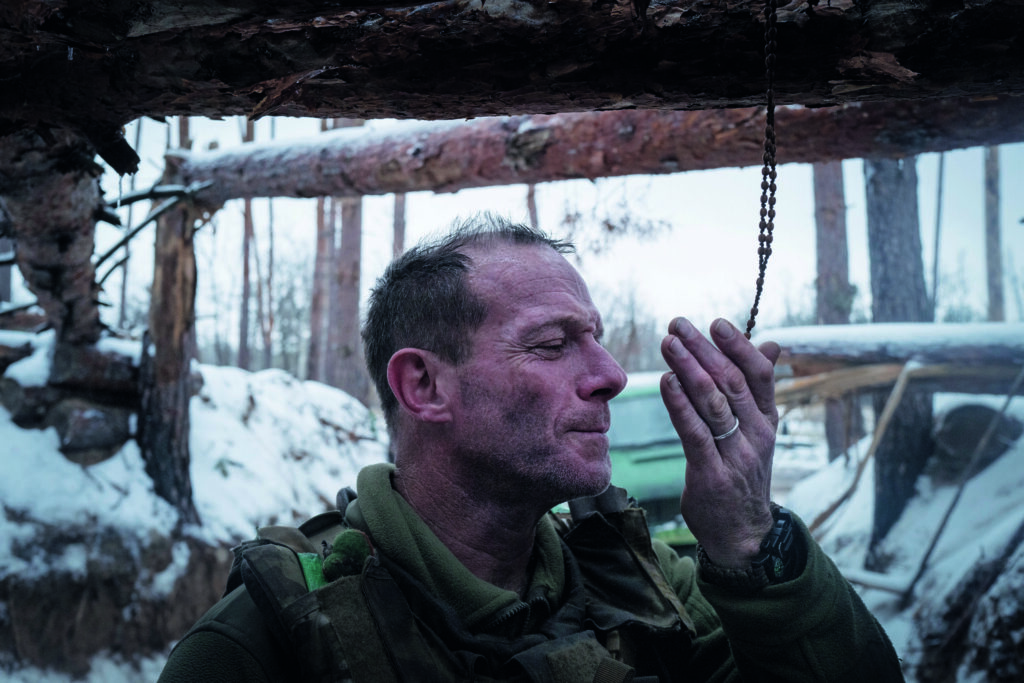
Peter Fouché kisses a rosary in a trench in Ukraine. His colleagues believe his Christian faith was part of what drove him to travel to Ukraine in an attempt to help others
Being killed isn’t the only danger foreigners face on Ukraine’s frontlines, however. If captured alive foreign fighters, especially Europeans and North Americans, are a valuable asset to Russian forces.
“The torturer’s mask was a worry. A gossamer-thin balaclava, the type worn by an old-school bank robber, it had two eyeholes and a gaping space for the mouth,” recalls British military veteran Shaun Pinner in his autobiography Live, Fight, Survive. “I was in serious trouble.” It was mid-April 2022, and Pinner had been taken to an FSB (Russian secret service) black site somewhere in Russian-occupied Donetsk in the east of Ukraine. Less than 24 hours earlier he’d been captured by Russian forces after his unit, the 36 Brigade First Battalion Ukrainian marines, had attempted to break out of the siege of Mariupol. By then, Pinner and his fellow soldiers had already spent nearly six weeks holed up in the subterranean networks that lie beneath the Illich Iron and Steel Works in the port city with an ever-dwindling supply of food and ammunition.
At this point, I’m really thinking ‘This could be the end’”
Pinner’s initial interrogation by ‘Mr Balaclava’ was just the start of a five-month ordeal in which he was stabbed, electrocuted and repeatedly beaten before being sentenced to death as a mercenary by a Donetsk court in a Kafkaesque trial that saw his defence lawyer argue in favour of his guilt.
One morning in September 2022, Pinner and his cellmates were ordered to pack up their belongings. With their hands tied and hoods over their heads the men were beaten before being forced into a truck where they were bound together in a human caterpillar designed to contort their muscles. “At this point, I’m really thinking ‘Shit this could be the end,” Pinner tells me.
When the hood was finally removed, he could hardly believe his luck. Instead of an execution site, he was in an airport lounge where he and the other prisoners were checked over by medics before being chaperoned towards the runway. The private jet they boarded had Arabic writing on the door, smelt of leather and looked like it belonged to Kim Kardashian, recalls Pinner. Adding to the bizarreness of the situation, aboard the plane was a man with striking blue eyes and a tailored suit, who was the spitting image of billionaire oligarch Roman Abramovich.
It was only after the jet took off that Pinner learned that the man was in fact the former owner of Chelsea football club and that he had been central, along with Saudi negotiators, in brokering the prisoner exchange that saw Pinner freed alongside ten other foreign prisoners, including four Brits and two Americans. In return, Russia received 55 prisoners from Ukraine. Among them was Viktor Medvedchuk, a personal friend of Putin and the leader of a pro-Russian party who was facing treason charges in Ukraine.
“Looking back it’s crazy. If you saw a movie with this plotline, you’d think ‘that would never happen in real life’. Some days I just think, ‘how did a regular guy from Watford get mixed up in this?’” says Pinner. “But in the end, I know we were the lucky ones. We made it out alive. If you look at my wedding photos, most of the guys in them are dead or still being held captive. That’s the reality. I was really, really lucky to survive and make it out.”
In the first days of the conflict, Ukraine didn’t know what the heck to do with these guys who were showing up”
The exact number of foreigners that have fought for Ukraine is unknown. However, experts’ best guess is that in the first five years of the conflict, between 2014 and 2019, around 2,000 foreigners joined Ukraine’s ranks. A second wave of international recruits arrived in the wake of Russia’s full-scale invasion of Ukraine in early 2022, likely also numbering around 2,000. “It’s hard to give exact numbers because they fluctuate. Some guys go back and forth. Others arrive in Ukraine but can’t find a unit or have a reality check and go home,” says Dr Kacper Rekawek, an expert on foreign fighters in Ukraine and research fellow at the International Centre for Counter-Terrorism in The Hague.
The secrecy that surrounds the world of foreign fighters also makes it difficult to get accurate numbers. “There are some guys who don’t mind being in the public eye, who perhaps even enjoy it. These guys often share updates and videos from the frontline on social media platforms,” says Rekawek. “But there are plenty of others who prefer a low profile.”
“In the first days of the conflict [in 2014], Ukraine didn’t know what the heck to do with these guys who were showing up. Some had military experience, like Shaun [Pinner], but a lot, even the majority, were just misfits and ideologues with no fighting experience,” explains Rekawek. “They just kind of showed up and imposed themselves on the Ukrainians.”
Fast-forward to 2022 and the situation was markedly different. Ukraine was actively calling on foreign fighters to join its armed forces. On 27th February, just three days after the start of the Russian invasion, Ukraine announced the formation of an International Legion. Foreigners could sign up via a new English-language web portal that called on them to “Join the brave, defend the freedom of Ukraine, Europe and the whole of the world.” Posting on X, formerly Twitter, Ukraine’s minister of foreign affairs wrote to potential recruits: “Together we defeated Hitler, and we will defeat Putin too.”
The creation of the International Legion and the online portal centralised applications, raised the standard for foreign recruits and diverted them away from units associated with far right and nationalist views. “Essentially it served to weed out unsuitable individuals. Applicants who had little or no military experience or who held extremist views were, for the most part, rejected before they arrived in the country,” says Rekawek.
At the same time, the creation of an online portal also broadened Ukraine’s recruitment reach. “Previously you had to be ‘in the know’, to be in the right online communities or to have the right contacts in Kyiv. People who would vouch for you and get you ‘in’,” explains Rekawek. “That really changed in 2022. Now anyone who is interested can just apply with a few clicks of a mouse.”
The question of what drives foreign fighters is an age-old one, says Dr David Malet, author of Foreign Fighters: Transnational Identity in Civil Conflicts and professor of public affairs at the American University in Washington DC. Although the presence of foreign fighters has attracted considerable attention in recent conflicts, such as Syria and Ukraine, their use in warfare dates back centuries. Malet points to the statues in Lafayette Square in Washington DC honouring one Polish, one Prussian and two French generals who volunteered to fight in the War of Independence between 1775 and 1783. “These statues of foreign volunteers are in the highest place of honour right by the White House, and you will find statues like these of foreign fighters all over the world. While we think of it as something unusual or exceptional, the involvement of foreign fighters is actually much more likely than not,” he tells me.
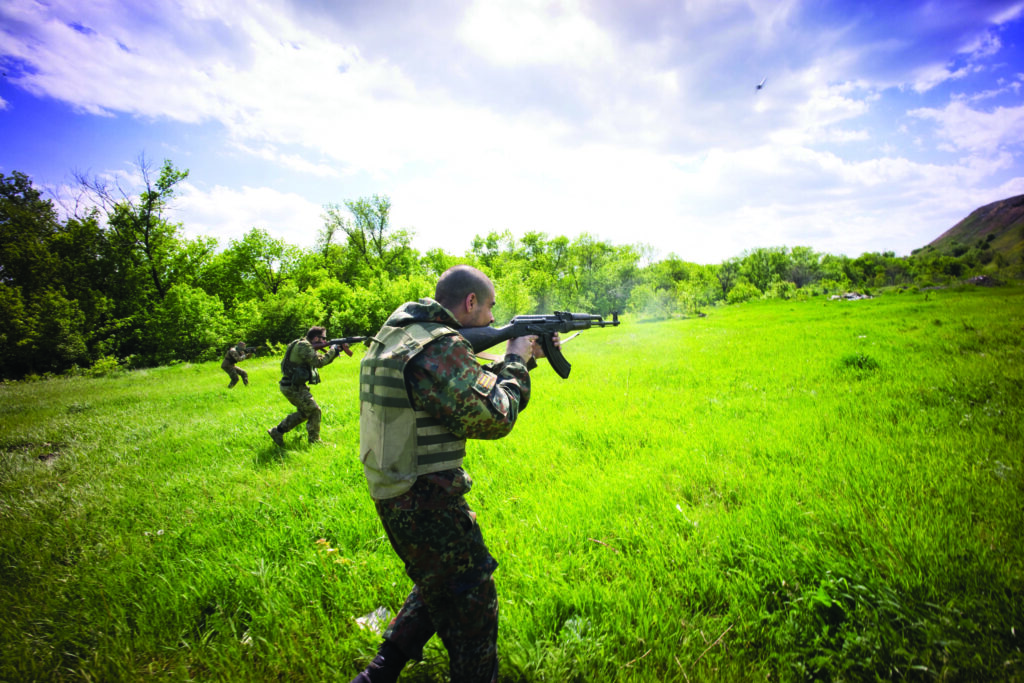
Foreign volunteer fighters take part in a military exercise to improve their combat skills in Donetsk in 2015. In the early days of the conflict Ukraine saw a flood of volunteers, many without any military experience
When it comes to the motivations of foreign fighters, Malet says there is no one-size-fits-all answer, but the dynamics underpinning a conflict can provide some clues. “Ethnicity, religion and diaspora ties – these can all be very strong motivations,” he tells me. Conflicts in which there aren’t strong group identity factors to draw in foreign fighters have to use different recruitment strategies.
“The conflict has to feel relevant. There has to be a connection there, be it emotional, political or ideological. What Ukraine has done very successfully is to frame the conflict as not just a local issue but as one that has resonance to a broader global audience,” explains Malet. “There has been a focus on the humanitarian framework, on the huge suffering and deliberate targeting of civilians. The message here is that Russia is a threat not just to Ukraine but to the stability of Europe, to the western world, to democratic values. In this world view, defending Ukraine is a duty, both because of the great humanitarian interest and because if Ukraine loses then Russia will be coming for you next.”
The geographical and cultural proximity of Ukraine to the west is also likely to play a role in attracting fighters. “The reality is that when these guys [would-be foreign fighters] see images of war in a place that looks like it could be their country, with people that look like they could be their friends and family, it strikes an emotional chord,” says Rekawek. “When Europeans see images from Ukraine it’s more possible to imagine that it could be them that this is happening to than when they see images from Syria.”
For some, it can be just one photo or video shared on social media that tips the scales. “I’ve heard many times in interviews [with foreign fighters] that a specific image had a very profound effect on them,” says Rekawek. “For example seeing a video clip of a father saying goodbye to his wife and child before going off to war. That can be enough for some people to say, ‘Right, that’s it, I have to go and help these people.’”
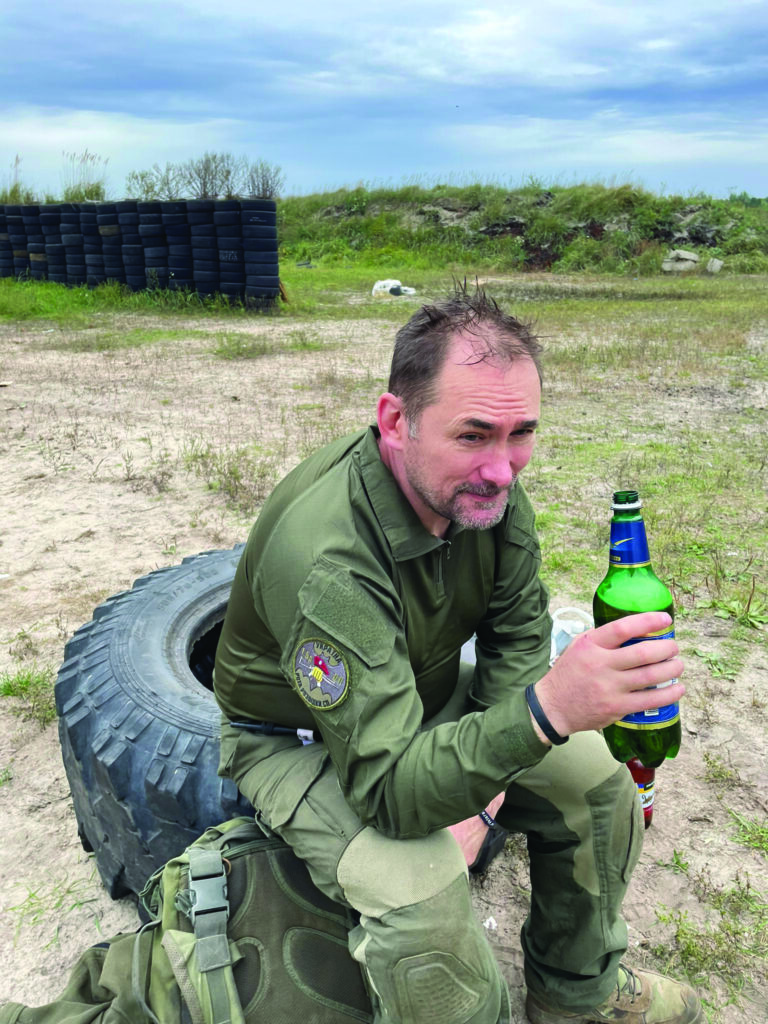
‘Mac’
I meet with “Mac” at the martial arts school he runs out of a storage unit in a city in south-east England. He puts on the kettle to make a cup of tea and we sit down to talk. The floors are cushioned with gym mats. Punch bags are suspended from the ceiling and in the corners of the room are specialist mannequins used for self-defence training. The walls are decorated with the flags of the UK and the Royal Anglian Brigade. “There’s a lot of people that would be offended by that these days,” he says, gesturing to the Union flag. “But I think we ought to be teaching our youth to have pride in our country and flag. Having pride in your nation is nothing to be ashamed of.”
Mac’s keen sense of right and wrong developed in his childhood. A socially awkward boy, who would later be diagnosed with autism as an adult, he found school challenging. “I was the weird kid, the oddball, the misfit. I was bullied, not physically but emotionally,” he tells me. From a young age he’d known he wanted to join the army. As soon as he turned 15, he signed up as a junior soldier at the Army Foundation College in Harrogate. The military life, Mac tells me, offered him the camaraderie, discipline and sense of purpose he was looking for as a young man.
Mac’s two tours in Northern Ireland in particular, left a lasting impression on him. As we talk, he flicks through the pages of The Never Gone 1441, an illustrated memorial book for all the British soldiers killed during the Troubles. “Six of our lads, just boys really, were killed while I was out there,” he tells me with a slight waver in his voice and tears welling in his eyes. “This poor bastard,” he continues, thumbing the pages until he reaches the portrait of a young man. “He was blown to bits; we had to pick up the pieces of him, what was left.”
Mac struggled to adjust to civilian life after leaving the military in 1991. “I wasn’t suited to it,” he tells me. Despite earning a degree in graphic design, he struggled to find lasting employment in the field. “It wasn’t easy. I often think about how different my life would have been if my autism was diagnosed earlier, or if I’d have been happier if I stayed in the military,” he tells me. In his free time Mac threw himself into hobbies as a distraction. He volunteered organising security for Justice for Northern Ireland Veterans, an organisation which held rallies in protest at the prosecution of British soldiers for their actions during the Troubles. He also began training in martial arts. “It became a real obsession for me. In a way I was reliving my military days, trying to find that thing that was missing in my life,” he says.
By the time of the Russian assault on Ukraine in 2022, Mac had been running his own martial arts school for 11 years. In the veteran and sports communities he’d become a part of in the years since he left the British military, the invasion was the hot topic of conversation. “There were a lot of photos being shared, of some really horrific, awful things. I won’t go into all the details, but those Russians are really sick bastards.” There was one video in particular that hit him hard. In it, Mac recalls, a young woman could be seen pushing a buggy with a young girl with Down syndrome along the street. Seconds later, a missile hit. As the dust cleared the woman could be seen lying on the floor next to the crumpled pram.
In my eyes it’s that simple — Russia’s a bully. And you have to stand up to bullies”
“It just made my blood boil, I was raging. Deliberately killing civilians like that, a woman and a child, it’s cowardly and that’s the one thing that triggers me, that really winds me up – bullies. And, in my eyes, it’s that simple – Russia’s a bully,” says Mac. “And you have to stand up to bullies.”
At first, Mac fund-raised for a sniper rifle and military equipment, including bulletproof vests and night vision goggles, to send to Ukraine. Then a contact he’d met through a veterans’ association offered him an opportunity to go to Ukraine himself and train troops in close-quarter combat. “At first, I wasn’t sure if I could actually offer anything useful, but they explained to me that they had a lot of guys with no military training or experience who were going to be deployed straight to the front, so really anything we could teach them would be a help,” he says. “When I heard that, I knew I wouldn’t forgive myself if I didn’t do my bit.”
Along with another martial arts expert from the UK, Mac flew to Poland before taking a 19-hour bus journey to Kyiv. Together they taught the recruits skills such as hand-to-hand knife fighting. Their training camp was in an area that had been occupied by Russian soldiers in the early days of the war and the woodlands, still heavily mined, were a no-go area. Then there was the frequent shrill of air raid sirens that were largely ignored, despite a fatal strike on a training facility near Lviv just a few months before that had killed at least 60 people. “If we’d stopped every time the sirens went off, we’d have never got anything done,” says Mac.
Alongside moral outrage, personal circumstances often play a role in foreign fighters’ decision to go and fight. “People who have commitments at home, a family, a job and so on, and people who are satisfied with their lives are less likely to want to make such a radical move,” says Rekawek. In contrast, many foreign fighters have circumstances, such as a bad divorce or debt, that mean they may be seeking an opportunity to make a big change in their life.
At that time, I was ready to just burn my passport, walk off into the forest and never go back to the Isle of Man”
Chris Garrett grew up idolising his grandfather, who was awarded the Burma Star for his service during the second world war. When he was forced to drop out of the Army Foundation College due to a knee injury it was a heavy blow. Back in the Isle of Man he found himself drifting from job to job, before setting up his own tree surgery business. “I wanted to follow in my grandfather’s footsteps, to be doing something useful with my life, but at that point I’d completely lost direction,” Garrett tells me. “If I’m honest I’m not proud of who I was then, I was getting into trouble, I was an asshole.”
In 2014, Garrett was struck by a personal tragedy. A friend of his committed suicide. “I wasn’t there… but I felt tangled up in it. He used my shotgun. It had a big effect on my mental health,” he tells me. By that time, Garrett had been making trips to Myanmar where he’d volunteered with the Karen National Liberation Army fighting against the Burmese government. Out there he’d learned skills including the basics of demining and bomb disposal.
When he saw that the situation in Ukraine was escalating, he reached out on social media to see if he could be of use. “They said, ‘Look we’ve got guys going to the frontline who have no firearms experience, no medical training, no understanding of landmines or anything like that.’ And I thought ‘Okay, I can help here even if it’s just teaching some real basics, and to be honest, I wanted to get away. At that time, I was ready to just burn my passport, walk off into the forest and never go back to the Isle of Man.” In Ukraine, Garrett signed up with the Azov battalion and threw himself back into life on the frontline. “In a way it was an attempt to redeem myself,” he tells me.
For Pinner too, the opportunity to go to Ukraine came at a moment in his life when he was looking for an out. After leaving the army in 2000, he’d worked in hazardous waste management, eventually working his way up to running his own company. On the surface everything was fine. “I was doing well, the business was doing well. I was making enough money, more than enough,” he tells me. But after a nine-year relationship fell apart, he started to feel depressed and lost. “To be honest I’m not good at being single. I started going down the wrong route. I was drinking too much, meeting the wrong people and making the wrong choices.”
When a friend from his military days reached out to suggest that Pinner join him in Syria where he was volunteering in the fight against the Islamic State it seemed like a godsend. After a short stint fighting with the Kurdish People’s Defense Units (YPG), Pinner decided to head out to Ukraine, like Garrett serving with the Azov battalion. “To most people that probably sounds crazy, but I was at a point in life where I’d lost sight of what really mattered. I missed the military life, the feeling of being a part of something bigger and doing something good,” he says. “I’d been seriously depressed before and that was a place I was determined to never go back to again. In some ways it was a selfish decision, but it just felt like the stars had aligned and it was the right opportunity at the right moment.”
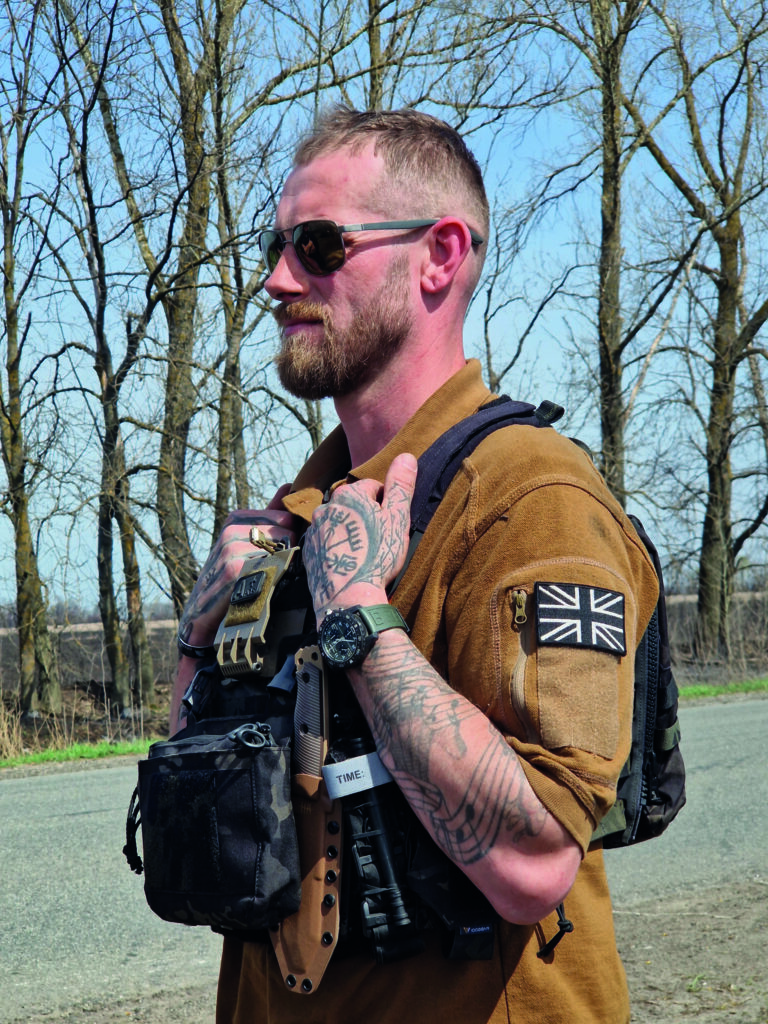
Chris Garrett
Motivations, however, aren’t static. “You have some guys who maybe start out looking for an escape from their lives back home, even a bit of adventure, but then they build lives and communities, they marry local women and decide to stay. Their reasons for fighting or signing a three-year contract with the Ukrainian army then change; remaining in Ukraine and maintaining their life there is their goal,” says Rekawek. Similarly, fighters who are not motivated by politics or ideology often become so when they spend time in the host country, fighting on its frontlines. “It’s normal that when you are under fire every day from the Russians, or whoever, that you will come to think of them as the enemy and of your side as the ‘good guys,’” explains Rekawek.
When Pinner first arrived in Ukraine in 2018, he didn’t think he would stay long. “Honestly, it sounds bad, but I can’t say that I knew that much about the political situation when I first came here and back then I didn’t speak a word of Russian either,” he tells me. “It was winter and there was four feet of snow, it was -20°C, and I thought, ‘Oh shit, what have I done!’ But then spring came and the cherry season began, and I started slowly falling in love with the country. My garden here has apricots, grapes and cherries. You go to the butcher and grocers, not just the supermarket. You don’t pay 20 quid to park your car at the beach. There’s a strong sense of national pride. You can go and eat steak and have a beer for £1.50. It’s a different way of life, more old school and simple.”
As well as the country, Pinner also fell in love with a Ukrainian woman. In 2021, he married Larysa, a sapper with a demining NGO that he’d met during a tour on the frontline in Donbas. “Everything just kind of fell into place for me here,” he tells me. “I had a woman I loved. A job I loved. And after living here, I was sure I was doing the right thing fighting for Ukraine because the people here aren’t Nazis. My friends aren’t Nazis, my neighbours aren’t Nazis. And here in eastern Ukraine everyone speaks Russian, and no one is persecuting them for it. So all these things that Russia is saying are just pure, utter bollocks. It’s just bullshit excuses for invading Ukraine, no one in Mariupol wanted to be Russian or join Russia.”
Garrett also stayed longer than he’d planned. “My initial idea was to come for three or four months but I didn’t leave until the end of 2018,” he tells me. After a three-year hiatus, he returned to the country in early 2022. Not long after he came back to Ukraine, he met his partner, Courtney, an American paramedic who also volunteered on the frontline. The couple have just had their first child. Garrett remains in Ukraine and has set up his own demining NGO called Prevail. Others, however, have had their time cut abruptly short.
On 27th June, Jana Fourie of Project Konstantin was sent a screenshot of a group chat between fighters in Ukraine saying that her friend and colleague Peter Fouché had been killed. She contacted Halyna Zhuk, her co-worker and Fouché’s fiancée. “I asked her when she had last heard from Pete. She said, ‘Last night when he told all of us he was going to the front’. I told her about the news I had received and asked her to get in touch with Pete’s commander. We were holding out hope that it was a miscommunication. But Halyna contacted the commander, and he said it was true.”
Fourie talks warmly about Fouché, who she believes was driven in part by his Christian faith to help others. “He was a complete altruist,” says Fourie, who runs administration for Project Konstantin from her native South Africa. “Whenever we would run low on supplies with Project Konstantin, he would take his own salary and spend that. People would say, ‘Hey, Pete, your trousers have holes, go buy yourself some new ones.’ And he’d be like, ‘Yeah, but we need supplies.’ Taking care of other people was his main thing.”
Chris Garrett had direct experience of Fouché’s altruism. In February 2023, a colleague of his partner Courtney, former US marine Pete Reed, was killed in a Russian missile attack in Bakhmut, a town in Ukraine’s east. Fouché, who at the time was based just 800 metres from the besieged city’s ‘zero line’ as a volunteer medic, helped Garrett locate Reed’s remains and then went to retrieve them so they could be repatriated to America. “There’s a very good chance we would have been killed too if we’d driven down that road in military vehicles,” Garrett tells me. “We can’t be any more grateful for what he did for us, and more importantly for Pete’s wife and family.”
On 6th July 2024, a memorial service was held for Fouché in his adopted homeland. Mourners knelt on Kyiv’s Maidan Square, the site of the mass demonstrations that overthrew Ukraine’s pro-Russian government in 2014, as Fouché’s coffin was carried in by an honour guard of Ukrainian soldiers.
I think what Peter would like best is if people can look at his life and say, you know what, we will stand up to injustice”
The coffin, draped in the blue-yellow flag of Ukraine and the red and black ensign of the 67th Mechanised Brigade with which Fouché served, was then taken on to the church. There, a statement was read out on behalf of Nicola, Fouché’s daughter: “Dad, when you asked me if you could go to Ukraine, I told you to go. But I told you to make sure you came back. And dad, I want you to know that you have come back as you promised, to my heart. I love you forever.”
Since Fouché’s death, Fourie and Zhuk have been picking up the pieces of Project Konstantin. “Pete had said that he wanted to make his brigade, the 67th, the most well-equipped in Ukraine. So Halyna and I decided, okay, then that is what we will do. We’re just focusing on that. We can’t crack now, we’ll pause and rest afterwards. But there’s work to be done and people who need supplies now.”
Fourie muses about the legacy of Fouché and other international volunteers. “There’s an entire international community helping Ukraine, and having people like Pete there has brought in external funding and helped make sure the rest of the world remembers about the war,” she says. “A while back, I told Pete about this quote of Archbishop Desmond Tutu, that if you’re neutral in the face of injustice, you’ve chosen the side of the oppressor. He just took to it, he said ‘I couldn’t have said it better myself!’”
“I think what Peter would like best is if people can look at his life and say, you know what, we will stand up to injustice,” Fourie continues. “We will take actionable steps, not just a retweet, but something proactive. We will hold people accountable for what has been done to Ukraine.”
Slow Journalism in your inbox, plus infographics, offers and more: sign up for the free DG newsletter. Sign me up
Thanks for signing up.