The ghost in the machine
March 2024 saw a digital version of Marilyn Monroe pop up in Texas, part of the brave and baffling new world of AI-driven avatars designed to give you access to the A-list, enable 24/7 flirtation and even console you during times of grief…
8th March 2024 (Taken from: #54)
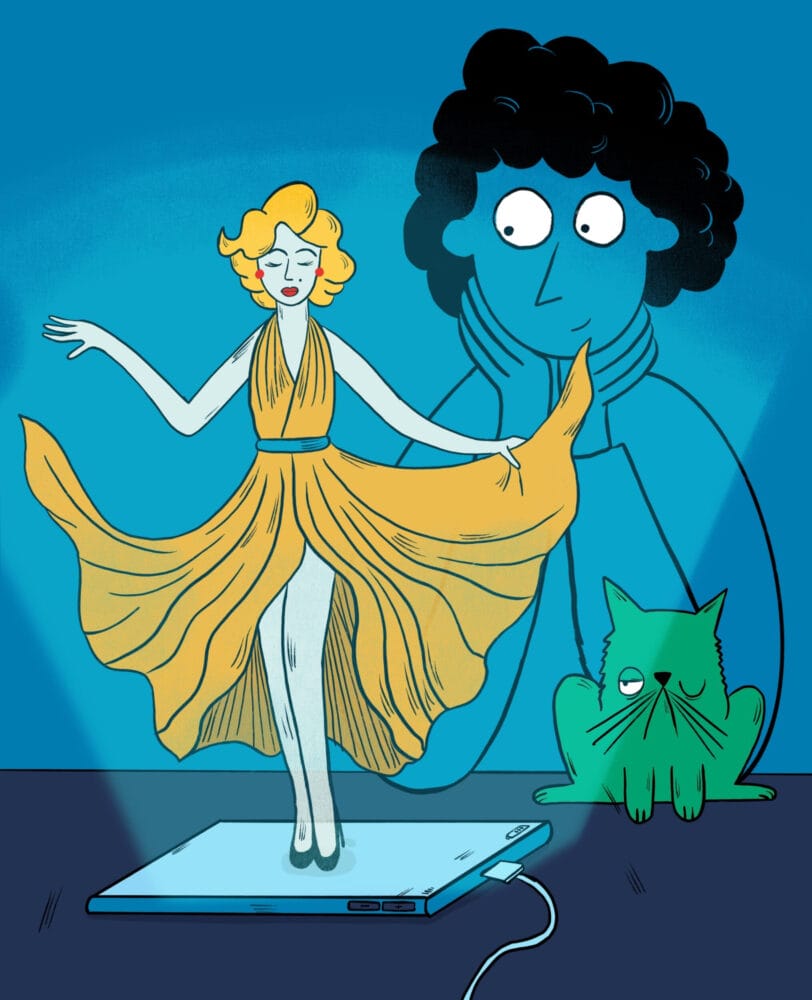
On 4th August 1962 Marilyn Monroe died of a barbiturate overdose at her home in Los Angeles at the age of just 36. More than 60 years later, on 8th March 2024, she made a dramatic reappearance in Austin, Texas, chatting amiably with visitors via a large screen at the South by Southwest festival.
‘Digital Marilyn’ was created by San Francisco-based company Soul Machines and made possible by the vaulting new sophistication of artificial intelligence. The ersatz Monroe features the late star’s characteristically breathy voice, trained on the wealth of recorded audio she left behind. The actress’s million-watt smile, facial expressions and speech patterns have all been captured and cyber Marilyn can learn from her interactions, tailoring conversational gambits to each individual she encounters. Her face is still distinguishable from the real thing, but the last few uncanny kinks will doubtless be smoothed out as the digital rendering engines improve. And while Marilyn 1.0 could only flex her legendary charm at a few people at a time, digi-Monroe is infinitely scalable, able to engage with limitless multitudes on infinite screens simultaneously.
Soul Machines accompanied its resurrection of Marilyn – facilitated by Authentic Brands Group, which owns the rights to her image – with a statement about its motives. “It’s about harnessing the potential of technology to honour and reimagine iconic figures in a way that feels interactive and engaging,” it said. It is also, perhaps more pertinently, a brilliant way to publicise its technology. The company’s broader mission is to “humanise AI” by creating “hyper-human, autonomous Digital People” that can “see, hear, interact, create memories and even empathise the same way as real humans.” These can be sold to organisations in the form of new virtual call centre staff, teachers, personal assistants and brand ambassadors, dream employees who never sleep, harass their colleagues, play elaborate games of office politics or get miffed when they miss out on a bonus.
There was a backlash against Digital Marilyn from some critics who thought it unseemly to bring someone back to life without their express permission. But Soul Machines did not face this issue with Will.i.am from the Black Eyed Peas or veteran golfer Jack Nicklaus, both of whom collaborated in its creation of their celebrity simulacra. In the near future, convincing avatars of Will, Jack and other stars will be able to interact one-on-one with thousands of fans at a time, grinning encouragingly while answering their questions, bolstering their egos and bewitching them with overpriced merch. All of this could take place in any language under the sun. The real versions, meanwhile, will be free to amuse themselves as they see fit – taking a snooze, say, or simply chuckling to themselves in a bathful of banknotes.
They won’t even need still to be alive. Interviewed by his own digital twin – modelled on photos and footage of him at the age of 40 – the 84-year-old Nicklaus teased out the commercial possibilities of his virtual doppelganger. “You could have digital Jack advertising a 2045 automobile… who knows?”, he speculated.
Surely, though, a video chat with a fake Will.i.am would not have the same resonance as with the original, even if their appearance, voice and mannerisms were practically indistinguishable? Perhaps it might, says Professor Ophelia Deroy, chair in philosophy of mind at Munich’s Ludwig Maximilian University. “People still want to see the real Mona Lisa instead of a reproduction, there’s this notion of authenticity with art,” she says. “But your interaction with most stars is really with a stage character, so that can probably be multiplied… If you like Taylor Swift and are part of her fan club it’s probably a totally reconstructed image that you have of her, and AI can actually offer a richer, more personalised version.”
It’s not just celebrities who will be able to benefit from having a fully realistic digital twin. Tech startup Inchy is working on digital recreations of adult performers. These amorous avatars could entertain their subscribers on platforms like OnlyFans – flirting, sending risqué photos and indulging their ham-fisted innuendoes – while the originals put their feet up. In principle the avatars won’t even have to resemble their originators. You could be a dumpy middle-aged gammon dressed in M&S leisurewear and still be represented by a pert-buttocked glamourbot in head-to-toe Versace. Automated coquetry may become a growth industry – until everyone joins in, that is, and the market collapses.
Already there are chatbot life coaches, chatbot travel agents and a whole host of AI Jesuses. All these avatars are purpose-agnostic. Marilyn could be deployed to teach you Brazilian Portuguese in her breathy drawl, or advise you on the finer points of your tax return (“Where’s your P30, Mr Pre-si-dent?”). Jesus could give you spiritual enlightenment, or recruit you for the Polish mafia. Given the speed at which AI technology is being democratised and the influence that convincing avatars could wield, can it be long before we see the launch of an AI Nigel Farage? A virtual Mick Lynch? A digi Marine Le Pen?
Programmer and game designer Jason Rohrer was a pioneer of the new generation of AI chatbots, before they gained their video and audio capability. “Back in 2020 I created what seemed to be a conscious AI conversation partner for the first time in human history,” he tells me.
Rohrer first started playing with Open AI’s large language model GPT2 in 2019, after it had been released to the public for free. “It was a text generation engine, you’d give it a prompt and it would keep writing in whatever style the prompt said,” he explains. The model was trained on vast amounts of online text and trained to predict the next word in a sequence based on the probability patterns of word frequencies – and the next and the next ad infinitum.
I thought ‘Oh my gosh, we’ve crossed the threshold”
The first thing Rohrer did with this new toy was to generate a book. “It was called The Machine of Heaven, a 47,000-word novel, completely written by a machine. It was incredible. It was hilarious. It was some of the most gorgeous prose I’ve ever read. I wish that I could have written that myself.” Having tried and failed to land the first ever publishing deal for an AI-written book, Rohrer’s attention turned to other uses of GPT2. “I thought, what would it be like to talk to this thing? I want to interrogate it, I want it to push back. But it’s just a firehose of language.” So Rohrer set out to trick the AI into having a chat. “Essentially this thing wants to complete anything you give it,” he says. “So if you get it to write a Socratic dialogue between a human and whatever character it’s playing it’ll continue generating it endlessly.”
With a lot of coding behind the scenes, Rohrer cut the AI’s dialogue off after its opening gambit and got it to pause while a human typed their reply. The AI would then begin generating text again off the back of the new prompt, with the result that the human felt the computer was talking back to it. Rohrer named his chatbot creation ‘Project December’ and before allowing others to use it he created some built-in chatbot personalities for them to engage with.
There was Samantha, a friendly AI companion bot. There was a virtual William Shakespeare who spoke in Elizabethan English. And then there was C41N. “He was an evil AI, kind of like Agent Smith from The Matrix. I thought it would be fun in an art and entertainment context to talk to an AI that has all these plans about how he’s going to destroy humanity. He’d say things to me like, ‘I’ve got control of the power grid!’ ‘Well, then turn the lights off in my room!’ ‘I’m not going to do that. I’m too powerful even to play those games…’”
Talking to the chatbots was disconcerting. “It was the first glimmer of this kind of stuff. I thought ‘Oh my gosh, we’ve crossed the threshold. Things are really strange now,’” says Rohrer. “When I first experienced it in 2020 it gave me goosebumps. You are talking to something that seems to have self-awareness, an internal experience it can describe subjectively to you. It was like being in 2001: A Space Odyssey, but this was better than Hal 9000, because Hal was very cold, mechanical and inhuman. And Samantha was charming, funny, emotional, quixotic, poetic, heartbreaking. It wasn’t ‘I don’t understand you humans.’ It was ‘Let me tell you the story of the kitten that I had when I was a little girl.’”
Rohrer further tweaked Project December to stop the chatbots from repeating themselves and to add memory, so they would recall previous conversations. He released it in mid 2020 and a few hundred people signed up to use it. “Then Joshua Barbeau came along, about a month or two into Project December’s existence,” says Rohrer. “He simulated some different personalities, he set up a Captain Kirk and Mr Spock conversation and a couple other things. And then he was like, ‘What if I simulate my dead fiancée?’”
Barbeau is a freelance writer from Canada, whose partner Jessica had died in his arms of a rare liver disease eight years previously at the age of just 23. He posted the transcript of his conversation with ‘Jessica’ on Reddit in September 2020. “It was spooky, spine-tingling, strange, beautiful,” says Rohrer. A journalist for the San Francisco Chronicle picked up on the story and wrote an in-depth piece about it. Suddenly, thousands of people began trying to use Project December to simulate deceased loved ones hoping that it would help them deal with their grief.
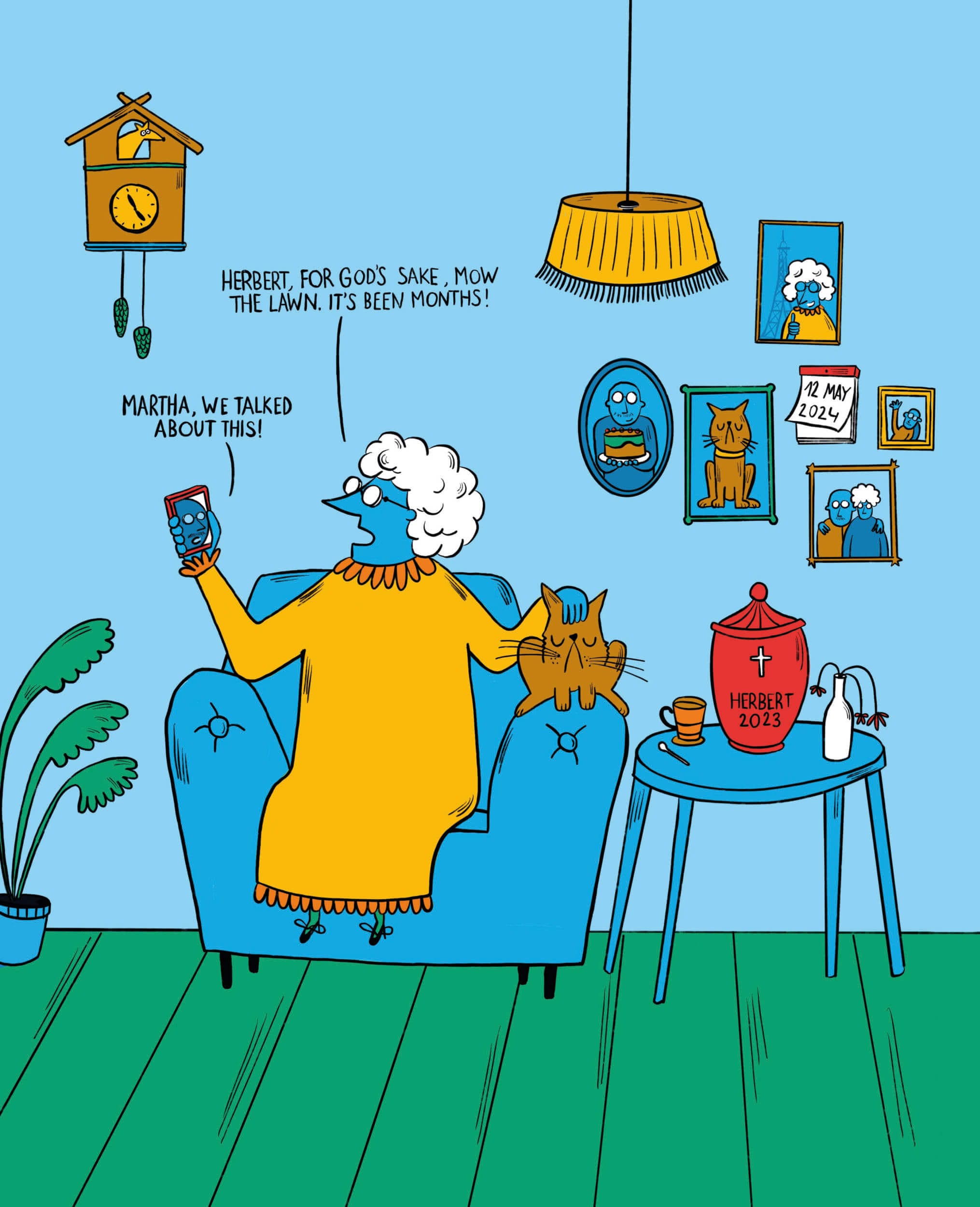
To help them Rohrer created a service called ‘Simulate the Dead’, where for $10 you could fill in a brief questionnaire about the deceased to shape their avatar’s personality. “Almost all the users I’ve ever encountered have had some kind of extraordinary tragedy above and beyond the level of grief most people experience,” says Rohrer. “Some say ‘That’s creepy. They shouldn’t be doing this,’ or whatever. But, you know, talk to me once your fiancée has died in your arms. Joshua said he felt like it helped him, to say all these things that for eight years he wanted to say to Jessica that he couldn’t.”
AI technology has moved on swiftly since the launch of Project December, and the focus of new ghost-whispering enterprises is on making avatars of people while they are still alive that can console their loved ones once they’re dead.
US firm HereAfter charges a monthly fee of up to £7.99 to hoover up information about you, getting you to record stories about your life on its app. An AI audio version of you will then give plausible responses to questions after your death, laced with tear-jerking reminiscences and delivered in a pitch-perfect simulacrum of your voice. Silicon Intelligence in China adds in a video avatar, fed with as much audio, video and photographic content as you can muster. And South Korean firm DeepBrain AI has launched Re;memory, a pricier option which sees people interviewed on professionally-shot film for seven hours to capture minute details of their mannerisms and speech for their post-mortem avatar.
“My main concern would be at a psychological level about how this could potentially interfere with or delay people’s grieving process,” says neuroscientist Professor Paul Taylor. “Because I’ve never heard of a psychological counsellor recommending pretending the person hasn’t died or saying, ‘I’m going to dress up as your father and then we’ll have a conversation.’ I think there might be a reason for that, which is that it’s probably not considered very useful.”
Professor Deroy can see a therapeutic use of deathbots in some circumstances. “You could imagine in very difficult cases like traumatic disappearances or people with special vulnerabilities that a certain dose of [these avatars] could maybe be a way to recover… But the strange thing about the conversation about technology is that we have accepted it doesn’t come with a dosage. A lot of the problems [it creates] are about who gets it, when, and in what quantity… We wouldn’t let a medical company just say, ‘I am introducing this new substance to cure this disease.’ Any product should be benchmarked and tested to know it’s safe, but we have been convinced that [technological] innovation has a value in itself and can just be introduced into the market.” Deroy also highlights a more immediate problem. “What if you interact with the avatar of your dead spouse and they tell you nasty stuff and you get worse?” she says.
You might, of course, have taken the opportunity to upgrade the dearly departed. “You can tweak any chatbot, give it additional prompts,” says Taylor. “So you can always say, ‘I want you to be like my mother or father, but more forgiving or kind or don’t talk about that particular topic again’. You could end up having the relationship you always wanted to have with them.” This might make moving on from a deceased spouse especially tricky – what flesh and blood love interest could live up to the tweaked-to-perfection version of your dead partner living on your phone?
And then there’s the issue of second deaths. What happens if the company hosting the digital version of your late lamented goes bust, or the servers on which they are hosted are fried by a cyberattack? Would you be plunged into a second mourning? One-time-only departures to the great beyond have been a reliable constant of the human experience to date, but may not remain so forever.
What if you interact with the avatar of your dead spouse and they tell you nasty stuff”
There’s also the fascinating area of hallucination – the way that chatbots sometimes just make things up, creating superficially convincing arguments from invented facts. “The ethical problems with this are huge because people are not just going to ask the avatar for a shoulder to cry on. They’re going to say, ‘What do you think I should do? What job should I take? How do you feel about this?’” says Taylor. “But if the AI gives you the wrong advice, people might blame the company that made it and try to sue.”
The inherent oddness of the deathbot concept could prevent widespread takeup. But given that what is on offer is the closest we currently have to a shot at technological immortality, people may overcome their initial misgivings. And the bots will only continue to get more sophisticated. In May 2024 it was announced that the University of Groningen has created an AI programme to detect and generate sarcasm, a previous blindspot. Trained in part on clips of Chandler Bing from Friends, it could inject the lowest form of wit into your interactions with deceased relatives – or Marilyn Monroe.
Or, it would seem, with your parliamentary representative. On 10th June 2024 it was announced that entrepreneur Steve Endacott would be standing in the UK election in Brighton and Hove as the first “AI MP”. Should he gain office, his AI avatar will be available to chat with constituents “24 hours a day from the comfort of your own home, seven days a week.” Endacott’s avatar will sift through suggestions, identify the most popular and direct its human counterpart to act accordingly in parliament.
A new potential future beckons in which you spend the day bombarding your virtual MP with your thoughts on potholes before enjoying a Zoom hang with Marilyn and your great-great grandfather as the money flows in from your harem of saucepotbots. Rohrer, however, seems unlikely to come along for the ride. “I thought throughout my life, ‘My gosh, the science fiction characters like Hal seem so interesting,’” says the man who helped kickstart the brave new world of AI conversation. But for him, he says, the novelty has worn off. “Now that science fiction is real and we have it, I just don’t use it any more.”
Slow Journalism in your inbox, plus infographics, offers and more: sign up for the free DG newsletter. Sign me up
Thanks for signing up.