Moment that mattered: Nahel Merzouk is buried amid riots in France
In issue 52 we spoke to investigative journalist Valentin Gendrot about his time spent undercover with the police
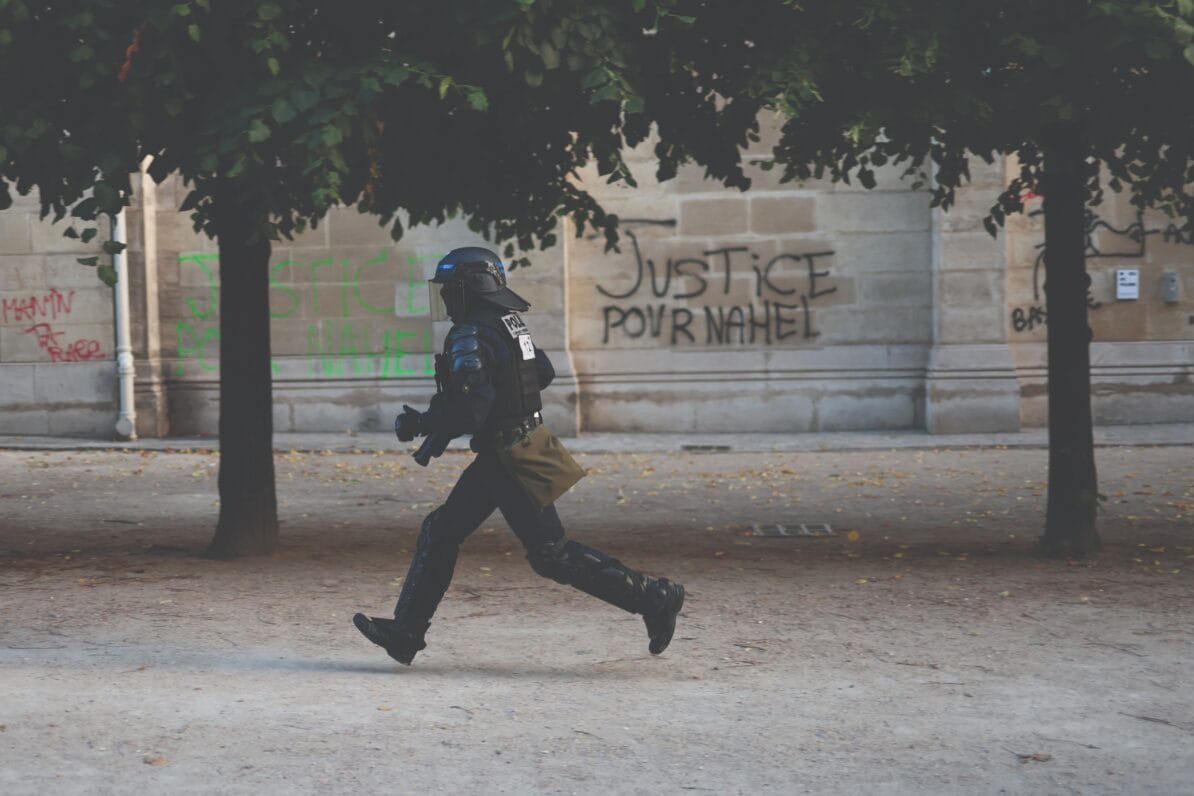
A riot police officer runs past graffiti reading ‘Justice for Nahel’ in Paris. Riots broke out across France over the fatal shooting of teenager Nahel Merzouk at a traffic stop. Photo: Charly Triballeau/AFP via Getty Images
1st July 2023 (Taken from: #52)
On 1st July 2023, Nahel Merzouk was laid to rest in his home town of Nanterre, in the western suburbs of Paris. The 17-year-old, a trainee electrician and keen rugby player, had been shot dead by a 38-year-old police officer, identified only as Florian M, while held at a traffic stop on 27th June. The police said that Merzouk had been pulled over because he looked too young to have a licence and was driving in a bus lane.
I was shocked because a 17-year-old kid was killed by a police officer, but I was not necessarily very surprised”
It was also initially claimed that Merzouk had driven the car at Florian M, who had killed him in self-defence. A video of the incident was uploaded shortly afterwards by an onlooker, however, which appeared to show that Merzouk was in fact attempting to pull away from Florian M and his fellow officer when he was shot at point-blank range. It swiftly went viral.
“Like everyone else I was shocked because a 17-year-old kid was killed by a police officer,” says French investigative journalist Valentin Gendrot. “But I was not necessarily very surprised, because there were more than ten deaths in France last year following refusals to comply with a police traffic stop.” Like the majority of people killed by French police at traffic stops since 2017, Merzouk was not white: a French citizen, he was of Algerian and Moroccan descent.
Gendrot has a unique perspective on the culture of French policing. In 2017 he undertook training to become an adjoint de sécurité (an ADS, the rung below a regular police officer), and became the first ever journalist to infiltrate the French police. “What interested me was being able to tell the daily life of a police officer in a Parisian police station,” he says. He was shocked by what he found.
Merzouk’s death triggered protests across France, which continued for several days after his funeral. Cars and vehicles were set on fire, shops and banks were looted, hundreds of police stations and police officers were attacked and tear gas was fired at demonstrators. Public transport was suspended at night in case trams and buses were set alight. Such was the scale of the rioting that President Emmanuel Macron, who had described Merzouk’s killing as “inexcusable”, was forced to cancel a long-planned state trip to Germany to deal with the crisis.
The national outpouring of rage focused on accusations of police racial profiling and aggression. Merzouk’s mother said that she didn’t blame the police as a whole, but the person who shot him – claiming he “saw an Arab face” and “wanted to take his life”.
Gendrot has first-hand experience of racism and violence within the police. Back in 2017, after just three months of training, he was employed as an ADS, authorised to carry an automatic weapon in public and sent to patrol Paris’s 19th arrondissement. In Flic (Cop), a book about his experiences in the police, he wrote that after a few months on the force, he had seen fellow officers “slam a black immigrant into a bus shelter and then throw him into the police van”, “rough up a Moroccan immigrant” and “slap a number of people in custody, all of them black, Arab or dark-skinned.” “Out of the 32 police officers with whom I worked, there were five who were sometimes violent and racist,” he says. “The other police officers did not exhibit problematic behaviour – except in the sense that they never denounced what they saw.”
There is a demonstrable racist bias in the French police. In 2018 the country’s independent Defender of Rights published a study showing that young men “perceived as black or Arab” are 20 times more likely to be stopped by police than others their age. In October 2023, the Conseil d’Etat court said that racial profiling is often used by police when making identity checks.
There’s also a widespread perception in France that police act with impunity. One of the reasons that the case of Merzouk triggered such uproar was that the killing was caught on film, and could not be covered up. As Assa Traoré, an activist and the sister of a black man killed in police custody in 2016, told one protest, “The whole world needs to see… that when we march for Nahel, we march for all those who were not filmed.”
While undercover, Gendrot observed this impunity in the case of ‘Konaté’, a teenager assaulted by an officer in Gendrot’s presence. When Konaté made an official complaint, the colleagues of the offending officer closed ranks to falsify their testimonies and exonerate him. “When cops fuck up, everyone sticks together,” wrote Gendrot. “The officers feel as though they’re untouchable. As though there’s no chain of command, no supervision by senior officers. As though, based on nothing more than a mood or a whim, an officer can choose to be violent or not.”
Additional blame for Merzouk’s death has been levelled at the French adoption in 2017 of Article 435-1 of the internal security code. It allows for the use of guns ‘in a strictly proportionate manner’ when officers ‘cannot compel to stop, other than by the use of weapons, persons who seek to escape their custody’ and who are ‘likely to perpetrate, in their flight, attacks on their life or physical integrity.’ “When article 435-1 was put in place, it was just after the attacks,” says Gendrot, referring to the terrorist atrocities in Paris in 2015. “There were terrorists in cars in the streets of Paris and the police were looking to stop and arrest them. The law was in part to reassure those police officers.”
Alongside the anger at the police over the killing of Merzouk there was also a backlash against the ensuing riots and support for officers dealing with them. “The scum that we see pillaging stores, setting libraries and town halls on fire, all while laughing, they’re not doing this for Nahel,” said Rassemblement National MP Edwige Diaz. “It’s an excuse to attack the police and everything that represents the republic.”
After Florian M was placed in detention and put under investigation for voluntary homicide, a crowdfunding campaign was started for his family by Jean Messiha, a former spokesperson for right wing presidential candidate Éric Zemmour. The appeal stated that Florian M “did his job and is paying a heavy price.” Within a few days it had raised €1.6 million. Manon Aubry, an MEP from left wing populist party France Unbowed, tweeted that the message being sent by the crowdfunding campaign was that “It pays to kill a young Arab.” Meanwhile, a fundraiser launched for Merzouk’s family raised only €200,000. “The French have very strong opinions about the police, either they love them or they hate them,” says Gendrot. “There are no nuances on the subject.”
While Gendrot recognises the major flaws in the police, he is also keen to highlight the pressures they work under. “It’s a job where little by little your mind turns negative,” he says. “By the end of my undercover work I noticed that my level of compassion was dropping. You can’t have faith in humanity with a job like that, it’s not possible.” He describes a situation in which stressed, overworked, underpaid, undertrained and sometimes traumatised officers operate in an atmosphere of constant violence and hostility.
This, he says, is not conducive to upholding the values of ‘exemplary conduct’ and ‘respect for every individual’ that he was taught at the police academy. “It is fundamental for our society to have the police and it is essential that they feel good in their work,” says Gendrot. However, he says, “They are not well supported and every year 50 to 60 French police officers end their lives. It says a lot about the deterioration of public services in France.” During Gendrot’s own brief time on the force, one of his colleague at the commissariat died by suicide.
When Gendrot published Flic in 2020, it caused some soul-searching in France. An inquiry was launched by the authorities – not into how to solve the problems in the police, however, but into whether the revelations in Gendrot’s book were true. It is still going on, three years after publication.
On 15th November 2023, Florian M was released from custody and is now awaiting a trial which is likely to re-open the divides in French society. In the meantime, says Gendrot, “There are still, unfortunately, news stories appearing in which officers continue to do whatever they like, giving the police a bad name. Setting out to clean up the force could change things – but I’m not very optimistic that will ever happen.”
Cop by Valentin Gendrot is published in the UK by Scribe
Slow Journalism in your inbox, plus infographics, offers and more: sign up for the free DG newsletter. Sign me up
Thanks for signing up.