Moment that mattered: Australia votes against the Voice
In issue 53 we spoke to Professor Megan Davis, Indigenous rights advocate and constitutional lawyer, about losing a divisive referendum in Australia
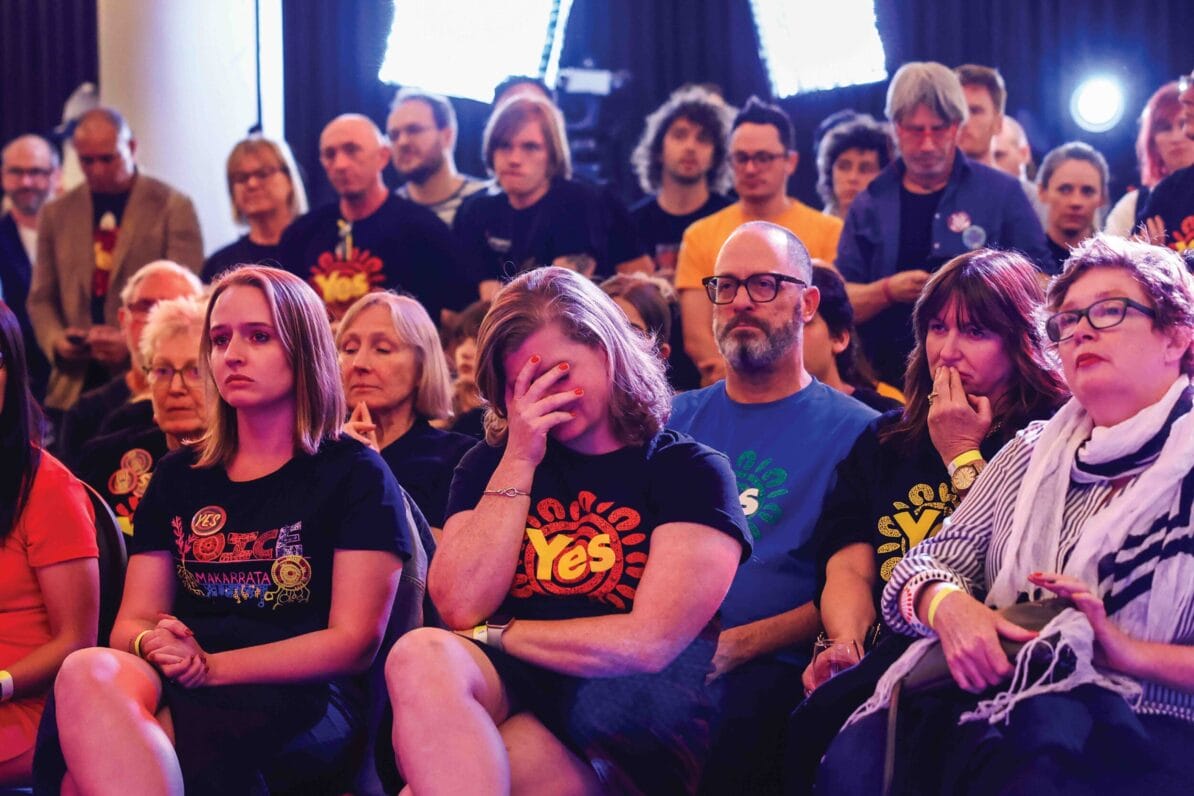
A woman watches a speech by Yes23 campaign director Dean Parkin at an event in Sydney on 14th October 2023 shortly after it became clear that the Voice had been defeated
14th October 2023 (Taken from: #53)
On 14th October 2023 Australians rejected a proposal to change the country’s constitution to create a permanent indigenous advisory body. Six months before the referendum defeat, backing for the Aboriginal and Torres Strait Islander Voice, known simply as ‘the Voice’, had been strong, with around 60 percent of Australians supporting the proposal. But in the heat of a ferocious campaign those numbers were flipped on their head. The Voice was ultimately rejected by 60 percent of voters – 9.4 million to 6.2 million – and in every Australian state.
“For all of us that were deeply involved [in the ‘yes’ campaign] it’s still tough,” says Professor Megan Davis four months later. For the indigenous constitutional lawyer and University of New South Wales professor the Voice was largely about recognition. Australia’s 1901 constitution didn’t recognise Aboriginal and Torres Strait Islander people as the country’s first inhabitants. For years politicians have backed constitutional recognition, but many argued that a preamble recognising indigenous people as the land’s original inhabitants would suffice. For Davis, this kind of symbolic recognition didn’t go far enough. “It had to be something substantive, to change people’s lives,” she says.
As a member of the Referendum Council, established in 2015 by then-prime minister Malcolm Turnbull, Davis and her colleagues consulted indigenous communities across the country to discuss what meaningful constitutional recognition might look like. In 2017 she co-authored – and was the first person to read aloud in public – the outcome of those consultations, the ‘Uluru Statement of the Heart’.
In an August 2023 event in her home state of Queensland, Davis described the Uluru Statement as “a sign of friendship, an olive branch” from a people whose land was invaded in 1770. It called for an independent Voice, the exact shape and function of which had yet to be determined, to advise the government on issues that affected indigenous people, who make up around four percent of the population. Its members would be chosen by indigenous communities around Australia and the government would not be obligated to act upon its advice. “[Indigenous people] want to be at the table when laws and policies are made about our communities,” Davis said. The kind of structural change promised by the Voice, Davis argues, would help close the gap between indigenous and non-indigenous Australians in areas such as life expectancy (indigenous people live around eight years less on average), as well as disease, education, suicide rates (double for indigenous people), incarceration rates (almost a third of prisoners are indigenous) and infant mortality.
The Voice was the first pillar of the Uluru Statement. After constitutional recognition, it was hoped, would come a commission which would supervise a truth-telling process to acknowledge past wrongdoing against indigenous people, as well as a treaty-making process. When Anthony Albanese was elected prime minister in May 2022 he vowed to implement the Uluru Statement in full. But changing the constitution is hard. It requires a referendum that delivers a ‘double majority’ – over 50 percent in the total national vote, and at least four of the six states voting in favour. Only eight out of 44 previous constitutional referendums have been successful, the most recent of which was back in 1977.
For Albanese’s first ten months in office, it seemed the ‘yes’ campaign would cruise to victory. But on 5th April 2023 Liberal party leader Peter Dutton confirmed that his party would campaign against the Voice. Only one of the eight successful constitutional referendums hadn’t enjoyed bipartisan support. “That was the killer, the end,” replies Davis when asked about Dutton’s decision. “The moment he said ‘no’ our 60-40 began to flip the other way. It was definitive in terms of us not succeeding.”
The leader of the opposition wasn’t the only reason the Voice campaign failed. One problem was that many Australians found the proposal confusing, and Davis admits that the argument for the Voice was “difficult to articulate in a simple way”. Moreover, she says that her campaign overestimated voters’ knowledge of the challenges facing indigenous people. “There are huge numbers of Australians who know nothing about the history of Aboriginal people,” she says. “Many don’t know that Aboriginal people are disadvantaged.” While the ‘yes’ campaign struggled to communicate its argument, the ‘no’ opposition had a simple slogan which worked in 1999 when the country held its last referendum, on whether to become a republic. “‘Don’t know? Vote no’”, recalls Davis with a sigh. “That [slogan] always works in Australia.”
Davis worked with Albanese on the phrasing of the referendum question, and the lawyer was dubbed “the voice of the Voice” by the press. The most prominent organisation on the ‘no’ side was Advance Australia, a conservative lobbying group. It called its campaign ‘Fair Australia’ and argued that the Voice “divides Australians by race” and “changes the way the democratic parliamentary system functions”.
Davis rejects the notion that the Voice was divisive and bristles at the argument pushed by Advance that it would be a bureaucratic and inefficient “pet project of the politicians in Canberra”. She says that the Uluru Statement emerged from consultations with people who “don’t have a voice, who never get to speak, who never fly to Canberra.” But was Advance’s message successful? “Oh, absolutely yes,” says Davis, who claims that many voted ‘no’ because it was a vote against politics and politicians, a kick in the teeth for the establishment. “Trust in politicians is at a historic low and that [lack of trust] played out across the country,” she says. “We kept hearing Aussies saying ‘We want to vote yes, but we don’t trust the pollies [politicians]’”.
Davis says that her side “had hope” on the morning of referendum day because “a no vote was inexplicable, right?” Hadn’t she considered that losing was a likely outcome, given the polling? “You just can’t do that when you’re trying to win a campaign, you just can’t think like that,” she replies. “Maybe we were Polyannas but we had faith in the Australian people to understand [the referendum issues]. But the forces against us were just overwhelming.”
Those forces, Davis says, include the “deep money” of the Fair Australia campaign, which received millions of dollars in donations via its wealthy backers at Advance. It also includes what she describes as an “avalanche” of misinformation and disinformation, deployed with a level of viciousness that “blindsided” the ‘yes’ campaign. The Voice referendum, she says, marked the arrival of “Trumpian tactics” into the Australian political system. These included Advance setting up Facebook pages which purported to be neutral news sites while promoting an anti-Voice message and ‘no’ campaigners suggesting that the Voice would lead to non-indigenous people losing their homes as part of future reparations packages [Albanese had ruled out reparations and the Uluru Statement hadn’t mentioned them].
After their defeat, indigenous leaders called for a week of silence and reflection, a time for grieving. “That people who have only been on this continent for 235 years would refuse to recognise those whose home this land has been for 60,000 and more years is beyond reason,” they wrote in a statement. Davis was among the indigenous leaders to pen an open letter a week later saying that a “majority of Australians have committed a shameful act whether knowingly or not.” They also blamed the ‘no’ campaign’s tactics for unleashing a “tsunami of racism” against indigenous people.
Davis describes the aftermath of the referendum as “awful” for her community. “People kept their kids at home for days and days; we wanted them to be surrounded by love and not walking around looking at people and thinking ‘you voted no, you voted no’,” she says. “I think most mob [a term used by indigenous people to identify themselves] went to ground and saw it as a rejection [by wider Australian society].”
What comes next for the defeated campaign? “We keep going,” Davis replies. “We’re back at work now and the leaders are starting to talk. The 6.2 million [who voted ‘yes’] are saying, ‘What can we do?’”
“The Uluru Statement is for all time,” she continues. “It doesn’t stop because we got outplayed in terms of campaign politics… The difference between the [referendum] campaign and the Uluru movement now is that we now have over six million Aussies with us… Next time we’ll be much more organised, with a lot more allies. That’s the positive [outcome] of this, that we’re no longer alone.”
Slow Journalism in your inbox, plus infographics, offers and more: sign up for the free DG newsletter. Sign me up
Thanks for signing up.