
A picture of health
The government came to power declaring that “the NHS is broken” and set itself the mission to build a health service “fit for the future that is there when people need it, where everyone lives well for longer.” Thea Stein, chief executive of independent healthcare think tank the Nuffield Trust and former CEO of Leeds Community Healthcare NHS Trust, talks us through the state of the health service that Labour has inherited – and the challenges it faces in achieving its goals
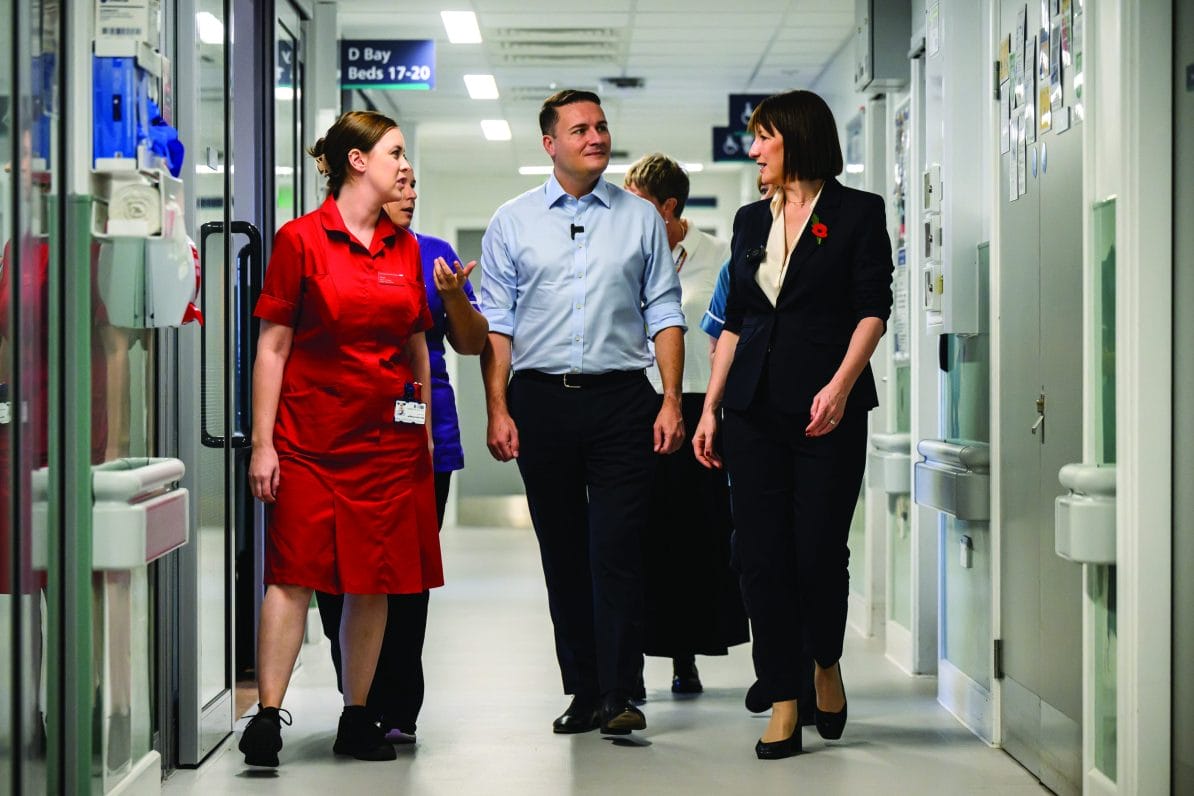
Chancellor Rachel Reeves and health secretary Wes Streeting speak with staff members as they visit St. George’s Hospital in London, 28th October 2024
5th Dec 2024 (Taken from: #57)
How has the NHS changed since the end of the last Labour government in 2010?
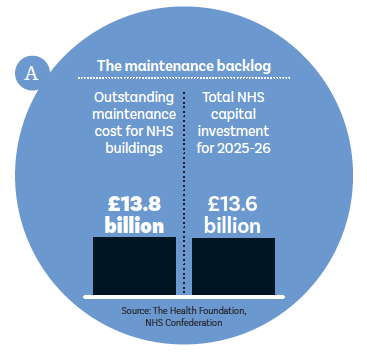
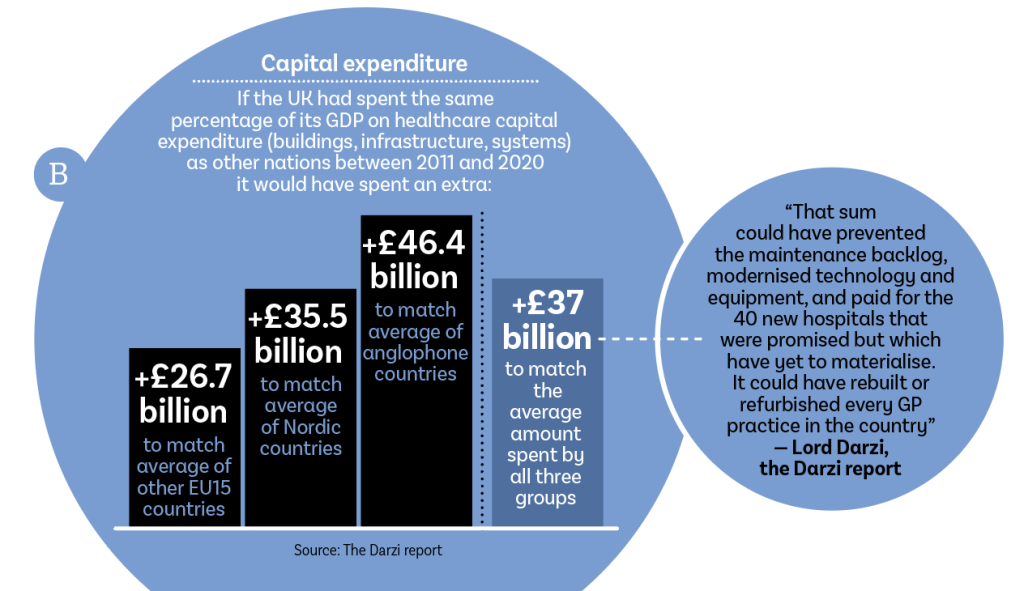
Thea Stein: The government has inherited an NHS where buildings are slowly collapsing (A↓) and admin and tech systems don’t really work. It is under pressure because spending has not kept pace with the demands made of the service (B↓). We have new technologies and new drugs that have become available since 2010, which is normally greeted as good news but which, on the flip side, is another cost for health services to accommodate. We also have growing problems with the impact of inadequate social care.
In addition, the Darzi report [an in-depth study of the NHS written by surgeon and academic Lord Darzi], which this government commissioned, draws particular attention to the reforms of former Conservative health secretary Andrew Lansley, especially the Health and Social Care Act 2012. Among other things, the act radically restructured the NHS and attempted to improve efficiency and reduce costs through marketisation and commercialisation of services. It’s now widely agreed that the Lansley reforms didn’t achieve those goals and were in fact very disruptive to the health service’s architecture.
While management systems and service structures aren’t necessarily what people experience directly when they access the NHS, if a lot of staff are spending time moving around the system [because of the restructuring] and thinking about whether they’ve got a job or who’s got power and who hasn’t, then it means they don’t have time to focus on what most people working for the NHS want to do, which is to make services and people better. In this way the Lansley reforms were very dysfunctional and we are still dealing with the legacy of them today. And then, of course, there was the pandemic…
How big an impact did the pandemic have?
Anyone who worked in the NHS during the pandemic, as I did, knows it was the most extraordinary of times. It was very stressful, very overwhelming. What I think you still see now among NHS staff is really a trauma response – people who maybe worked in a care home and saw 25 people die over a weekend or who worked in wards where a large number of patients were leaving in body bags. Staff who wanted to go the extra mile, do the extra shift but who were also scared, who saw friends die and saw a lot of suffering.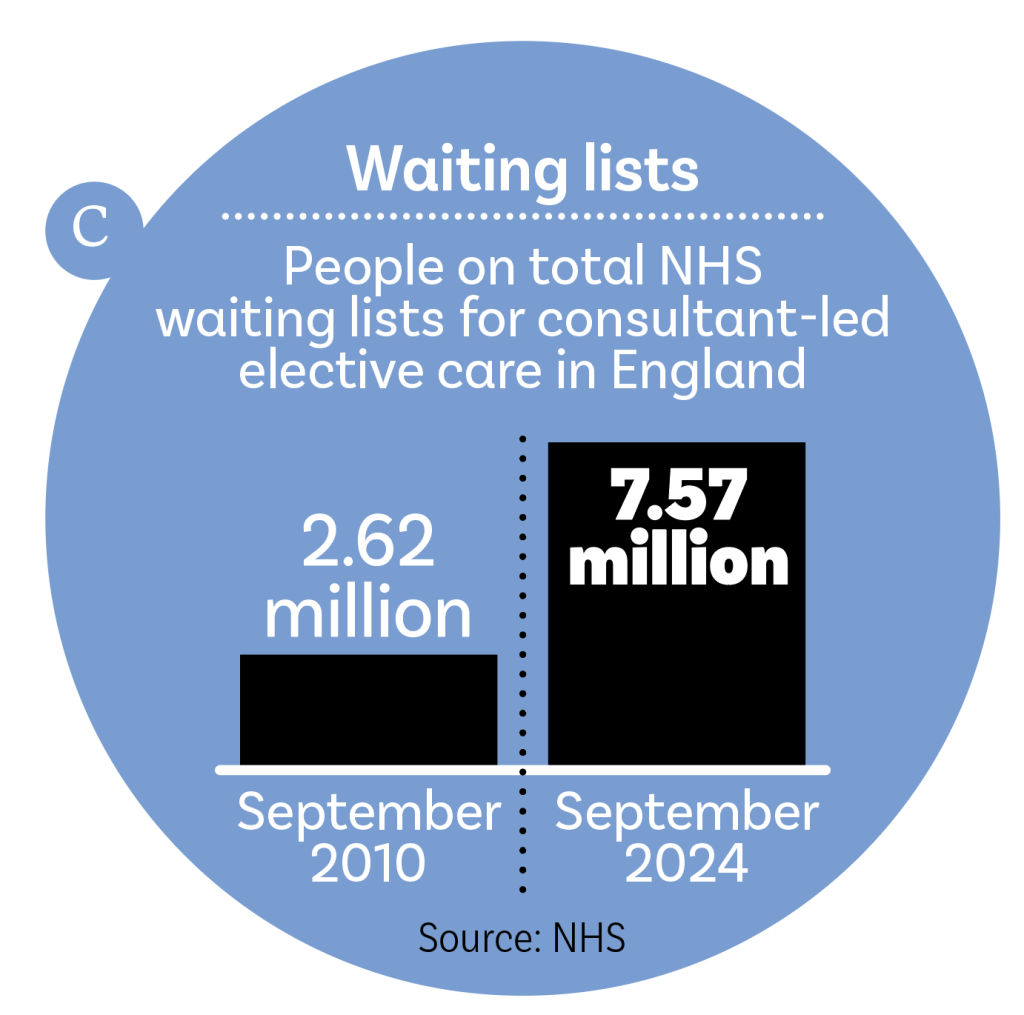
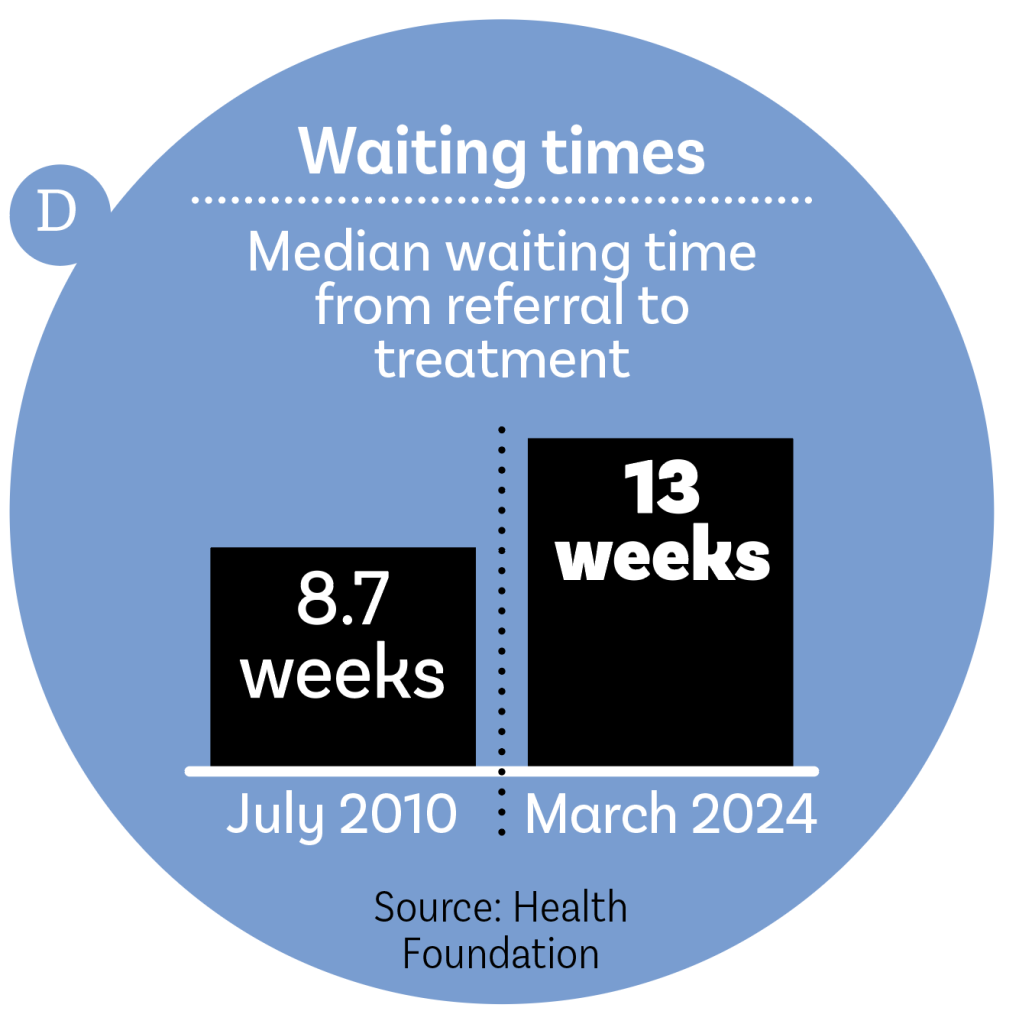
So there’s the issue of how the pandemic has affected staff and their morale but then there’s also a direct practical impact. Following the pandemic, the English NHS has been slower to recover than many other European healthcare systems. The backlog of care (C↑) and delays in treatment (D↑) that we’re seeing now have been partly created by the fact that we shut down so many of our services.
Why has demand for NHS services increased?
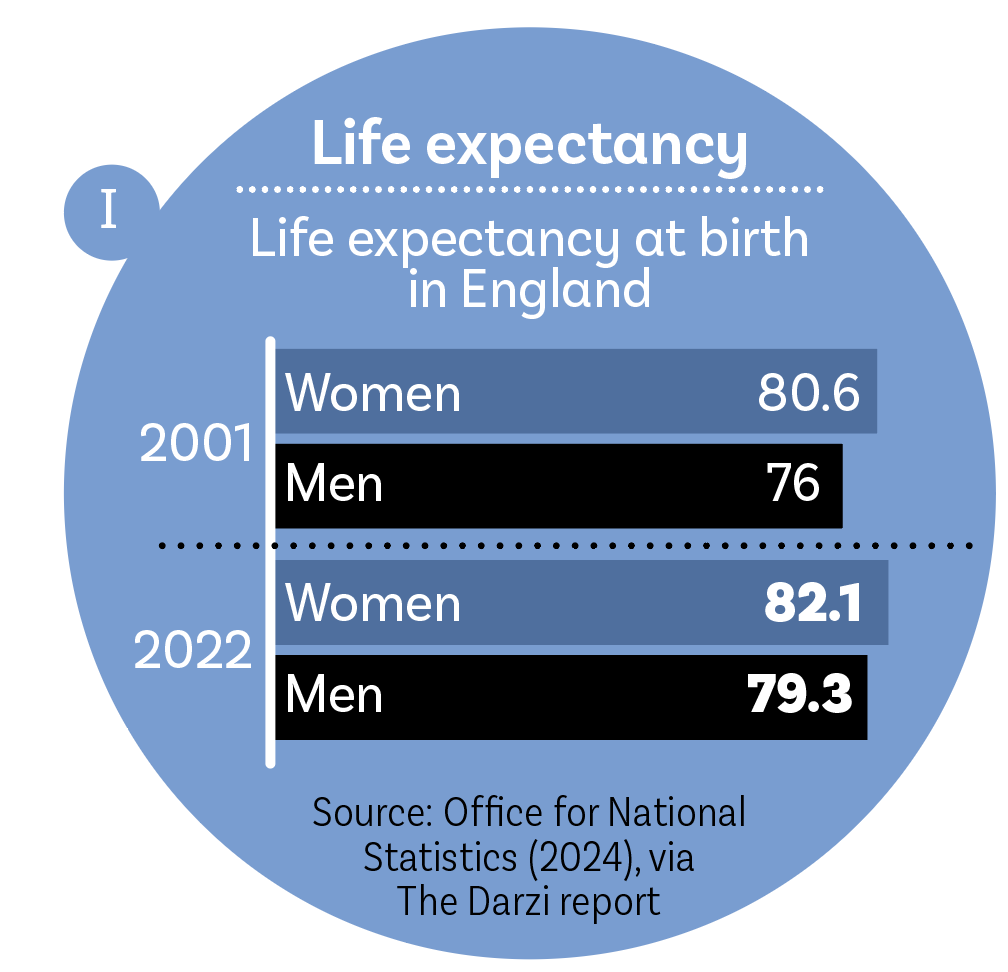
The good news is that we are living longer. The bad news is that we are spending more years of our life in bad health, we are adding years to life but not adding life to years. More and more people – particularly those living in poverty, because poverty creates illness – will live longer but with more complex healthcare needs and poorer health for longer periods. There are other pockets of demand, like illnesses we used not to be able to treat that we now can, but the aging and growing population is a significant source of the increase.

Ambulances queue outside the accident and emergency department of the Bath Royal United Hospital on 16th February 2024
Is the NHS in crisis?
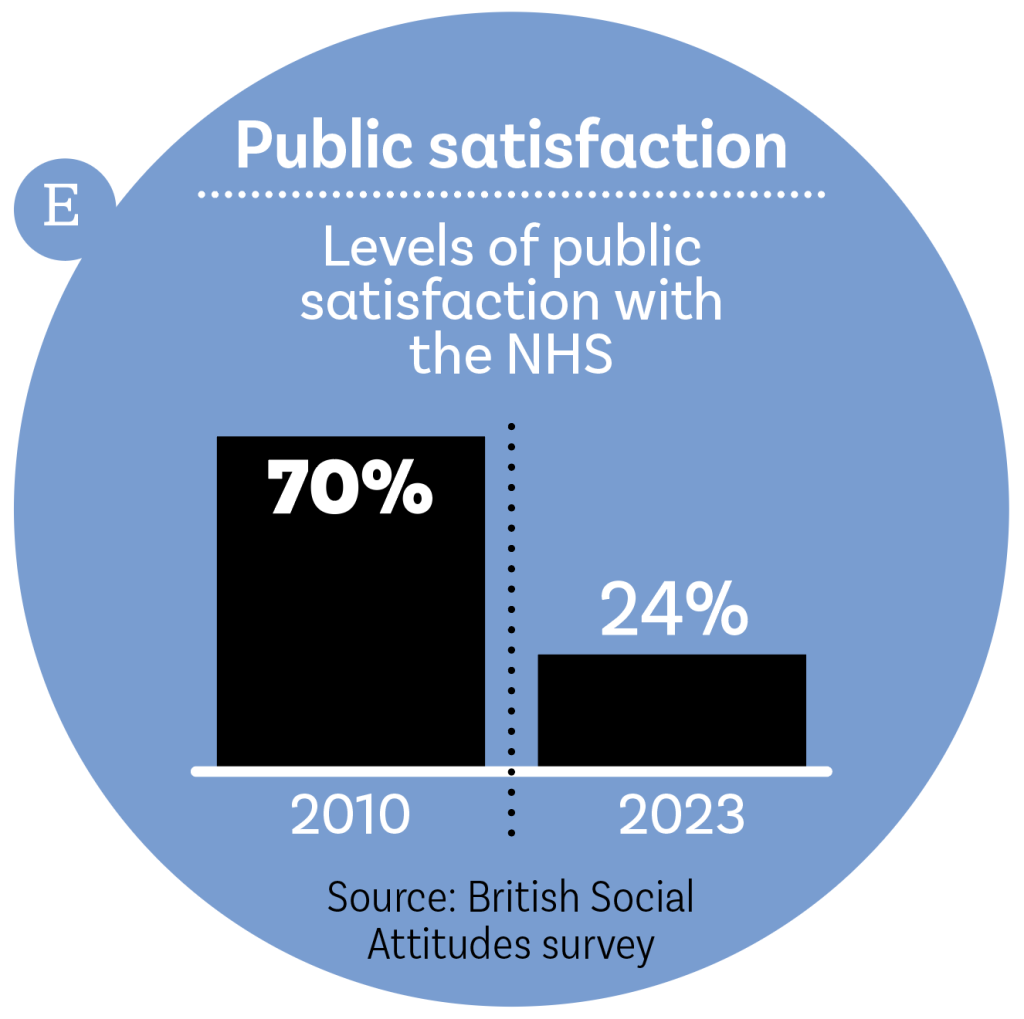
Public satisfaction with the NHS is certainly the lowest it’s ever been (↑E). When we look at the data, what the public is saying is that it’s about waiting lists, access to a GP, perceived staff shortages and the feeling there isn’t enough money – often understood in terms of the poor state of buildings, digital infrastructure and so on.
But ‘crisis’ is a very emotive word. Is the NHS in a period of intense difficulty and challenge? Yes, without a doubt. We could call it a crisis. Essentially, what the public are saying is that some of the basics aren’t there. And we can talk about fancy, complicated and sparkly solutions but fundamentally what they are talking about are basic expectations of the health service: “My experience seeing a GP wasn’t so good” or “My experience of taking my grandmother into A&E was bad.” Obviously, that’s very concerning.
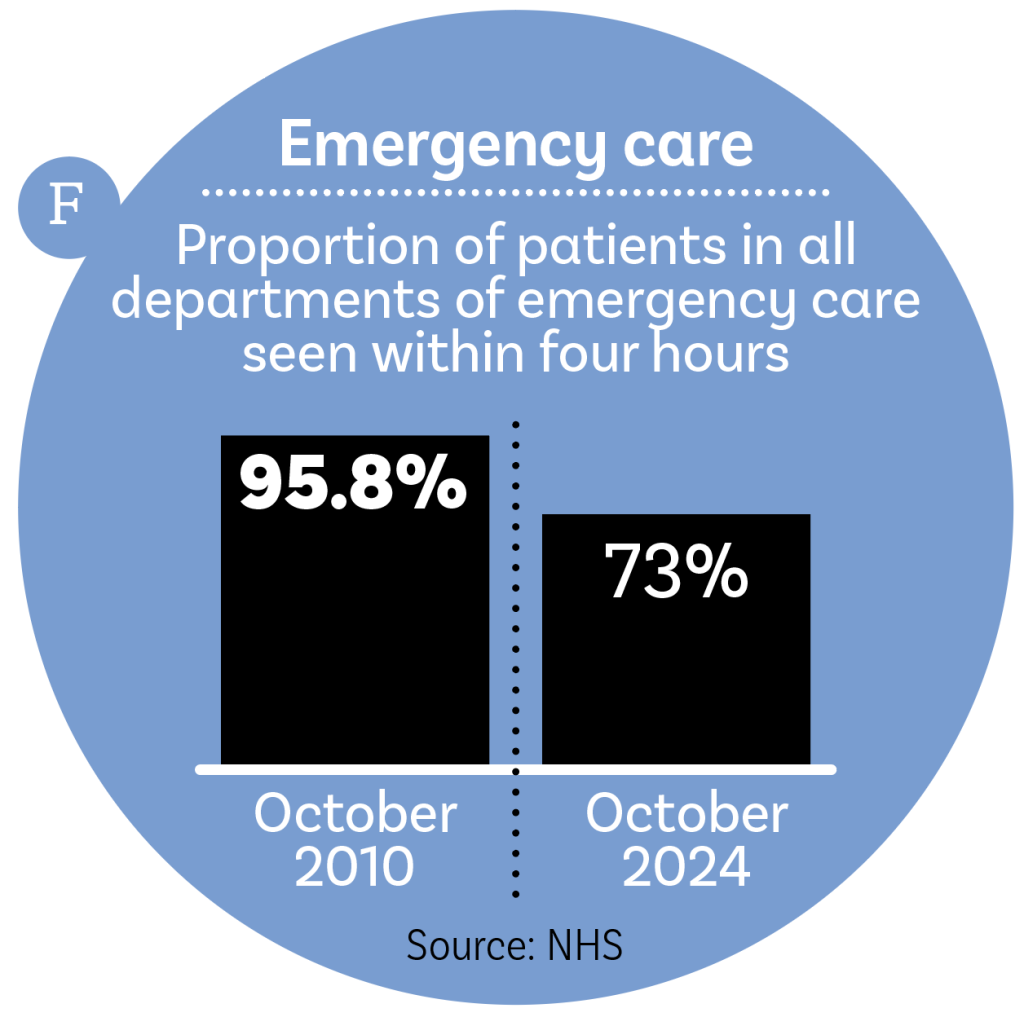
A lot of media attention has been given to problems in A&E (F↑). Is this the area of the NHS we should be most concerned about?
Imagine you can see an A&E department from the point of view of a drone flying above it, you can see all the stories unfolding below that led to these crises and to these people coming here.
If you just focus on the A&E department and that proximal relationship to the ambulance dropping someone off then your attention probably isn’t in the right place. We need to look at why that elderly, frail person is in that ambulance. What happened that meant no one noticed the deterioration in the patient? Why did no one look at the fact that she was living in a house with no heating so she was really cold? If you do that then you end up uncovering the roots of the problem… inadequate funding of community services, the mental health crisis and so on.
Between 2010 and 2024 there has been a rise in the number of clinical staff working for the NHS but a decline in outcomes in several areas including wait time. Why is there such a big productivity gap?
The first thing to recognise is that there definitely is a productivity gap – it is real, the reasons for it are complicated and no-one has a definitive answer.
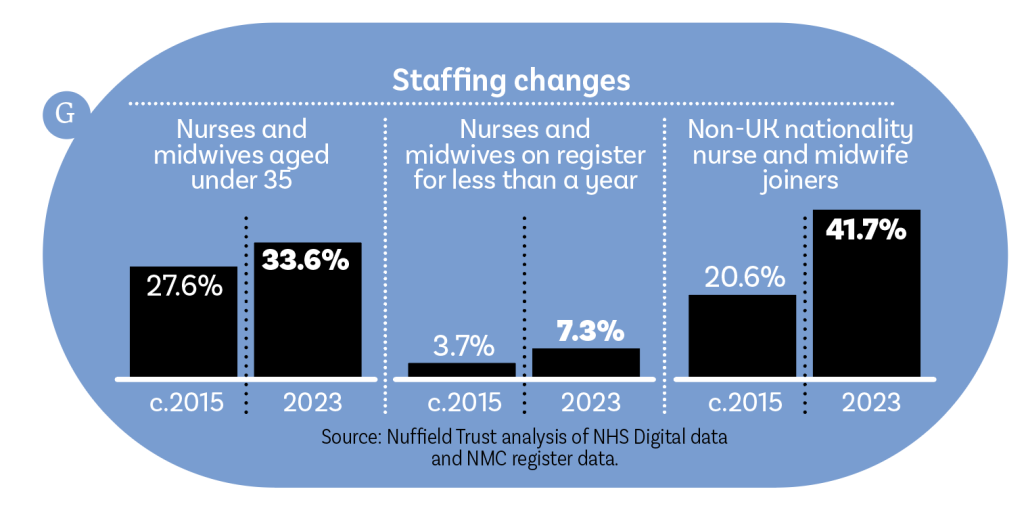
One potential driver is the long term lack of investment in systems in comparison to our peer nations, meaning that technology and digital systems aren’t being spread and embedded as quickly or as well as they could be. There is low morale, not just because of pay but because of working conditions, a fact which has been reflected in a series of strikes which have reduced productivity. It’s interesting, too, that if you look at the make-up of the NHS workforce in 2023 compared to 2015, the workers are younger, they have less experience in their roles on average and a much greater number of them are of non-UK nationality (G↓).
Then there’s what sociologist George Ritzer called the ‘McDonaldization of society’, in which in order to gain efficiency, people are given one repetitive task to do over and over again. You can see something similar in the NHS. If you look at somewhere like Austria or Italy there is a far higher number of doctors and nurses on wards, who will see care of patients through from start to finish. We have more healthcare assistants, more physio assistants, more different types of roles, each focusing on one area. That’s not necessarily bad, but we haven’t really understood what it means in terms of the impact on productivity.
What I do want to stress, though, is that much of the NHS hears the productivity debate as a rebuke that they are lazy and that is not a good starting point to build on. These conversations need to be had in the right way to allow people to be heard. That’s the case for everyone but in particular for the NHS where I think there’s a feeling that the conversation has moved very quickly from “You’re all heroes” [during the pandemic] to “You’re not being very productive.”
What is the impact on society when public health services aren’t operating as well as they should?
Let’s turn this question on its head. The NHS is dealing with the failure of other public services and the effects of poverty. We already talked about the elderly woman who ends up in A&E because she is cold. But there are many people accessing health services today because they live in terrible housing, they are malnourished, they have no work and the stress they have is so overwhelming, because they are living on benefit levels that are hard if not impossible to exist on. So I would say the NHS is partly in the crisis it is in because it is where people come when they are suffering from the effects of poverty.
The government has pledged to build an NHS that is fit for the future. How is it doing?
It’s too soon to judge. It does appear to be committed to the right goals, but then governments that came before it have been as well. We will soon see if it can find the investment, the focus and maybe the political bravery to do what needs to be done. It has made a commitment to reduce waiting times a centrepiece of its strategy. Of course, meeting the waiting times target would be fantastic for patients, but it doesn’t sort everything else out. There will still be problems with primary care, with people’s concerns about seeing a GP, with a lack of sufficient mental health services and so on. One thing that really worries me is the government’s decision to delay reforms to social care to the second parliament.
There are certainly no silver bullets for the NHS’ problems. Above all, there’s a need to get back to boring basics and to get those right. To have apps and tech that work, to mend buildings, to send out letters on time and to listen to and support staff. The basics should be the focus.
Can the NHS function at the level of health services in other developed nations without a radical reformulation of how it is funded?
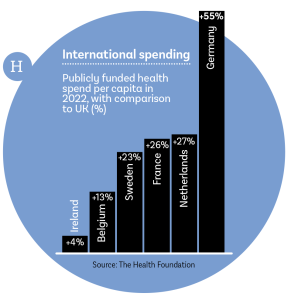
The short answer is yes. Other countries, like Germany and France, took a different approach several decades ago. We don’t have examples of countries that have changed wholescale from a Bismarck system [a social health insurance model] to an NHS-type system, or vice versa, and it would be remarkably dysfunctional to try and do something like that right now. Would we be in a better place if we’d started out with a different system? I don’t know. It’s likely just a different way of cutting up the same cake and we don’t have a counterfactual. What we do know is that every health care system in the world is having to top up funding in one way or another and dealing with the challenges of a shrinking working age population, high cost of drugs and so on.
Finally, it’s worth noting that most other western and anglosphere countries are spending more money on health services than we are in the UK right now (H↑). The bottom line is that changing our system wouldn’t solve the problems: we just don’t spend enough money on the health service in this country. Another thing that seems to be particularly difficult in England is long-term planning – there’s a lot of chopping and changing, short-termism and political football. When you look at countries that have achieved sustainable change in health care, like Denmark, they made a plan, got cross-party agreement and stuck to it.
What do you make of the abolition of NHS England [announced on 13th March 2025]?
The news will be devastating for staff at all levels of NHS England, and we must remain mindful of the human cost of this decision. With the public finances under extraordinary pressure it does, however, make sense to remove the duplication and bureaucracy that exists currently – and patients and the public are probably not going to shed many tears over the shifting of power from an arm’s-length body into central government.But profound problems facing the NHS remain: how to meet growing patient need in the face of spiralling waiting lists and how to invest in care closer to home with the NHS’ wider finances already underwater and social care reform in the long grass. It is not immediately clear that rearranging the locus of the power at the top will make a huge and immediate difference to these issues, which ultimately will be how patients and the public judge the government. And the government should be careful that this doesn’t lead to even more top-down micro-management of local services from Whitehall, which has been the bane of the health service.
What are the positives about the NHS?
The NHS is its people. Even at the worst times the NHS staff are extraordinary and mostly provide outstanding care from birth to death (↑I), 24 hours a day, 365 days a year, despite all the problems.
Slow Journalism in your inbox, plus infographics, offers and more: sign up for the free DG newsletter. Sign me up
Thanks for signing up.