Inside DG #56: Dead popular
A Q&A with the Paraguay-based writer of our story about the cult of San La Muerte from issue 56 of Delayed Gratification
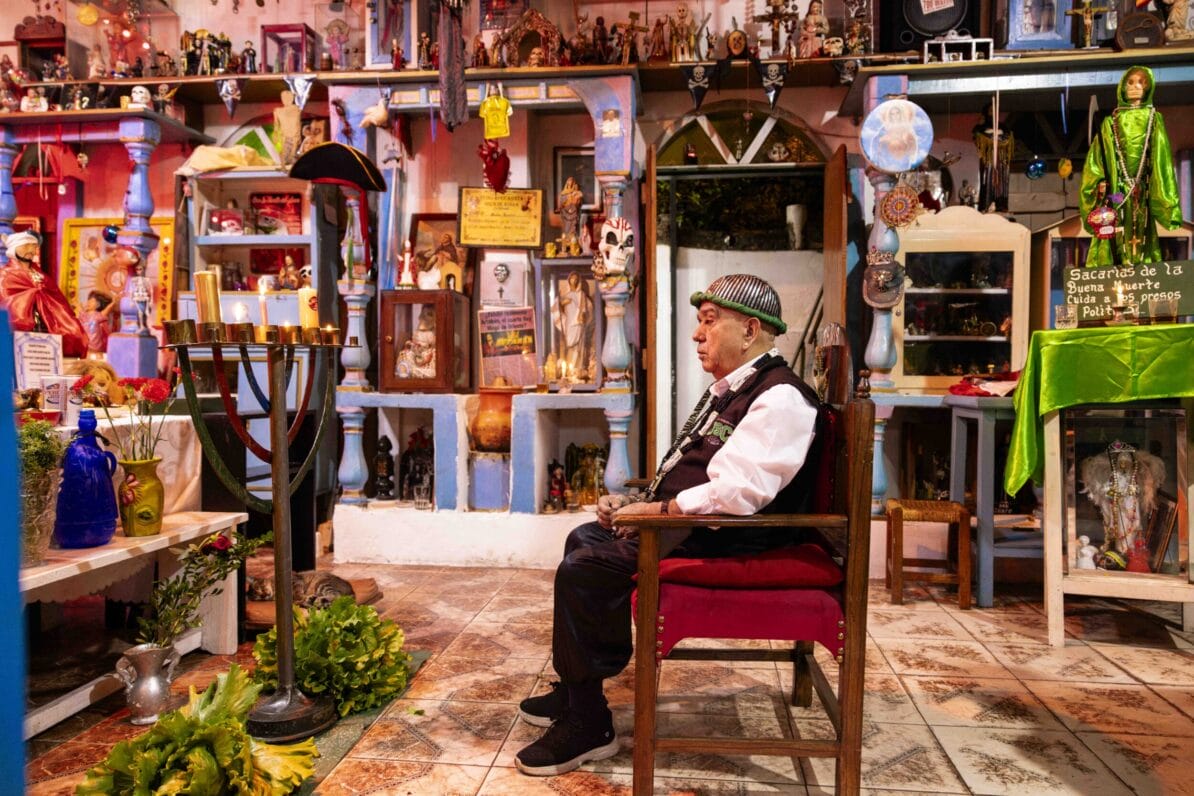
The 56th issue of Delayed Gratification features an article by Laurence Blair about the rapidly growing cult of Saint Death in Latin America. Laurence lives in Paraguay, and for his article he travelled to the outskirts of the capital Asunción to meet Nicolás Benitez (pictured above), the charismatic leader of the local San La Muerte congregation, to try to understand why a mix of indigenous beliefs, Catholic theology and pop astrology was proving irresistible to so many. Here, Laurence speaks to Delayed Gratification‘s Matthew Lee about writing and researching the article.
Matthew Lee: In a nutshell, what is San La Muerte?
Laurence Blair: San La Muerte is a folk saint, popular across Latin America, that looks like the grim reaper. But rather than interceding with God, he directly grants prayers in the here-and-now. He can protect believers from their enemies, lure customers to their businesses and even make people fall in and out of love. The cult, which is frowned upon by the mainstream Catholic Church, dates back centuries but has exploded in popularity in recent years.
What initially sparked your interest in San La Muerte?
I’d heard about the predominant Mexican version, La Santa Muerte, who is so closely associated with violence and drug cartels that she’s often dubbed a “narco-saint”. So when friends mentioned that a local variant existed here in Paraguay, I was determined to check it out. I read some academic and anthropological analyses of the cult, but I was more curious to find out how it started and what kinds of people were drawn to the embrace of el santito.
Were its followers and practitioners happy to talk openly with a journalist? Did you feel comfortable?
I felt a bit of trepidation showing up out of the blue, but they were incredibly hospitable. I came back twice, stayed the night during the August festival, and freely interviewed over a dozen devotees. Javier, Nicolás’s adopted son, was very open about the time he’d spent in jail on drug charges, and how his shrine to San La Muerte kept him strong. They seemed grateful to have a chance to set the record straight: most insisted they were law-abiding Catholics. But I think Nicolás, who used to be a professional dancer, also relished the attention: religions thrive on publicity, after all.
We hardly ever hear about Paraguay here in the UK. Is it being unfairly forgotten or ignored?
I’m biased, but I think so! Paraguay is the size of Germany, a major supplier of drugs and food to the world, and is seriously intriguing. It’s home to the Ayoreo, the Americas’ last uncontacted people outside the Amazon. And its links with the UK go back centuries, including the British engineers who defended Paraguay in the deadly War of the Triple Alliance (1864-70). I try to address this deficit in my new book Patria: Lost Countries of South America, an alternative history of the continent. And I’m working with local colleagues to bring more news to English speakers via a new outlet, The Paraguay Post.
You can read the full feature by Laurence Blair in issue 56 of Delayed Gratification, available from our online shop here.
Slow Journalism in your inbox, plus infographics, offers and more: sign up for the free DG newsletter. Sign me up
Thanks for signing up.