Inside DG #54: Colombia’s ‘false positives’ scandal
A Q&A with the journalist who wrote a story about a Colombian scandal in issue 54 of Delayed Gratification
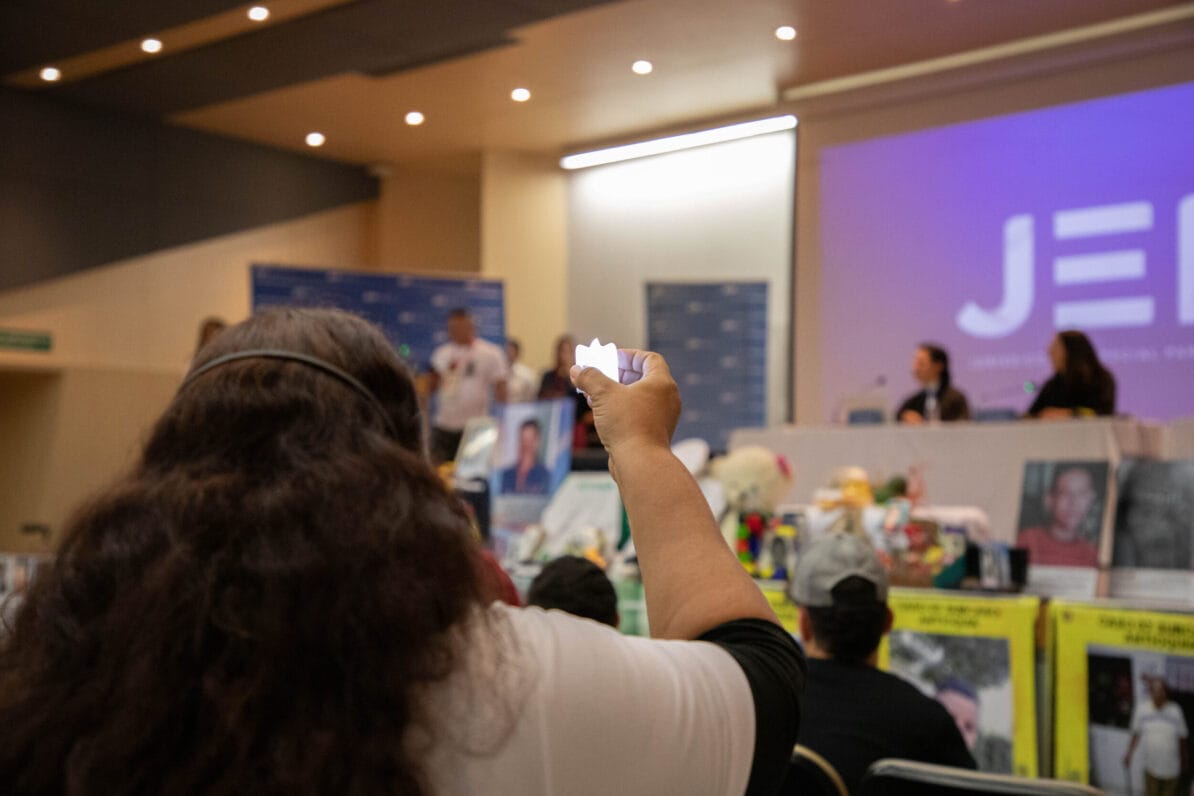
Bertina Badillo, whose nephew was killed and framed as a 'combat kill' holds up a candle at the JEP peace tribunal
The 54th issue of Delayed Gratification features an article by Emily Hart about the ‘false positive’ killings in Colombia, which saw innocent citizens murdered by soldiers during the country’s civil war in exchange for cash rewards and promotions. We spoke to Emily about her reporting from Colombia.
DG: Why were you keen to write about the ‘false positives’ scandal?
EH: This is an unfinished chapter – and an open wound – in Colombia’s history. Though the original crimes were committed more than a decade ago, bodies are still missing, the dead are still defamed, and justice is still a long way off for so many of the victims. And the scale and details of this tragedy are a wave which just keeps on breaking: with the first sentences for perpetrators came an opportunity to tell this story as we know it now – a much bigger, bloodier, more systematic tragedy than could have been guessed from its first revelation in 2008.
And there’s just not enough recent reporting on the ‘false positives’ in English – I am (as always) extremely grateful to Delayed Gratification for giving space to stories like this one – and 13 pages of it!
You heard several deeply moving and tragic stories while researching this article. Is there a single conservation you had that particularly sticks in the mind?
There are so many conversations which lie just underneath and at the borders of this article, too many to fit – stories which make your chest hurt. Dulcelina, whose two teenaged sons were murdered; Andrey, whose father was killed when he was a small child… But one conversation in Yopal, Casanare, with a man named Jacobo has really stuck with me. A softly-spoken middle-aged guy, he is one of very few survivors of these attacks. Before he was attacked, he was a local politician, a community leader. He was shot one night while driving – he didn’t then know who by. He ran into the jungle, bleeding and with the bullet still in his back, and hid there until dawn, hearing men hunting for him all around.
He emerged in the morning to find an army battalion. Thinking he was saved, he went with them in their truck, but realised they weren’t taking him into town to hospital, but driving further into the countryside. The military were taking him to a faked battlefield in order to leave him for dead, and then claim him as an insurgent – a combat kill. A call [to the military] from a friend in local law enforcement, who had realised Jacobo was missing, saved him, deus ex machina, and he was finally taken back down to hospital in town.
He survived, but it ended his life as he knew it. He showed me his scar. He still has the bullet in him, lodged less than a centimetre from his spine.
Reporters Without Borders describes Colombia as one the most dangerous countries on the continent for journalists. Have you faced any challenges, restrictions or threats when reporting on the alleged corruption and violence of former officials?
Bertina, Magdalena, Ninfa, and Nancy are just some of the women I met who face repercussions for storytelling – all of them have been threatened for reporting their own stories and the stories of the loved ones who were ripped away from them. In Colombia, as in many countries, white European foreign correspondents (like myself) enjoy a lot of privilege and protection, especially compared to local journalists and community activists, who do face very real and immediate risks from officials, business interests and armed groups.
Can we be hopeful that these campaigners for justice will one day be successful at holding the perpetrators of the false positives scandal to account?
Whether or not [former president Alvaro] Uribe or [former army chief Mario] Montoya ever face repercussions under criminal or international humanitarian law depends on so many factors – some of them so hard to control or predict that I’m hesitant to feel optimistic on that front.
But this work has left me with a sense of the remarkable diversity of people’s desires and definitions when it comes to justice. Definitely some want to see Uribe behind bars, but others just want to be heard, to clear their relatives’ names, to speak face to face with perpetrators, or to make sure this never happens again. Some of those types of justice are being achieved in parts of Colombia – and there’s real hope in that.
You can read the full feature by Emily Hart in issue 54 of Delayed Gratification, available from our online shop here.
Slow Journalism in your inbox, plus infographics, offers and more: sign up for the free DG newsletter. Sign me up
Thanks for signing up.