Too much skin in the game?
Melanoma, the most deadly form of skin cancer, is on the rise, with cases rocketing by almost a third in the last decade. Encouraging data released in June 2024 about a new vaccine offers hope for the future. But with nine in ten cases entirely preventable, could a new attitude to the sun offer a quicker solution?
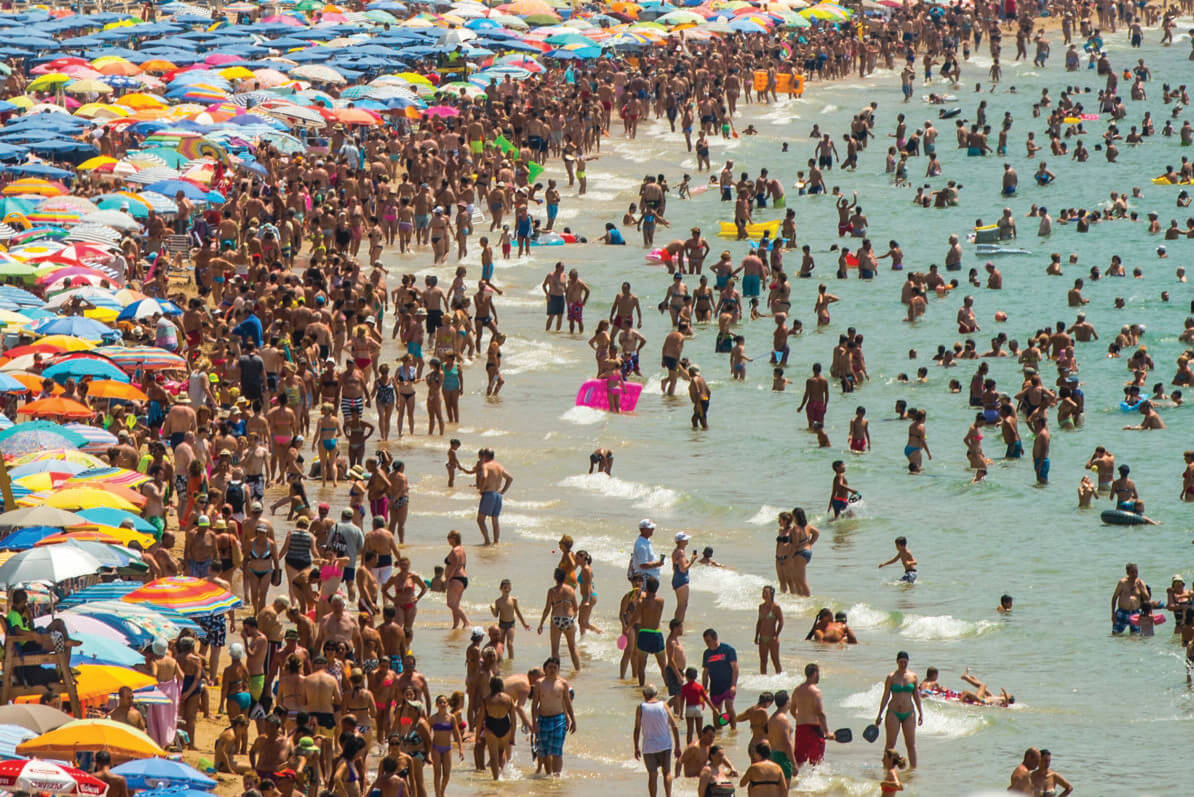
People sunbathe at Levante beach in Benidorm, Spain. The World Health Organization estimates that cases of melanoma, the most deadly form of skin cancer, are up by nearly 50 percent worldwide over the last decade, with 90 percent of them avoidable
When my phone appointment with the specialist was abruptly changed to in-person and I arrived to find a nurse standing in eye-contact-avoiding silence in the corner of the consultation room, I was pretty sure the news wasn’t going to be great. And so it proved. Tests done on the mole removed from the top of my ear had revealed, I was gently informed, the presence of malignant melanoma – the deadliest form of skin cancer.
Two things would need to happen as soon as possible: a segment of my upper ear around the excised mole would need to be removed in case cancer cells were also present in the surrounding tissue. And I’d need a sentinel node biopsy in my neck.
Think of the body’s lymphatic system as the UK’s road network, and melanoma as a group of aimless but diligent hitchhikers. In my case, it transpired, they had been standing at the roadside with their thumbs out for quite some time. We were going to check the nearest services; discover them there, and I’d instantly move from Stage 1b to the more critical Stage 3.
My two-part “slice and dice”, in waiting room parlance, was booked for three weeks hence. “Try not to worry. You should be fine,” said the consultant, a touch less emphatically than I might have hoped.
On that discombobulating Tuesday morning a couple of summers ago, it came as scant reassurance that the emotional rollercoaster onto which I suddenly found myself strapped is an increasingly crowded one. As everyone involved in my subsequent treatment, from nurses and consultants to surgeons and dermatologists, made clear, melanoma is on the rampage.
Last year, record rates in the UK were reported in a string of news articles from the likes of the Guardian, Times and BBC. In May this year, the very same articles could have been lifted verbatim – with only the figures revised upwards. An unprecedented 20,800 melanoma cases will be diagnosed in the UK this year, according to Cancer Research UK – claiming the lives of 2,300 people, or 44 a week. In the decade to 2019, the number of cases in this country rose by almost a third, from 21 per 100,000 to 28.
Globally the increase has been even more stark. The World Health Organization estimates that melanoma cases are up by nearly 50% worldwide over the last decade, to more than 287,000 per year. Baked in, to use an apposite term, is another 62% increase by 2040 to nearly half a million, according to patient support and advocacy group Melanoma UK. This, as things stand, will result in more than 105,000 deaths annually. The disease, the organisation concluded, has “reached epidemic proportions”.
“We’re not going to see anything other than case rates rising over the next 30 years,” says Brian Diffey, emeritus professor of photobiology in dermatological sciences at Newcastle University and one of the country’s foremost experts in the field.
Covid was manifestly disastrous for cancer treatment across the board. An abyssal drop-off in patients presenting with melanomas was one symptom of this, ultimately leading to backlogs, more serious cases and worse outcomes. And yet there was one overwhelming positive of the pandemic – one that could prove seismic for the long-term treatment of the deadliest form of skin cancer: the acceleration, some say by as much as a decade, in the understanding and application of mRNA (messenger ribonucleic acid) vaccines. The urgent necessity of developing an effective Covid vaccine was the driving force for this. Yet, through harnessing the galloping scientific advances that were made at the turn of this decade, multiple cancer vaccines are now coming to fruition – and the furthest along of these in development terms is the one targeting melanoma.
Created by Moderna, one of the big four Covid vaccine suppliers in the UK, the snappily named ‘mRNA-4157 (V940)’ is personalised to individual patients. A sample of their tumour is removed during surgery and then, using DNA sequencing and artificial intelligence, a custom-built therapy is created that trains the immune system to recognise and attack the cancer cells anywhere in the body.
It is to a standard vaccine what the Michelin-starred Fat Duck at Bray in Berkshire is to McDonald’s, said Dr Heather Shaw, head of the UK wing of the trial at University College London Hospitals (UCLH), with an analogous flourish. And its efficacy has surprised even its creators. Phase II trials found that patients with high-risk (Stage 3 and Stage 4) melanomas who were given the personalised jab alongside the standard immunotherapy drug, Keytruda, were half as likely to die from the disease or have the cancer reappear after three years. The overall survival rate of patients given the combined therapy was 96 percent after two and a half years.
In April it was announced that the vaccine was moving to final-stage Phase III clinical trials, with further encouraging data released on 3rd June. Phase III sees the vaccine tested on more than 1,000 patients worldwide – before, all being well, it can be rolled out for general use. Professor Paul Lorigan, of the Christie NHS Foundation Trust, has called the breakthrough potentially “transformative”. Dr Shaw described it as a possible “game changer”.
We’re not going to see anything other than case rates rising over the next 30 years”
Of course, there is another possible game changer in combating the ballooning rates of melanoma. But it’s not medical; it’s behavioural. A startling statistic that anyone diagnosed with the cancer quickly learns is that up to 90 percent of cases are caused by an excess of ultraviolet (UV) radiation – essentially sun exposure – and thus are entirely preventable.
My case was complicated by genetic factors but, for the vast majority, whether you develop melanoma or not is almost entirely in your hands. It’s both highly encouraging and – for those at the front line of this battle witnessing the almost wilful obliviousness to the dangers of the sun among large swaths of the population – enduringly depressing.
Among these experts, a consensus is slowly but surely emerging: the time for softly-softly warnings is over. Shock tactics are what’s needed.
References to “fatal black tumours” first emerged in the writings of classical Greek physician Hippocrates in the 5th century BC. But it wasn’t until the early 19th century in Britain that the term melanoma was actually used – derived from the Greek words melas (“dark”) and oma (“tumour”).
“To the eye of the morbid anatomist it was interesting to behold the tumours scattered in the utmost profusion in every direction,” read one of the earliest accounts of melanoma in the UK, by a Dr William Norris in 1820 following an autopsy of his patient.
Back then, the insidious nature of the “black cancer” struck terror into physicians. Frankly, it still does. It’s by far the deadliest form of skin cancer – accounting for less than five percent of cases but 80 percent of deaths.
The advent of cheap air travel led to a lethal combination of ready access to ultraviolet rays and widespread ignorance”
In essence, melanoma is a mutation of the skin cells that produce melanin, the pigment that gives your skin its colour. Most people know it can develop in moles, but it can also appear in other areas of the skin pretty much anywhere on the body. The lower legs are the most common spot in women, and the trunk in men – but also arms, face, soles of the feet, even toenail beds, as per the rare form that killed Bob Marley.
The tumours burrow into the layers of the skin in the manner of an insatiable tick, thickening and deepening with the passing of time. Once in the bloodstream or the lymphatic system, the malignant cells metastasise (spread) quickly and widely, forming secondary tumours in distant sites including the lungs, liver, spine and brain.
Henry Lancaster, an Australian mathematician, was the first to make a connection between ultraviolet radiation exposure from sunlight and the incidence of melanoma back in 1956. He observed that the risk of developing the tumours, particularly in Caucasian populations, was directly associated with “latitude” or the intensity of sunlight.
Nearly 70 years on, a warming planet – the ten hottest years on record have all occurred during the last decade – is tempting more of us outside and for longer. That has coincided with a developed world that has far greater access to leisure than previous generations, a tendency to wear fewer clothes and, pandemics aside, both the financial means and the opportunity to travel.
Unlike non-melanoma skin cancer (NMSC), which tends to be the result of long-term exposure – think a gardener or roofer – melanoma is correlated with intermittent bursts of high-intensity UV light striking skin that is perilously unaccustomed to it. For my parents’ generation, for whom a foreign beach holiday meant a week on the Isle of Man, the dangers of a risibly ineffectual sun-protection strategy (“pass the olive oil, would you please?”) were attenuated by the scarcity and relative impotence of British sunshine.
But the advent of cheap air travel in the 1970s led to a lethal combination of ready access to more potent ultraviolet rays and widespread ignorance – the delayed impact of which partly accounts for today’s spike in melanoma incidence.
I come from a generation, and gender, for whom the go-to, fail-safe defence against a roasting hot day is the battered baseball cap. Not great for the ears, I’ve had cause to reflect. Indeed, genetic predisposition aside, the most significant factor in my having developed melanoma is arguably my maleness. Cases have more than doubled in the UK since the early 1990s, yet the rates in men have almost tripled.
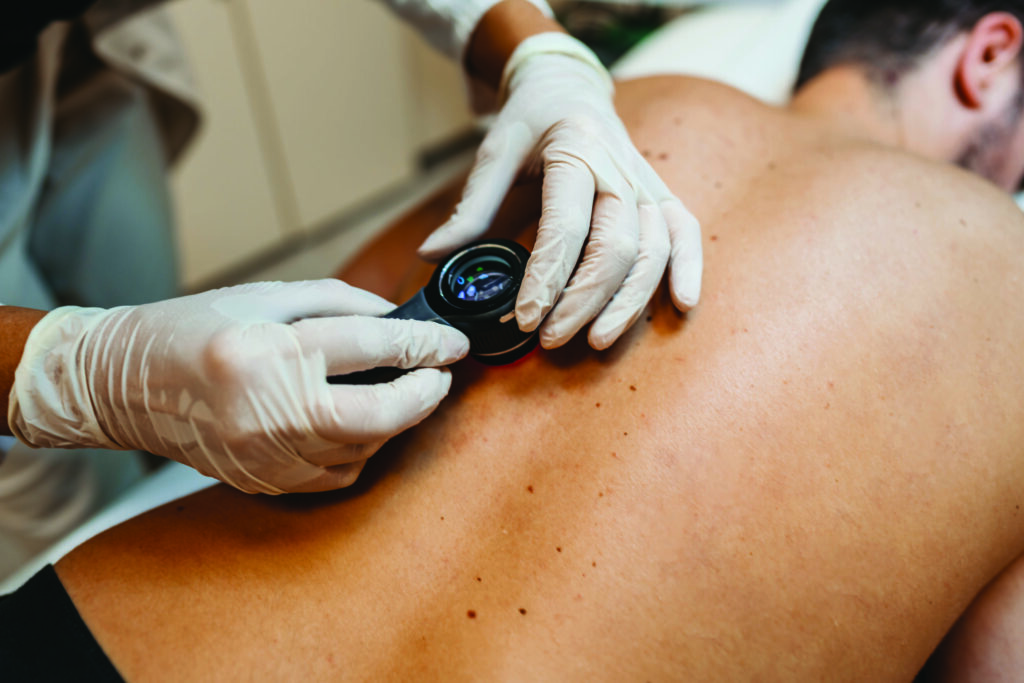
A doctor examining a patient for skin cancer. New trials have found that the combination of a new vaccine and standard immunotherapy drugs could halve the number of melanoma deaths
“Blokes really aren’t great,” says Dr Bav Shergill, chairman of the Skin Cancer Prevention Working Party Group at the British Association of Dermatologists. “Certainly compared with the diligence of the average woman. Women tend to scrutinise their skin more, they’re more likely to wear a hat, to moderate their sun exposure…”
It’s not the male-female imbalance in melanoma cases that really alarms Shergill, however. It’s the way incidence rates are increasingly skewing towards the young. Shergill lives and works in Brighton and Hove, what he calls Britain’s “Sunshine Central”. “No one moves to this area to sit inside,” he says. Everyone’s active, everyone’s outdoors. And melanoma rates are spiralling.
“We’ve seen a threefold increase over the past decade on the south coast,” says Shergill. “It’s a big disease burden and I’m seeing patients in their 30s and 40s. These are adults with responsibilities and jobs. We often think of cancer happening to retired people, it’s a natural bias; that’s not the case with skin cancer. My youngest melanoma patient was 18 with no genetic factors, so it’s affecting younger people more and more.” Today, one in four skin cancer cases are in people under 50 [I was 45 when diagnosed] while Skin Cancer Foundation figures show that melanoma is the most common form of cancer diagnosed in those aged 25-29 and the second most common in the 15 to 19-year-old bracket.
“Control out everything else and it can only be down to sun behaviours,” says Shergill. “Sunburn under the age of 20 is significantly associated with skin cancer and melanoma. These are young people with their whole lives ahead of them.”
No one thinks it will happen to them… It’s difficult to equate sunburn today with cancer tomorrow”
In the build up to my own treatment I took solace in the fact that, as disconcerting as the diagnosis was, there’s never been a better time to have melanoma. Just a generation ago, Stage 4 melanoma was tantamount to a death sentence. Now, with advances in immunotherapy, survival rates are improving all the time; the expected success of the personalised vaccine’s Phase III trials will raise that still further.
Treatment has improved immeasurably, too – and certainly since 1837 when, in North America’s first documented case, an unfortunate 43-year-old widow was treated with a combination of laxatives and leeches to the groin. Whereas until as recently as the 1990s, the removal of a 5cm margin of tissue around a melanoma was standard (accounting for the entire ear, in my case), now it’s more proportionate.
My “intermediate” tumour, having burrowed from the epidermis (outer layer of skin) a little way into the dermis (the next one down) required a 2cm margin.
The operation went well and I returned home, sore, bandaged and looking – according to my eldest daughter – unerringly like the injured emoji. Two very long weeks after my operation I was phoned by my surgeon James Sloane, a consultant oral and maxillofacial specialist working at the Royal Surrey Hospital in Guildford, Surrey. My neck biopsy had come back clear, as had the excised area around the tumour on my ear.
The scars healed well – Mr Sloane’s deft surgical cutting and pasting had ensured my ear was still very much ear-shaped – and within six weeks the Bond villain-esque absence of feeling on one side of my face came to an end. I’d lost a little symmetry and that in-built sense of invincibility, and the virulent nature of melanoma meant I’d need regular check-ups over subsequent years. But otherwise it was clear that I’d been incredibly lucky: less a battle with cancer than a skirmish.
As I recuperated, I found myself noticing others’ sunshine habits for the first time. And wincing. A tiny drop of suncream added to an already lobstered child’s face; unprotected shoulders grilling almost audibly. And an approach that seemed to target, rather than avoid, the high points on the UV Index. Mad dogs and Englishmen, and all that…
Melissa McMahon-Jones, the specialist oral and maxillofacial nurse tasked with picking out my stitches post-op, is one of those who wants to see scare tactics deployed. “Melanoma is particularly an issue for young people. It’s horrific,” she tells me. “Young people don’t care – tans are cool. They want one. The problem is they don’t see what that does, the problems they’re storing up for later. On cigarettes they have pictures of lung cancer. They need to have [on bottles of sunscreen] pictures of some of the things I see: patients with chunks of their arms or face missing.”
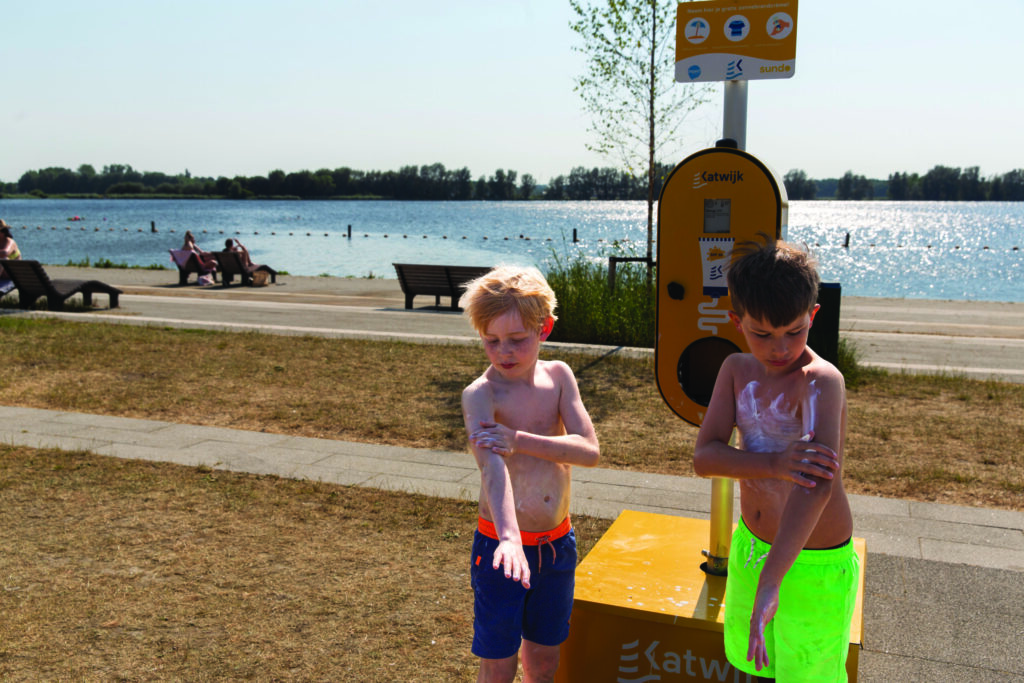
Two boys at the Valkenburg lake in the Netherlands apply suntan lotion from a free dispenser. The Dutch government has installed dispensers across the country in an effort to combat rising skin cancer levels
We can trace the tanning trend back to French designer Coco Chanel. For centuries the fashion for the western elite had been to maintain pale skin, setting them apart from the tanned toilers of the field. And then Coco took a cruise. In 1923 she was a fixture of high society and, while holidaying aboard the second Duke of Westminster’s yacht in Cannes, she accidentally caught the sun. When photos circulated of a tanned Chanel getting off the boat a new beauty standard was set.
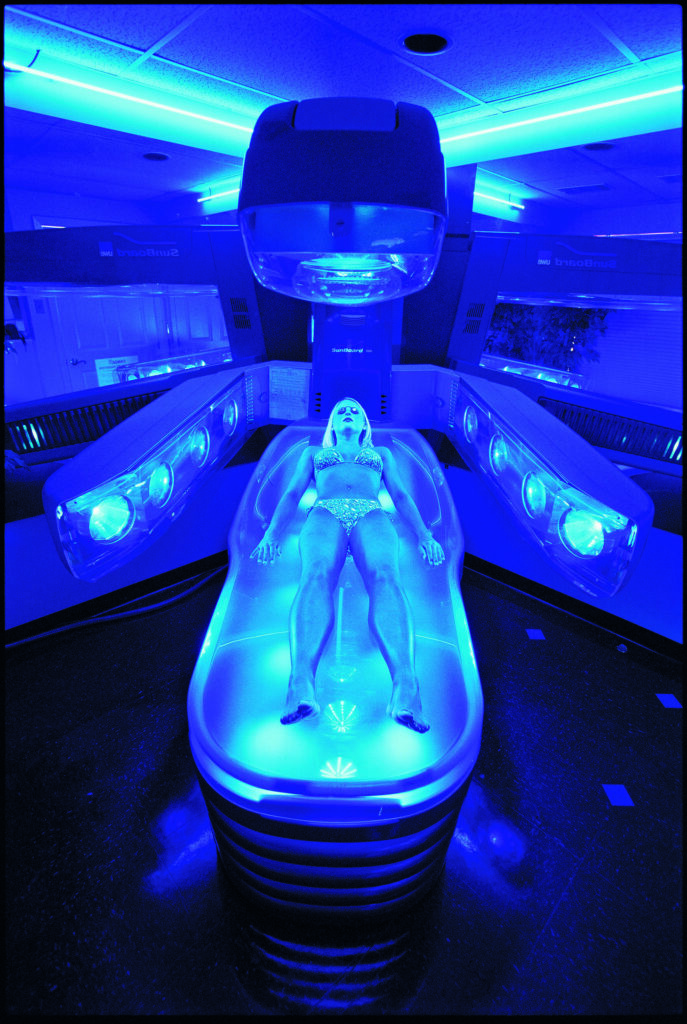
Severing this deeply entrenched association between tans and attractiveness would greatly help. But it’s a Sisyphean task, and requires targeting not just sun behaviour but also sunbed use. The latter – banned in the UK for anyone under the age of 18 by the Sunbed Regulation Act 2011 – emit UV radiation in amounts up to 15 times higher than the sun at its peak intensity. According to the Skin Cancer Foundation in the US, where an average of two people die of skin cancer every hour, more people develop skin cancer from indoor tanning than develop lung cancer because of smoking.
In April, a campaign launched by Skin Cancer UK and Ogilvy Health UK called on the government to mandate the displaying of images on sunbeds and in tanning salons showing the harm to the skin caused by UV exposure.
Professor Georgina Long, co-medical director of Melanoma Institute Australia and 2024’s Australian of the Year, put it best. “We need to push against the glamorisation of tanning,” she said in an interview in August. Australia has the highest melanoma incidence rate anywhere in the world, with 37 cases per 100,000.
There’s a cognitive dissonance here: 92 percent of people recognise that sun exposure can cause health problems, the Melanoma UK skin cancer report in 2020 found, but 61 percent believe having tanned skin is attractive. Our innate short-termism is the problem, says Shergill.
“No one thinks it will happen to them, right?” he says. “It’s difficult to equate sunburn today with cancer tomorrow and the risk of that.” He says that he understands the attraction of tans – “they make people look healthy, they even [out] their skin tone” – but this has to be balanced against the risk. “We’ve got to make it so it’s just not cool to be tanned.”
It’s not just the packaging of sunscreen that needs attention but the pricing too, says Melanoma Focus. A survey the charity conducted in 2023 found that 67 percent of people would use sunscreen more if it was cheaper. In August this year, the Liberal Democrats called on chancellor Rachel Reeves to cut VAT on high-factor sun cream to help combat skin cancer rates that Daisy Cooper, the party’s health spokesman and deputy leader, described as “staggering”.
Axing VAT on sunscreen is the most powerful message the government can send about sun safety”
As writer, campaigner and former skin cancer sufferer Jessica Zbinden-Webster, 32, memorably commented, it’s ridiculous that there’s VAT on sunscreen yet not on the biscuits served in the cancer clinic waiting rooms. Zbinden-Webster has launched a campaign, #AXEtheSPFtax, to help bring about the change.
“Axing VAT on sunscreen is the most powerful message the government can send about sun safety,” she says. “The tax applies to children’s products as well as adults’ and, in a cost-of-living crisis, that means struggling families are priced out of cancer prevention. With diagnoses soaring, it’s time the price of sunscreen reflected its importance.”
It’s one thing getting people to buy sunscreen, says Diffey, but quite another ensuring they use it effectively. In the official testing process from which a sunscreen derives its SPF rating, the internationally agreed amount is 2mg per square cm of skin, with the cream applied up to 30 minutes prior to exposure so it can properly dry. It should be applied evenly and lightly as it needs to sit on the outside of the skin. And it needs to be reapplied.
“Obviously this all rarely happens in practice,” says Diffey, resignedly. “We slap it on and rub it in a haphazard way. The result is that most of us are typically protected to only a third of what it says on the bottle.”
It’s the reason why he advocates the use of sunscreen only as the third line of defence against the sun’s most harmful rays – behind clothing, and something that’s never going to cost you £40 a pop or have its own slick marketing campaign: shade. Understanding, and factoring in, the UV Index could arguably be seen as a fourth line of defence. “People still think when it’s hot they get sunburn,” says Diffey. “Not true. The heat comes from infrared rays and it’s the ultraviolet that cause sunburn. The higher the sun is in the sky, the higher the UV index.”
Kate Upshon, 44, heads up the clinical nurse specialist team for skin cancer at the Royal Surrey Hospital and has seen patient volume grow from six a week, seven years ago, to 70. The preventability of skin cancer – which costs the NHS an estimated half-a-billion pounds a year – is starting to grate.
“If I see children out in the sun and burnt it absolutely riles me,” the mother of three tells me. “I have to restrain myself from approaching people. If they could see the surgical consequences of having sunburn… Come and spend a day with me. That would stop them getting burnt.”
It should be stressed that, of everyone I spoke to in researching this story, not one recommended cowering away from the sun altogether. Sunshine is crucial for vitamin D, which can help to protect against cancers, melanoma included, and is also a welcome fillip to mental health in our turbulent times. But all my interviewees advocated moderation, something that’s hard to maintain on the first beautifully sunny days of the year after another miserable British winter.
The simple fact is that, on a national level, we need to recalibrate our relationship with sunshine. We should be treating it like an overly charismatic politician: fun to be around but absolutely not to be trusted. In the often sun-starved UK, our mentality (and I’m generalising) tends to be more groupies around a rock star – rip off our clothes and throw ourselves at it.
That has to stop, says Diffey – and it’s not actually that hard. “You only need small, simple behavioural changes to make a massive difference in this. Minimising the risk of skin cancer doesn’t mean staying out of the sun; life is for enjoying. But you can enjoy it sensibly. It’s like wine: enjoy a glass or two. You don’t need to have 10.”
Radiation nation
Despite warnings, sunbed use in the UK is on the rise. In May, new research by skin cancer charity Melanoma Focus revealed that 28 percent of adults in the UK say they use sunbeds.
That number rises to 43 percent among those aged 18 to 25, while the city of Belfast is the UK’s sunbed capital, with 37 percent of adults in the city using the machines either at home or in tanning salons.
In 2009 the World Health Organization classified the ultraviolet light emitted from tanning beds as carcinogenic, placing it in the highest category of carcinogens alongside asbestos and tobacco.
Slow Journalism in your inbox, plus infographics, offers and more: sign up for the free DG newsletter. Sign me up
Thanks for signing up.