A matter of time
At the London Marathon on 26th April 2026, the fabled sub-two hour barrier was not just broken but smashed. But was Sabastian Sawe’s landmark feat a triumph of technology and sports science over human endeavour – and can the shadow of doping among elite East African distance runners ever truly be escaped?
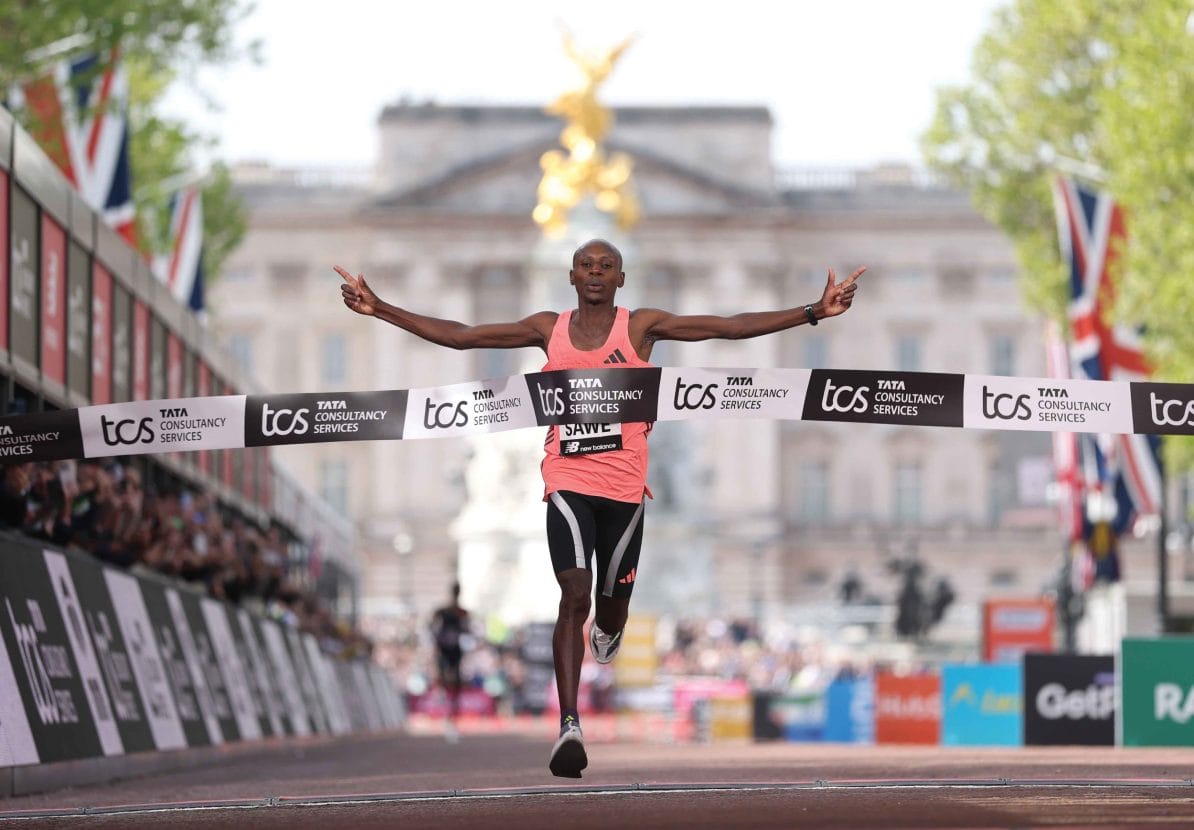
Sabastian Sawe celebrates after winning the 2026 London Marathon in a world-record time of 1:59:30, 26th April 2026
Sun 26th Apr 2026 (Taken from: #63)
Josh Rowe smiles as he recalls his first encounter with Sabastian Sawe. The performance scientist for Swedish sports nutrition company Maurten was in the high-altitude training hub of Kapsabet, in western Kenya, collecting performance data on some of the East African country’s top marathon runners. Ahead of a high-tempo, 40km training run, the athletes were fitted with various sensors and Rowe handed a heart-rate monitor to each.
Yet when these devices were returned, one was bone dry. Rowe was disappointed rather than angry, to use the old teachers’ refrain; if some athletes weren’t going to bother to wear such items then the data would be incomplete. He spoke to Claudio Berardelli, the group’s coach, and the charismatic Italian’s face stretched into a broad grin. “‘Ah, that’ll be Sabastian’s’, he said,” recalls Rowe. “And he proceeded to tell me all about him.”
Even in the exalted company of the country’s 2 Running Club set up by Berardelli, Sawe was fast acquiring outlier status. Partly, it was his meticulous manner; while the dorm rooms that the athletes shared would often be strewn with gear, Sawe’s bed would always be made, his kit folded and running shoes neatly aligned. Mostly, it was the superhuman numbers he was hitting in training – and the apparent ease with which he was achieving them. He had worn the monitor for the 40km, it transpired, completing the gruelling training run through the region’s undulating tea plantations at a pace mere mortals would be content to sustain for a few seconds in a sprint. Then he’d calmly returned the device, as sweatless as someone stepping off a first-class flight.
That was in January 2023. Three years and three months later, on a perfect spring day in London, his outlier status was cemented on the global stage, as the self-effacing Kenyan, previously a farmer, ran not just the fastest official marathon in history, but the first to dip below the fabled two-hour mark.
It was a barrier, and a quest, that had entranced and indeed transcended the running world for several decades – a milestone of human endeavour likened to the conquering of Everest in 1953 or Roger Bannister’s breaking of the four-minute mile the following year. “The Narnia of distance running,” was how author Ed Caesar described the goal in his 2015 bestseller Two Hours: The Quest to Run the Impossible Marathon.
And 31-year-old Sawe achieved it, not – as Bannister had done – with his face contorted in pain, on the very edge of collapse, but as smoothly and serenely as he’d tackled the very first of the 26.2 miles of the race that day. Thrillingly, and surely instrumentally, the result was in the balance until the final few kilometres, as Sawe was shadowed by East African rival Yomif Kejelcha. The 28-year-old Ethiopian, running his debut marathon, would cross the line just 11 seconds adrift of Sawe’s 1:59:30.
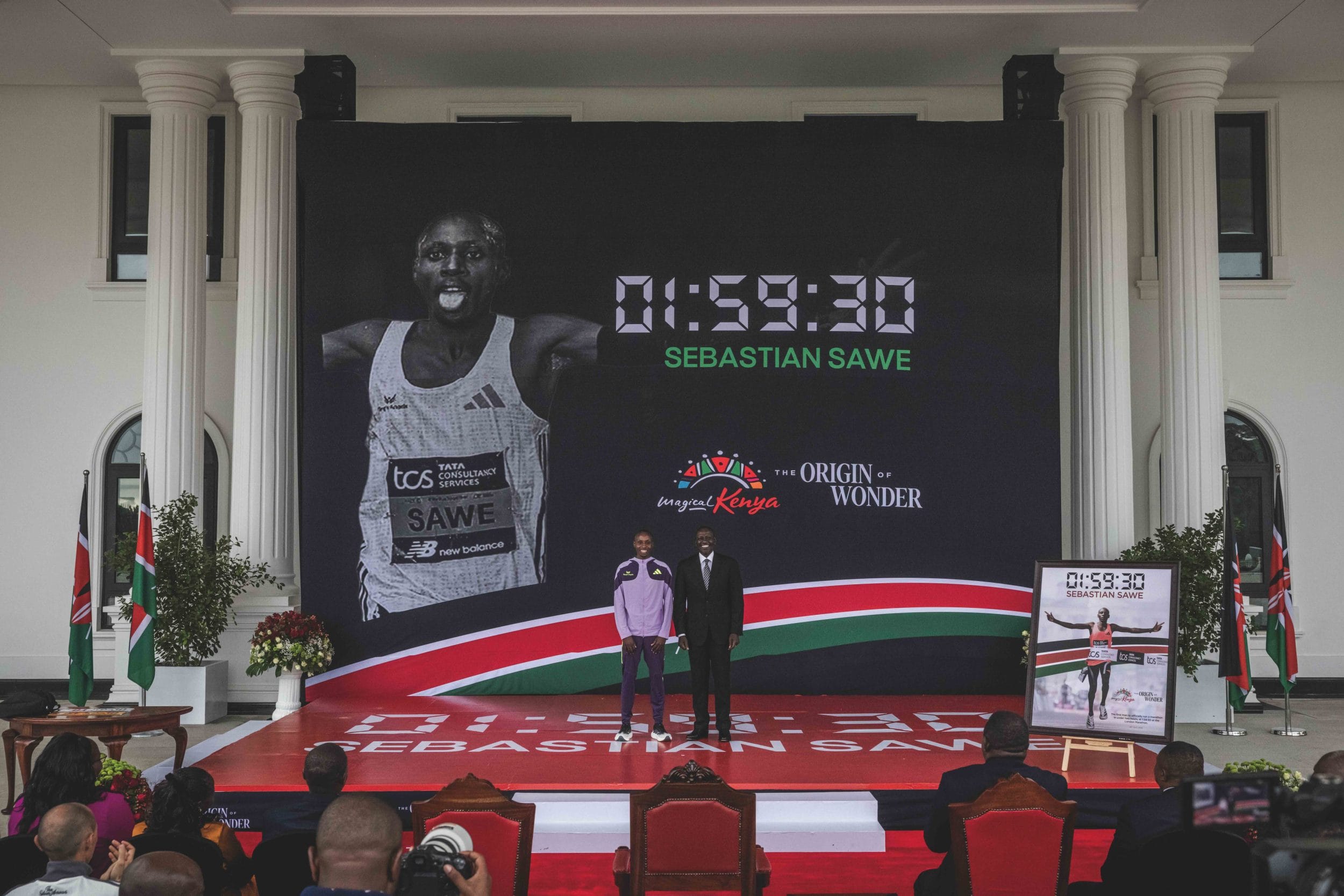
Sabastian Sawe is welcomed by Kenyan president William Ruto in Nairobi on 30th April 2026
For what had seemed like aeons, the marathon world had craved a sub-two-hour time. Now two had come along in one morning. London bus comparisons were quickly drawn. Rowe was among the tens of thousands of spectators at the finish, watching the man he’d come to regard as a close friend round the final bend and cruise to victory. “I was ecstatic but also emotional,” says the 33-year-old. “Sabastian is a dream athlete to work with: so talented but not someone who sees himself like that. I think it was only coming into London that he began to appreciate just how special he is.” By the time the team departed London the following day, Sawe and his milestone had been immortalised on a giant billboard screen in Piccadilly Circus and a private jet had been laid on to whisk him to Bavaria and the HQ of his sponsor, Adidas. After that it was onwards to a ceremony with the Kenyan president. His life had moved abruptly into the spotlight.
Yet amid the accolades and adulation, reservations were already being expressed on running forums, and caveats inserted: it was down to the shoes, not the athlete; quantum leaps in nutrition and fuelling had shifted the marathon goalposts and thus fundamentally devalued the achievement; most distressingly for Sawe and his team, doping must surely have played a part.
The running establishment had long debated whether completing a marathon in less than two hours would ever be possible. For some, Sawe’s historic achievement had provided a vexingly equivocal answer.
Rowe and I are sitting at a quiet table in the lobby cafe of a smart hotel in central London, just a couple of miles from the spot where Sawe glided into the history books. Guests come and go, clutching sightseeing daypacks or the bounty from a day’s shopping in nearby Oxford Street.
It was here that Sawe and his tight-knit team based themselves during race week. Rowe, who splits his time between his home in Leeds and Maurten’s central office in Gothenburg, arrived on the Wednesday, four days before the Sunday marathon. Berardelli and Sawe checked in the same day. Sawe was installed in a 10th-floor suite, a welcome change from his camp dorm.
A few light training runs were undertaken in nearby Hyde Park. But mostly the week was about rest and mental preparation. A niggling injury had been shaken off and Sawe, the race’s defending champion, felt ready. Berardelli joined Sawe in his suite on the Friday, having what he later described as an “intense, emotional discussion”. The gist: you’re in incredible shape; this is a free swing. If history comes knocking, be ready. On the Saturday, Rowe met with Sawe in the same room to prepare his eight race bottles – each meticulously measured out and marked for the course aid station for which it was destined.
Sawe is a dream athlete to work with… I think it was only coming into London that he began to appreciate just how special he is” — Josh Rowe, performance nutritionist
The fuelling and hydration of marathon runners has advanced immeasurably over the past century. In the early 20th century it was accepted wisdom that intentionally depriving the body of water made it more efficient and resilient, as if dehydration was something that could be stoically fought through. This lethally spurious science reached a nadir at the 1908 Olympics in London, the first running of the now-standardised 26.2-mile (42.2km) marathon distance – the result of a request by the British royal family to lengthen the course so that it started on the lawn of Windsor Castle. Prior to this, marathon courses tended to be around 25 miles (40km), roughly the distance from Marathon to Athens.
Leading as he entered White City Stadium in Shepherd’s Bush for the finishing lap, Italian runner Dorando Pietri collapsed repeatedly from dehydration and eventually had to be carried over the line by officials. US runner Johnny Hayes came second. He appealed, and Pietri was stripped of his medal.
Today, at the top end of the sport, nutritional intake is gauged to the nanolitre and, through its hydrogel product, Maurten has found itself the leading player, catering for an estimated 80-90 percent of the elite fields in both male and female marathon running. Rowe, who has devoted much of his career to studies of carbohydrate metabolism, talks me through the science. In essence, there had always been a tension between the high levels of carbohydrate needed to fuel the energy outputs of elite marathon runners, and the gastrointestinal problems associated with taking them on board mid-race.
Hydrogels solve that problem by bypassing the stomach and being absorbed straight into the intestine. There’s none of the sense of liquid sloshing around in one’s stomach that’s familiar to runners of any level. You drink it and then, magically, it’s gone; the Keyser Söze of carb delivery. “Before, the marathon was very much a case of ‘Get to 30km and see who could survive’,” explains Rowe. “Now, you get to 30km and it’s ‘Who can attack?’”
Sawe’s race splits for the London Marathon vividly illustrate this point. Guided through the half-marathon mark by pacemakers in 1:00:29, he began to markedly speed up. The Kenyan covered the five kilometres from 30km to 35km in 13:54, equivalent to a 1:57:18 marathon pace. The next 5km he ran in 13:42, a 1:55:42 pace and only one minute and seven seconds off the world record for a five kilometre race – and that was after running 40km already. The last 2.195km, to bring him to the finishing line in the shadow of Buckingham Palace, was even swifter. “The big difference is that fuelling is not really a limiting factor now,” summarises Rowe. “We don’t talk about ‘hitting the wall’ – and runners aren’t scared of that happening.”
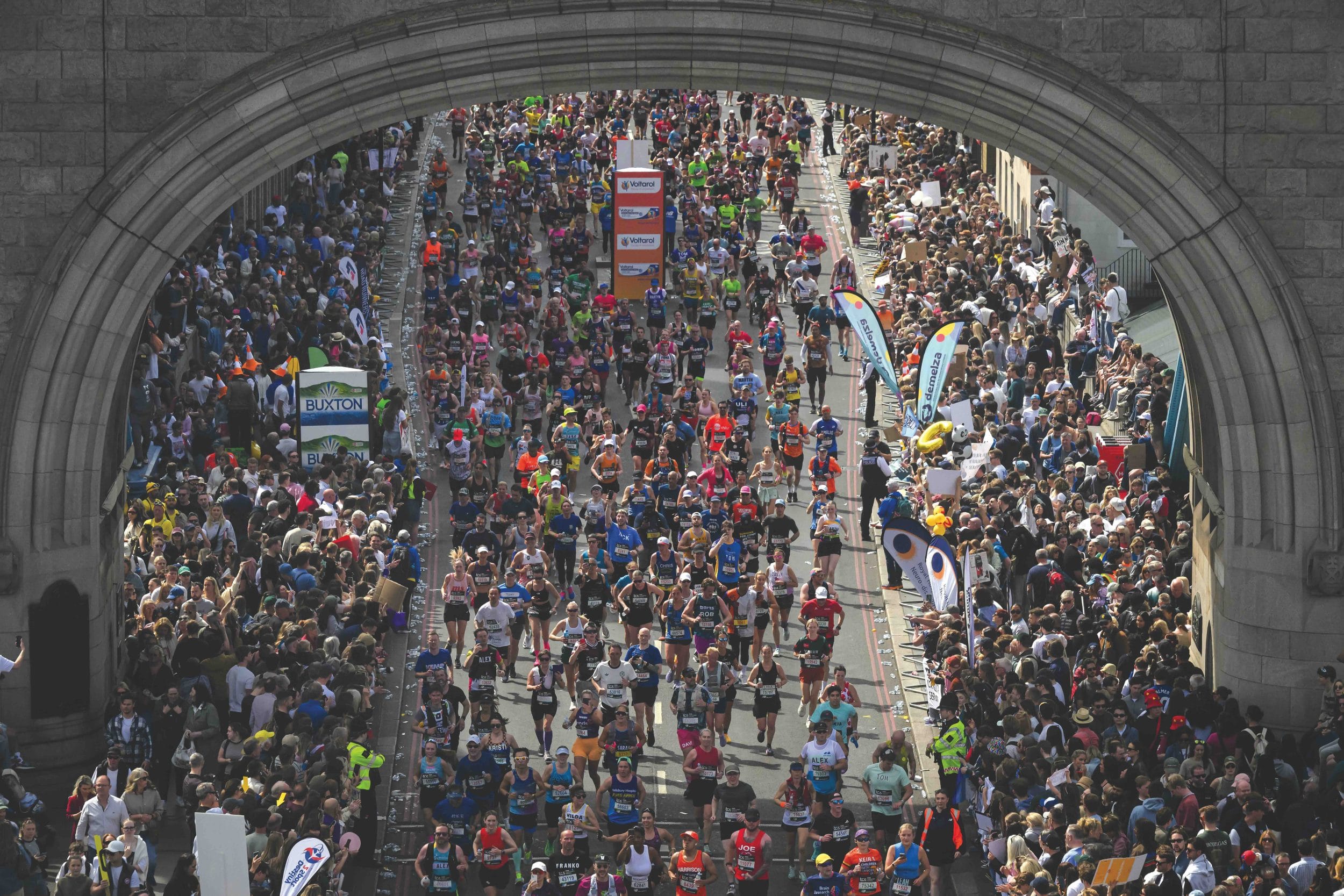
A record-breaking 59,830 runners crossed the finish line at the 2026 London Marathon, where two athletes broke the two-hour barrier, a feat long thought highly unlikely
It will come to be seen as a fortuitous coincidence for Sawe and the current crop of elite marathon runners that the start of Rowe and Maurten’s pioneering work around nutrition broadly coincided with the advent of what has become universally known as ‘the supershoe’. It started with a 2016 Nike prototype called the Vaporfly 4%. The figure relates to the improvement the shoe was said to offer in running economy – the energy cost of maintaining any given pace.
In the Rio Olympics of that year, the distinctively chunky-soled shoes – combining thick, lightweight foam offering improved energy return with a propulsive carbon-fibre rod or ‘plate’ – dominated the marathon podium. A new era had begun. Today, we’re deep into a supershoes arms race, with almost every trainer brand offering a variation of these marshmallowed performance enhancers.
Adidas is the current, undisputed superpower. Its Adizero range, launched in 2020, has powered 24 distance-running world records to date, and both Sawe and Kejelcha were wearing its latest featherlight model, the Adizero Adios Pro Evo 3, when they broke the two-hour barrier in London. The shoes, with their paper-thin upper of woven mesh and plate shaped like an elongated horseshoe, weigh just 97g each – roughly equivalent to a single banana.
I ask Harry Miles, an Adidas footwear innovation director who worked closely with Sawe in the build-up to London, whether Sawe was wearing the most advanced marathon-running shoes ever made for his record-setting run. He laughs. “Let’s just say that he had the most advanced running shoe that Adidas has ever made,” he answers, magnanimously.
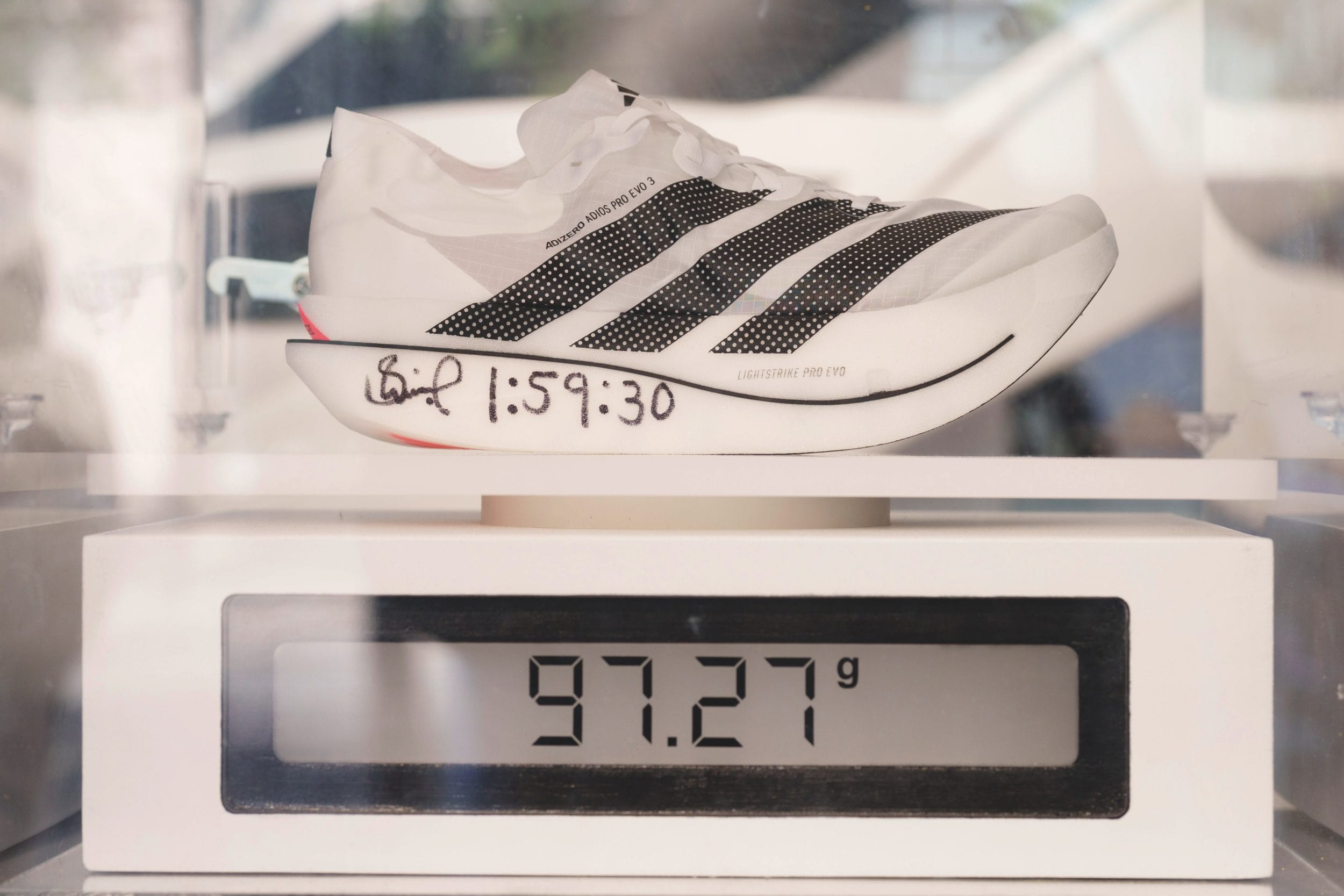
One of the shoes worn by Sabastian Sawe during his sub-two-hour marathon, on display at Adidas’s Oxford Street store in London
Sawe had made multiple visits to Adidas’s Bavarian HQ over the preceding 24 months, helping Miles and his team to hone the shoes in which he broke two hours. “It was one of the most insane weeks of my professional career,” says Miles, recalling the race in April. “I could imagine the team working with Bannister must have felt the same as we did. These kinds of barriers are just wild, and to be part of it… we just feel unbelievably proud.”
With supershoes now widely adopted among recreational runners too, there’s a considerable commercial dividend to what he terms “crescendo moments” such as Sawe’s. “What’s really cool is that we managed to do something that benefits our pro athletes to a very special extent. But it’s also something that will benefit any athlete who wants to go and break their own marathon PB [personal best],” says Miles. The hype seems to be working; at the time of writing, the £450 Pro Evo 3 was out of stock via official Adidas channels and only available for prices of up to £1,200 on trainer resale sites.
Quantifying precisely how many seconds and even minutes the latest, highly evolved supershoe is worth to the average runner is difficult. But you won’t find anyone arguing that the benefit isn’t significant. “For the past 40 years we’ve been relying on a couple of centimetres of rubber as a means of cushioning,” says Dr Bryce Dyer, associate professor of sports technology at Bournemouth University. “Now, suddenly, we’ve got a highly engineered spring that’s not only controlling the motion but directing it in the right way, to the right magnitude. I think that’s something entirely different.”
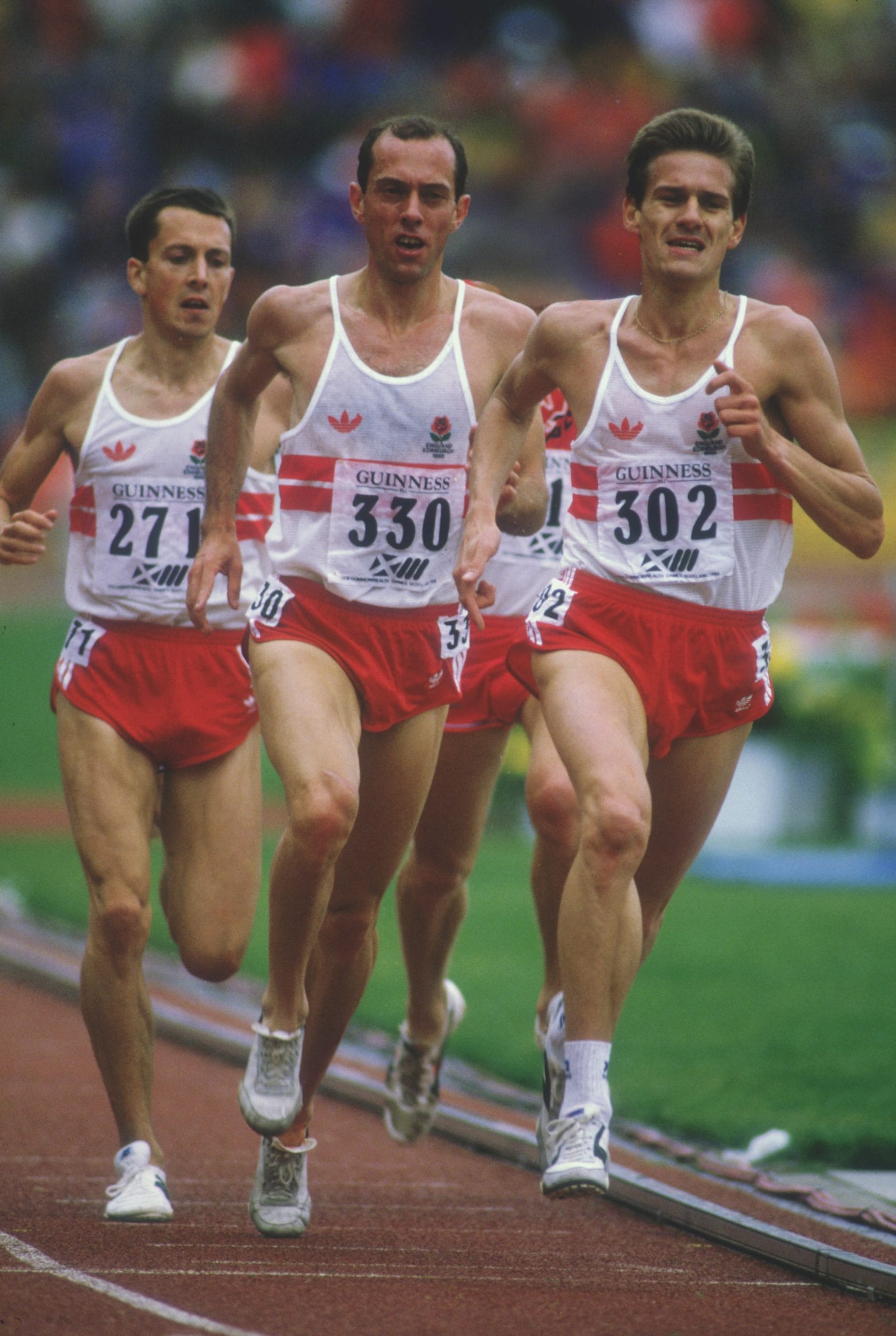
Others go further. Tim Hutchings is a British middle and long-distance runner who finished fourth in the 1984 Olympics in the 5,000m. On that day, he ran a career PB of 13:11:50 – just 30 seconds faster than Sawe’s last full 5km of his sub-two-hour marathon. Hutchings says that 10 years ago he had a bet with Dave Bedford, a former 10,000m world record holder and London Marathon race director, that two hours would never be broken. “I stand by what I said because the bet was made pre-supershoes,” he says. His frustration is not with the footwear per se, but with the lack of official acknowledgement of the benefits. “We’re seeing records broken every bloody week and it’s cheapening the currency,” he says. “I think that’s a retrograde step for the sport.”
Hutchings, now 67, thinks supershoes are worth “three to four minutes” in the marathon and wants to see asterisks in the record books appended to all marks set since their introduction. “The best analogy I can think of is World Athletics saying, ‘Oh, we’re going to take 20 grams off the weight of the javelin’, but not bothering to change the record books or anything. They’re trying to pretend it’s the same world we’re living in and it’s not.”
One of the most compelling aspects of Sawe’s stratospheric rise from humble farmer to history maker is his relationship with Berardelli. It’s built on mutual respect and has flourished under the 42-year-old’s renowned man-management skills.
Slight and shaven-headed, Berardelli has spent two decades working with athletes in Kenya, is married to a Kenyan and speaks fluent Swahili. He’s analytical and ferociously driven, yet also considerate and avuncular. He talks about being motivated primarily by the need to ensure that those in his charge reach their potential – a daunting responsibility in Sawe’s case.
With Rowe’s help I track him down for an interview. He tells me about the weeks leading up to London and the subtle shift in internal messaging. “Confidence is based on evidence,” he says, “and we had a lot of evidence that Sabastian was in excellent shape.” The pair began to openly discuss breaking two hours rather than tiptoeing trepidatiously around it. The previous world best, set by the late Kelvin Kiptum in 2023 in Chicago, was 2:00:35. Sawe’s PB was 2:02.05. “We decided to try to believe, and maybe that belief would push us that little bit further,” Berardelli tells me. Breaking the two-hour barrier was now on the table. “We started not to fear it.”
We’re seeing records broken every bloody week and it’s cheapening the currency. I think that’s a retrograde step”
— Tim Hutchings, former Olympic runner
I’m curious as to what he makes of the negative noise around his protégé’s crowning achievement. The average runner completes a Parkrun in around 30 minutes. Optimised shoes and carb intake notwithstanding, the physiological and psychological demands of running the equivalent of 8.5 Parkruns, back to back, at a pace of 14.28 for each, is almost unfathomable. “People have forgotten that in the end this was not just the result of a pair of shoes and efficient fuelling,” says Berardelli. Five years into their relationship, he continues, he’s “still in the process of trying to understand exactly who Sabastian Sawe is”, although he believes it’s the athlete’s mental strength that really sets him apart.
“He told me one day that the rest of the group sometimes say ‘It’s easy for Sabastian’ and ‘he doesn’t seem to struggle’. And he said, ‘No, I feel it, I feel the pain of the training. But I keep reminding myself that it is going through that pain, and learning to handle it, that makes me a stronger athlete.’ I didn’t teach him this. He’s expressed himself this way. So he’s definitely a guy with a different type of sensibility.”
Back when supershoes, hydrogels and the rest were little more than science fiction, back even before Sabastian Sawe was born, a trainee American doctor and runner with a keen interest in performance physiology made a prediction.
Were a runner to emerge with optimal readings in the three key metrics governing athletic performance – lung capacity, running economy and lactate threshold (the point at which lactic acid rapidly builds up in the blood, signalling fatigue) – then, according to the model he drew up, a marathon time of 1:57.58 would be possible. Dr Mike Joyner’s paper appeared in the Journal of Applied Physiology in 1991. At the time, the men’s marathon record sat a stubborn seven minutes adrift of two hours, and nine of his curiously exact prediction. Joyner’s paper was met with scepticism. “There was no social media then, so nobody could tell you you were crazy,” he says, with a laugh, when I speak to him from his home in Minnesota, where he’s a professor of anaesthesiology at the Mayo Clinic. But the prediction helped to fuel the mythology around two hours and, with every passing decade, has begun to look as prescient as it is precise. I ask Joyner how he felt at Sawe smashing through the two-hour barrier; the time difference meant that when he woke up on the Sunday morning of the race, the news was already waiting for him. “On one level, it was validating,” he replies. “But the thing you have to remember is that, depending on how you feel about Kipchoge’s 2017 and 2019 efforts, it was sort of just a matter of time.”
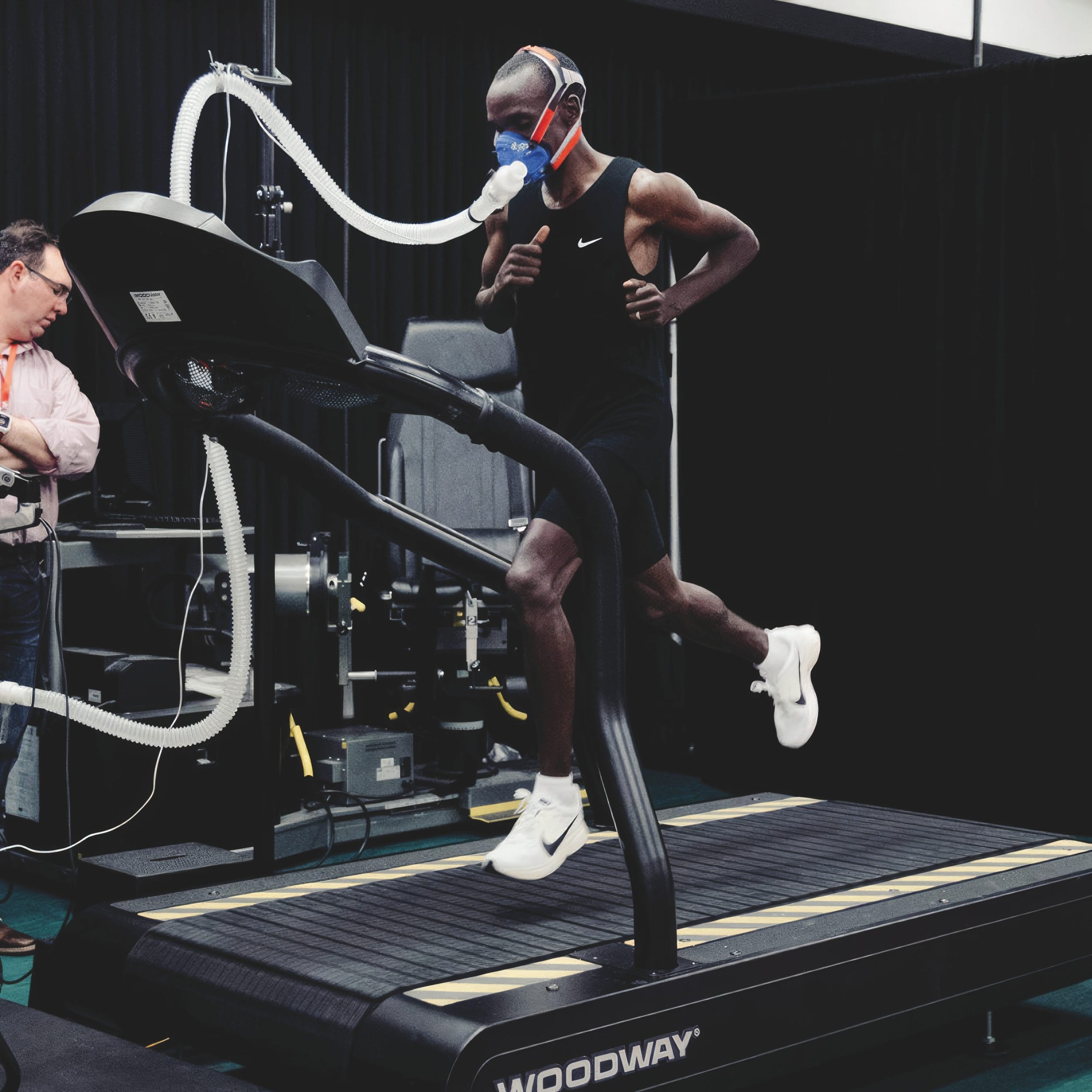
Kenyan athlete Eliud Kipchoge undergoes laboratory testing in 2017 ahead of Nike’s Breaking2 project, an ambitious bid for him to become the first person to run a marathon in under two hours
He’s referencing Nike’s Breaking2 project and the subsequent, successful, Ineos 1.59 Challenge. Using optimised courses, a moving laser beam to mark out the required pace and phalanxes of regularly replenished runners operating as wind shields, both were attempts to enable then-Olympic champion Eliud Kipchoge to break two hours. Given the hyper-controlled, closed-off format, Kipchoge’s 1:59:40 in 2019 was not ratified by World Athletics.
I find Joyner remarkably sanguine about the advances in such things as shoe tech and fuelling that have contributed to the rapid convergence of the marathon world record and his prediction. He references the incremental and inexorable forces of innovation, and the gradual accumulation of knowledge that make apparent quantum leaps possible. “It’s not like [Johannes] Gutenberg woke up one day and said, ‘Hey, I’m going to make a printing press’,” he says. “There were all sorts of things going on at the time that he integrated.”
He uses the example of American pole vaulter Cornelius ‘Dutch’ Warmerdam who was unbeatable in the 1940s and 1950s using a bamboo pole. Current Swedish-American phenomenon Armand ‘Mondo’ Duplantis has jumped 1.5m higher using his fibreglass composite pole. “Who’s better?” asks Joyner, simply.
Joyner believes that “social factors” have been just as important as technological ones in lowering the record: such things as World Athletics beginning to recognise and ratify marathon world records in 2004 following the implementation of course-standardisation rules. This, in turn, helped pave the way for the lucrative, competitive and commercially valuable World Marathon Majors – initially five, now seven of the biggest city marathons. “It used to be that the best marathoners were those who weren’t quite there as 5,000m or 10,000m runners or who were moving up to the distance at the end of their careers. Then the prize money, and the incentives for breaking records, got big enough that people started saying, ‘Hey, let’s go for it now’.”
For Two Hours author Ed Caesar, watching his titular barrier being breached was emotional. The 46-year-old admits to shedding a tear as Sawe neared Buckingham Palace and it became clear that he wouldn’t just slip inside the once-impregnable fortress of two hours, he’d kick the gates in. “It felt very fitting to me that this happened as a result of a proper tear-up [race] between two runners, and that drove them under two hours. I found that just thrilling,” he says.
This happened as a result of a proper tear-up between two runners, and that drove them under two hours” — Ed Caesar, author
But for him, he says, the “Bannister moment” was Kipchoge’s run in Vienna in 2019, at which Caesar commentated. It showed that breaking two hours was possible; it was then just a matter of stripping away the many contrivances. “I think Eliud’s run in Vienna, albeit in a time trial, had a big psychological effect on the people who came next: Kiptum, Sawe and the like,” he says. “They saw that it wasn’t this magical barrier. It was just something you had to run this fast, for this long, to break.”
As with Warmerdam vs Duplantis or Jesse Owens vs Usain Bolt or any number of other hypothetical head to heads, comparing athletes across generations is a frustrating exercise. But there’s one marathon runner whose accomplishments in a different time continue to be revered: Paula Radcliffe. Claudio Berardelli called the 2:15.25 time that the Briton ran at the 2003 London Marathon, 13 years before the advent of supershoes, “unthinkable”. Studies calculated that – measured against historical, gender-based, physiology-constrained norms – it was an outlier performance equivalent to that of a man running sub-two-hours. Radcliffe’s world record would last a full 16 years. Since 2019, however, benchmarks have come and gone with the frequency of British prime ministers – and with almost as much rancour and ignominy. The most recent saw Kenyan Ruth Chepngetich run 2:09.56 in Chicago in October 2024. The following July, the 31-year-old was suspended following a positive test for a banned diuretic commonly used as a masking agent for performance-enhancing drugs. She’s currently serving a three-year ban, although her world record still stands.
The month before Sawe’s win in London, another Kenyan – former New York Marathon winner Albert Korir – was banned for five years after admitting to doping with a synthetic hormone that increases stamina. They are just two of a string of such violations by distance-running athletes from the East African country. By the end of 2025 the Athletics Integrity Unit (AIU), an independent testing body formed in 2017 by World Athletics to combat widespread doping, had found 427 elite athletes in violation of their rules, 145 of whom were Kenyans. Among these was Esphond Cheruiyot, Sawe’s 2 Running Club teammate, who was banned for three years in October 2025 after admitting to using the outlawed heart medication Trimetazidine.
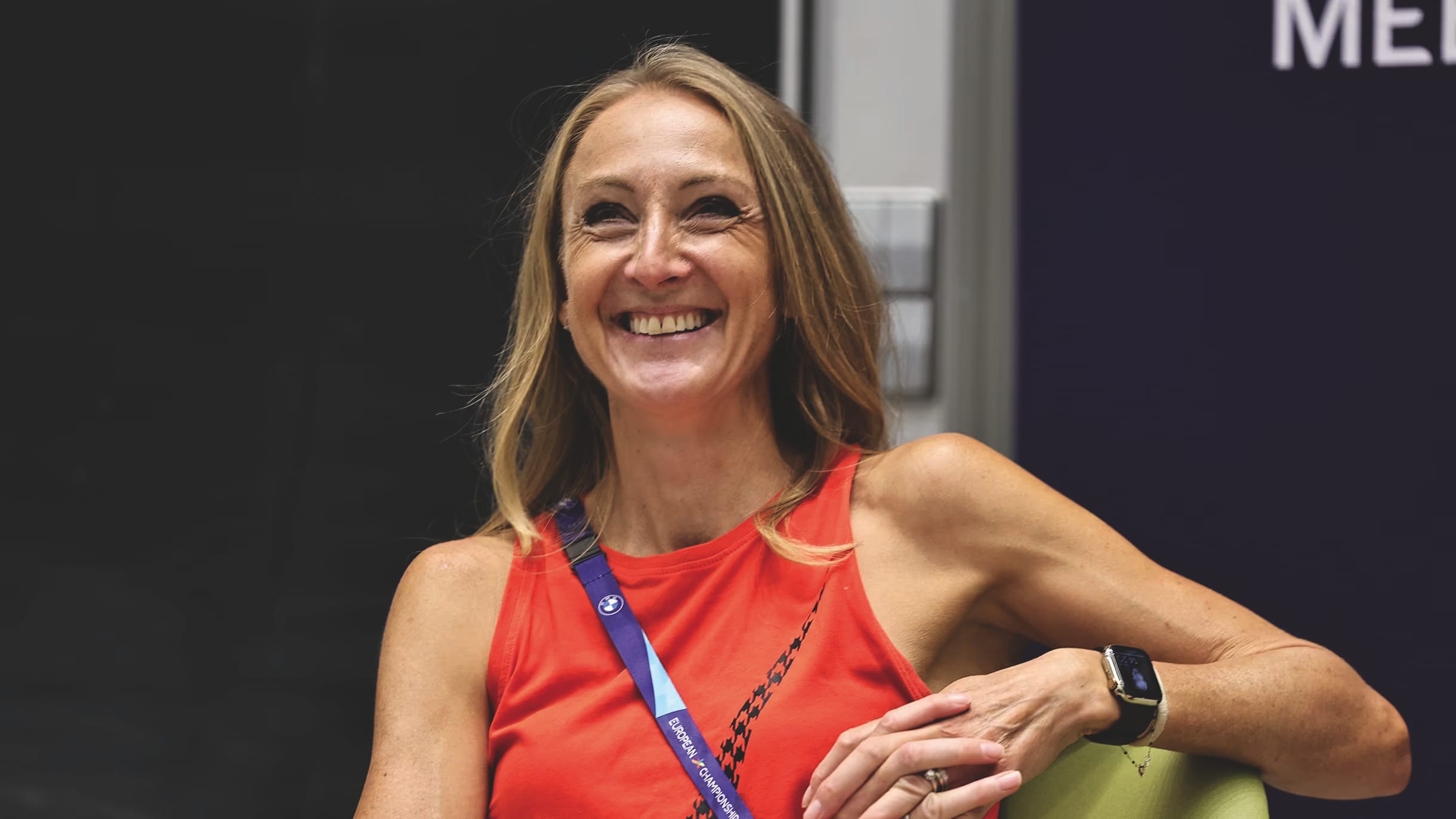
The shoes that I ran in… were certainly better than the bare feet with which Abebe Bikila won. There will always be improvements” — Paula Radcliffe, who held the world women’s marathon record for 16 years
The cloud over Kenyan athletes prompted Sawe and his team to make an unprecedentedly proactive move. Beginning in summer 2025, they initiated an Adidas-funded partnership with the AIU to undergo regular, unannounced, out-of-competition tests. “It’s frustrating [the assumptions of guilt] and I think that’s why the decision was made early last year to do this mass testing,” says Josh Rowe. “There was a lot of noise around Kenyan athletics and the doping scandals and that’s what really forced Claudio and the team to see if there’s a way to eradicate [the criticism] or at least inject confidence.” Given how quickly substances used in doping can clear the bloodstream, windows of opportunity still exist. But, speaking on the Science of Sport podcast which he co-hosts, Professor Ross Tucker praised the initiative as a move in the right direction that will help to build trust among an understandably sceptical public.
I speak with Paula Radcliffe from her home in Monaco, and when I put it to her that a woman breaking the two-hour threshold could be the next imagination-capturing goal in marathon running, she makes a pointed reference to doping. “I would like to see the 2:10 barrier broken legitimately first,” she says. The 52-year-old admits that she’d love to be competing in the current era – “to know what I could run, at my best, in the new shoes” and with a fuelling strategy that meant the marathon wasn’t simply about “preparing your body for everything wanting to shut down at 30km”. The four-time Olympian doesn’t love the fact that her 2003 PB is now in freefall on the table of fastest female marathons of all time. But she accepts the realities of the ever-evolving world of high-performance sport.
“The shoes that I ran in were better than the shoes that Ingrid Kristiansen [a record-setting Norwegian predecessor of Radcliffe] ran in. And the shoes that Ingrid ran in were certainly better than the bare feet with which [1960s Ethiopian runner] Abebe Bikila won Olympic gold. There will always be improvements.” It begs the question: how low can we go? Will Joyner’s 1:57.58 now be reached? Surpassed? In the course of my research there’s not a single person I speak to who thinks Sawe’s record time won’t be lowered further, and by a margin. Given that the Kenyan cleaved an enormous 65 seconds off the previous world best, it’s a strikingly bold consensus.
Radcliffe believes a number of others will now join the sub-two-hour club, as competitors and coaches – with the hard-nosed pragmatism of elite sport – simply reframe the parameters. Berardelli agrees. “The truth is I have around 20 marathon runners in my group, and all of them, in their own way, have a sub-two [within them]. And I think Sabastian is more motivated now than before, because he knows that, in a sense, the limit is farther.” Berardelli says the true legacy of this year’s London Marathon will be a “drastically changed” mentality among the world’s best. “The new generation will not fear to say, ‘Hey, why don’t we go out [run the first half] in 59:30 or 59:15?’ I’m not sure 1:55 is possible. But 1:58? Absolutely. 1:57? Why not? And I’ll probably stop there.”
Slow Journalism in your inbox, plus infographics, offers and more: sign up for the free DG newsletter. Sign me up
Thanks for signing up.