Moment that mattered: A coup is mounted in Bolivia
In issue 55 we spoke to Bolivian security analyst Gabriela Reyes about an extraordinary – and, according to some, faked – coup d'état against President Luis Arce
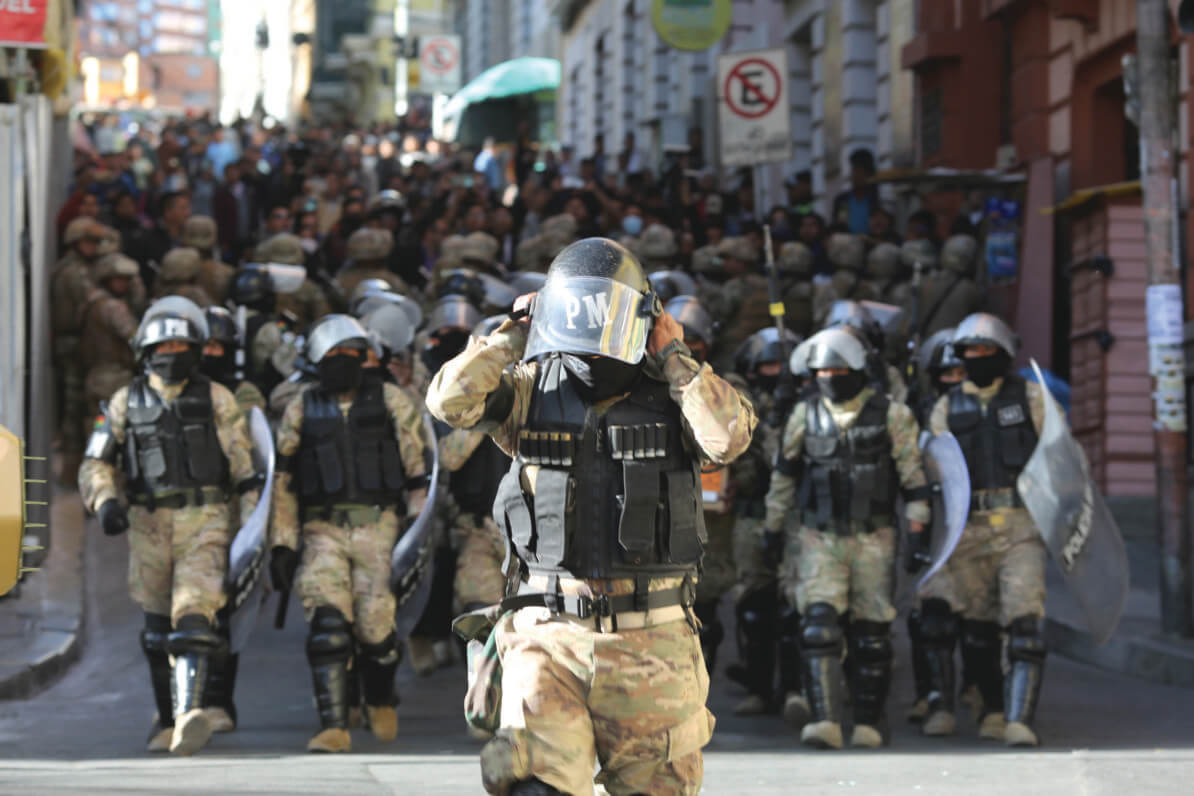
Military police arrive at the Plaza Murillo in La Paz, Bolivia, on 26th June, after warnings of a possible coup attempt
26th June 2024 (Taken from: #55)
It looked like a classic military putsch. On the afternoon of 26th June, rifle-wielding men in camouflage jogged into the square outside congress in La Paz, the seat of Bolivia’s government. An armoured car battered down the gates to the Palacio Quemado, the historic presidential palace and General Juan José Zúñiga, the army chief, said that he was seizing power.
President Luis Arce boldly confronted Zúñiga, ordering him to stand down. The US, the UK and neighbouring countries condemned the apparent mutiny. Then, within hours, it was over. Zúñiga’s troops melted away. The president appeared on a balcony before a cheering throng of supporters. But that evening, as the general was arrested, he accused Arce of a colossal fraud. The president, he said, had asked him to stage a fake coup so he could play the hero, and rally the public behind his floundering administration.
Gabriela Reyes was at home that morning in southern La Paz when her phone blew up with WhatsApp messages, screen-grabs from social media and video feeds. “Photos started to come in of the tanks, tweets by people saying something is happening in Plaza Murillo,” she says. Her first thought: “It looked weird to me.”
Under Evo Morales – Arce’s charismatic predecessor, and leader of their Movement toward Socialism (MAS) party – Reyes had served in Bolivia’s interior ministry. An independent analyst and academic with degrees from the universities of Maryland and Columbia, she keeps in close contact with the security services. Whenever they receive news of an imminent protest, she says, a specialised police unit seals off the square with vehicle-proof barriers. But this time they were nowhere to be seen. Even the Colorados – the scarlet-jacketed, bayonet-wielding honour guard that usually flank the palace doors – seemed to have vanished. “People started to say this was a coup d’état. And I wondered, ‘At midday? With the media broadcasting it live?’”
Bolivia was once a byword for uprisings, assassinations, rebellions and revolutions. Its presidents last, on average, barely three years in office. The poor, rugged and multicultural Andean nation of 12 million people has seen some two hundred revolts – roughly one per year – since it won independence from Spain in 1825. For most of this century, however, Bolivia has enjoyed an unusual streak of stability. Global prices for its gas and mineral exports soared. Morales – the country’s first indigenous president, and Arce, his bespectacled, Warwick University-educated finance minister – splurged the proceeds on hospitals, schools, fuel subsidies, sports pitches for tiny villages, and on keeping the soldiers sweet.
Photos started to come in of the tanks in Plaza Murillo. It looked weird to me” — Gabriela Reyes
“The armed forces were pampered,” says Reyes. “Their budget rose by 100 percent.” The troops were given new roles, many taken from the police, which enhanced their prestige and lined their pockets: securing newly nationalised oil refineries, handing out welfare cheques, chasing smugglers, building roads, guarding the president, even running bakeries. Bolivia’s navy, landlocked since a 19th century war against Chile, got a state-of-the-art sailing simulator; the army got the armoured cars that would later roll into Plaza Murillo. “It was a very close relationship,” Reyes notes.
But after Morales stood for a controversial fourth term in office in 2019 – ignoring a referendum on lifting term limits that he had narrowly lost – the love-in between MAS and the military soured. International observers claimed that the election of November 2019 was rigged, triggering mass protests. The generals called on Morales to step down and installed a conservative caretaker government that carried out a massacre on those who resisted, with security forces opening fire on Morales supporters, killing at least eight people. Arce led his party back to power a year later in a landslide; Morales returned from exile in Mexico. Yet a rift soon emerged between the duo over the leadership of their Democratic and Cultural Revolution. Divisions have sharpened as the August 2025 election has approached, natural gas production has plunged, and Bolivia’s supply of dollars – including in the central bank – has dried up. And on 26th June, Bolivians were glued to their phones as a curious coup d’état unfolded.
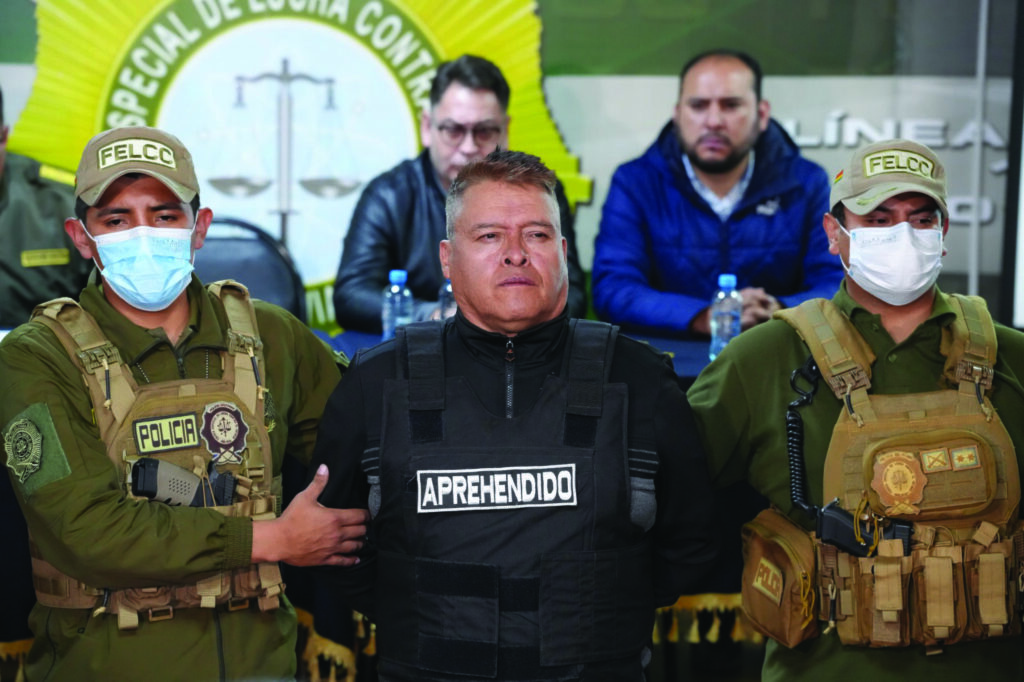
Bolivian authorities arrest General Juan José Zúñiga for his suspected role in a failed coup attempt against President Luis Arce (pictured above). Zúñiga claims the alleged mutiny was a hoax
The conservative opposition, including two jailed leaders, denounced the scenes in Plaza Murillo. Even Morales rallied to the defence of his estranged ex-comrade. After the heavy-duty vehicles smashed their way into the palace shortly before 4pm, the beret-clad general and his men marched through the buckled gates and inside. There they were confronted by the president and his cabinet in the hallway beneath an ornate chandelier. Arce’s close-protection team recorded the dramatic face-off on their phones. “I am your captain,” barks the president, just inches from the stony-faced Zúñiga. “Obey my orders. Return to the barracks, this instant!”
For Reyes, the Hollywood feel of proceedings was suspicious. As a bodyguard, “the first thing you have to do is look after your VIP, and put your body between them and danger. But they were filming.” What’s more, Reyes adds, “Protocol is that you need to protect him, take him somewhere where his life isn’t in danger. From there, he can address the people.” The Casa Grande del Pueblo – the adjacent 29-storey skyscraper which holds the presidential suite – is topped with a helipad for exactly this kind of eventuality, she notes. “They should have put him in a helicopter and taken him somewhere safe.”
What’s more, Reyes continues, “you don’t keep the president and vice-president in the same place.” If the head of state is captured or killed, his deputy can take over. But both Arce and his second in command, David Choquehuanca, took part in the showdown – and neither was wearing a bulletproof vest. Moreover, the interior minister and his security chief were caught on camera laughing and joking barely a metre away. Arce’s partisans have chalked up the giggles to nerves – and attributed their leader’s disdain for basic security procedures as a reflection of his courage. If the danger posed by Zúñiga and his band was genuine, Reyes adds, Arce’s decision to confront him was “an act of total irresponsibility”.
“They talked,” Reyes continues. “And then Zúñiga turned and went. And they let him go, they didn’t detain him.” Arce swore in new leaders of the army, air force and navy, who ordered the mutineers to disband. The tankettes trundled away, chased by a crowd of jubilant demonstrators, some of them aiming kicks at the retreating squaddies. The official version is that these were people who spontaneously rallied in defence of the republic. But “the majority of them,” Reyes claims, “were public employees”. Despite the alarming images on social media, she had gone out to fetch her daughter from a tennis club, stopping to grab a coffee along the way. “I knew this wasn’t a big deal,” she explains. “I have experience with this kind of thing.”
Many shared her sang-froid. The streets were busy; government ministries had let their workers go home early. But rather than hunkering down at home, Reyes argues, “they were stocking up on eggs and toilet paper, and trying to take money out of the bank.” Some savvy entrepreneurs saw an opportunity to cash in on the crisis, confected or otherwise. A burger joint advertised a promo golpista – or “coup-on” – via TikTok, splicing footage of the tank ramming the Burnt Palace with a crispy, marinaded pork sandwich. “I don’t know anyone,” says Reyes pointedly, “who thinks it was an attempted coup.”
Suspicions of an inside job were stoked on the same evening, when the authorities caught up with Zúñiga, who gave a short interview on camera. He had met with Arce on Sunday, he said. “The president told me, ‘The situation is seriously fucked up. This week will be critical. So we need to prepare something to boost my popularity.’ I asked him, ‘Let’s bring out the armoured cars?’ He says, ‘Do it.’” As the press scrum heaved, a reporter repeatedly yelled, “It’s a self-coup, general?” Zúñiga replied matter-of-factly, before being bundled into a police car, “Yes, yes.”
A minister later confirmed that the general and the president had met that weekend to play basketball. “There was a very close relationship between Arce and Zúñiga,” says Reyes. The former economist had promoted the career intelligence officer over dozens of more senior personnel to lead the armed forces in 2022. Zúñiga had since styled himself “the people’s commander”, inaugurating public works with his wife “as if… they were running a mini-government”, Reyes notes. “He couldn’t do that without the approval of a minister, of a president.”
Three months on we still know few of the details, Reyes cautions. Before the alleged coup unfolded, Arce was rumoured to be preparing to fire his commander: perhaps this triggered a genuine split. Few and contradictory statements have since been made by Zúñiga and his lawyer. The general has been kept out of Chonchocoro, Bolivia’s only high-security jail. Dozens more soldiers and officers have been arrested or gone into hiding. A cross-party group of senators have formed a commission to investigate what happened on 26th June, but Arce and his ministers seem unlikely to cooperate, Reyes argues. “They’re not interested in the truth or transparency.” Morales now accuses his former right-hand-man of “lying to the Bolivian people and the entire world.”
If the coup attempt were staged to rally Bolivians behind Arce, it seems to have backfired, Reyes adds. “The government has so little credibility, and this only made things worse. Even with all their government-controlled and allied media outlets, they haven’t managed to make their message stick. There were memes mocking every single moment of that day.” The images of armed men storming the seat of government, broadcast around the world, will only further weaken the boliviano against the dollar and add to Bolivia’s economic woes, she fears.
And it could soon be repeated, Reyes warns, potentially dragging the country back towards its tumultuous history. “There’s been a degrading and a weakening of institutions in the country: not just the army, but the courts and parliament too. If the government sees they can use the army for political ends, they won’t hesitate to do it again.
Slow Journalism in your inbox, plus infographics, offers and more: sign up for the free DG newsletter. Sign me up
Thanks for signing up.