
Justice in the balance
One of Labour’s five missions for government was to raise confidence in the criminal justice system “to its highest levels”. At the heart of this challenge is the need to tackle the UK’s backlogged courts, whose dysfunction has repercussions both for the country’s police service and its prisons. But how deep do the problems run?

The ‘Lady of Justice’, a statue on top of the dome of the Old Bailey in central London
5th December 2024 (Taken from: #57)
“You really have to gear up mentally to do it. I couldn’t sleep and I didn’t eat properly for at least two weeks beforehand,” says Naomi Wilson*. “When I heard the trial was postponed, I just got a knot in my stomach because I couldn’t handle the thought of having to go through it all over again.” In 2023, Wilson was due to testify against a man accused of assaulting and seriously injuring her brother with a weapon in a fight outside a pub in a town in the southeast of England. The trial was delayed twice – once because of a technical malfunction at the courtroom and the second time because the prosecution lawyer’s previous trial overran.
“I had to turn over the [television] channel if a courtroom drama came on. I even had this anxiety dream about being in the court and not being able to speak – I’d open my mouth but no sound came out,” says Wilson. Although the accused was being held on pre-trial remand, the two families came from the same town and knew each other. “I’d worry about running into his mum or sister if I went down to the shops or his friends at the gym… I was hyper-vigilant. People posted nasty stuff on Facebook. It affected my mental ability to be there as a mum to my kids. Thank God my partner was able to pick up the pieces. My brother got bad depression and anxiety. He couldn’t work, he didn’t want to leave the house any more so he moved back in with our parents, which put a lot of worry on them too… everyone in the family was under huge stress,” she tells me.
The experience of the Wilson family is increasingly becoming the norm for victims navigating the court system in England and Wales. Over the last five years, the number of pending crown court cases has more than doubled. In September 2024 the latest figures published by the Ministry of Justice showed the backlog had reached an all-time high of 73,105. And it continues to grow – by almost 7,000 cases in England and Wales in the first nine months of 2024 alone.
The system is basically in crisis. There aren’t enough courtrooms to deal with cases and when there is a courtroom, there’s not a judge available” — Zayd Ahmed, chair of the Young Criminal Bar Association
The figures are not surprising to those working in the justice system. “The system is basically in crisis. There aren’t enough courtrooms to deal with cases and when there is a courtroom, there’s not a judge available and when there is a judge available there’s not enough lawyers to try the case,” says Zayd Ahmed, a criminal barrister and chair of the Young Criminal Bar Association.
“There are times when everyone is ready to start a trial – witnesses, lawyers, the defendant, the victim – and at the last minute we find out, for example, that the judge isn’t available because their previous case has overrun and a replacement can’t be found. And then what happens? Everyone’s time is wasted. The whole trial is postponed, maybe for six months, maybe more… Witnesses’ memories fade, victims feel let down and the backlog gets bigger and bigger.”
The average time it takes from a crime being reported to a verdict being reached in the crown court (which deals with the most serious offences) increased from 16 months in 2019 to 22 months by the end of 2023. Many of the most complex and serious cases take significantly longer.
By the time the Wilson family finally got their day in court around eight months had passed since the original trial date and it was nearly a year and a half since the night of the attack at the pub. “On the one hand I was just relieved it was over, but on the other I felt angry because I couldn’t understand why it took so long to get to this point,” Wilson tells me. “But then one of the lawyers told me that we were actually lucky and that there are people who wait much longer than we did, so I guess it could have been worse.”
Sexual violence is a crime that takes away agency and control and so this kind of experience is a secondary traumatisation for survivors” — Maxime Rowson, policy lead at Rape Crisis England and Wales
Trials are now being listed in some courts for the beginning of 2028. “We all know the adage: ‘Justice delayed is justice denied’. A trial set-down date that is three years in the future is just completely unacceptable and shows what extremely dire straits our justice system is in,” says Richard Atkinson, president of the Law Society, a professional body representing solicitors in England and Wales.
Troublingly, in 2023 more than one in five outstanding cases related to sexual offences. “In this type of case, although we are talking about very serious crimes, the accused often doesn’t have previous convictions, they have employment, a stable lifestyle, what we call ‘good character’, and so they mostly get bail,” explains James Oliveira-Agnew, a criminal barrister specialising in sexual offences. “Because priority goes to cases where the accused is in [pre-trial] custody, sexual offences tend to be lower down the list for scheduling… The result is that I have to explain to complainants, to manage their expectations, that for this type of offence it could take three or more years from the start of a police investigation to trial completion…. [consequently] what we are seeing is that more and more complainants just drop out of proceedings because, understandably, they don’t want their lives to be defined by this terrible, traumatic event for years to come.”
The scheduling and re-scheduling of sexual offence trials is further complicated by the fact that hearings of this category of offence typically take several days, so they are less easily slotted in to last-minute gaps that become available in a courtroom’s schedule. Additionally, barristers and judges need to be suitably trained and experienced to try serious sexual offence cases, meaning a smaller pool to draw from.
Between 2019 and 2024, there was a threefold increase in the collapse of adult rape prosecutions after charges were withdrawn by the complainant. “It’s not just the long wait to get to court, it’s the being let down repeatedly. Getting a trial date and then having it put back, waiting for that new date, and then potentially having the same thing happen all over again,” says Maxime Rowson, policy lead at Rape Crisis England and Wales. “Sexual violence is a crime that takes away agency and control and so this kind of experience is a secondary traumatisation for survivors – the message is that their case, what happened to them, is not important… A lot of survivors we speak to say the experience has reduced their trust in the criminal justice system. Some report feeling suicidal or even attempting suicide and, worryingly, many say that they wouldn’t report this type of crime to the police again if something happened in the future.”
Defendants are also left in limbo waiting for trials to start. “If you’ve been accused of a crime, and that can be an extremely serious crime like rape, assault or murder, then that charge is hanging over your head until a verdict is reached,” says Ahmed. “Although there is, of course, the presumption of innocence, in practice this waiting period can impact on employment and education possibilities and mental health. It puts a huge strain on relationships with friends, partners, children, parents; it really affects every aspect of a person’s life.”
As cases stack up on courtroom dockets, remand detainees – being held in custody awaiting trial or sentencing – are further swelling the populations of England and Wales’ already desperately overcrowded prisons. In August 2024, the number of people being held on remand reached a record high of 17,711 with 11,366 – or more than one in eight prisoners – having not yet been convicted of an offence. Remand prisoners are more vulnerable than other detainees as they are held in Category B prisons which have some of the worst conditions and are the most overcrowded. Moreover they often do not have the same access to services, such as mental health support, drug treatment, and education and training opportunities as sentenced prisoners. In 2021, remand detainees accounted for 42 percent of prison suicides despite only making up 16 percent of the prison population.
Legally, remand prisoners should have their cases heard within six months but increasingly that isn’t possible. “It’s becoming more and more common that custody time limits are being extended repeatedly simply because there isn’t capacity in the courts… I had a recent case where a young man was held on remand for nine and a half months and was then acquitted,” says Ahmed. “There’s no recompense for that extra time spent in custody due to court delays. It’s just a case of tough luck and maybe, at best, the judge will say: ‘Oh I’m sorry that you’ve had to be held this long.’”
Ahmed’s client is far from the exception. In 2023 more than 2,500 remand prisoners in England and Wales had been held for more than six months, while another 2,000 had been in custody for over a year. More than a third of remand prisoners will ultimately be acquitted or given a non-custodial sentence.
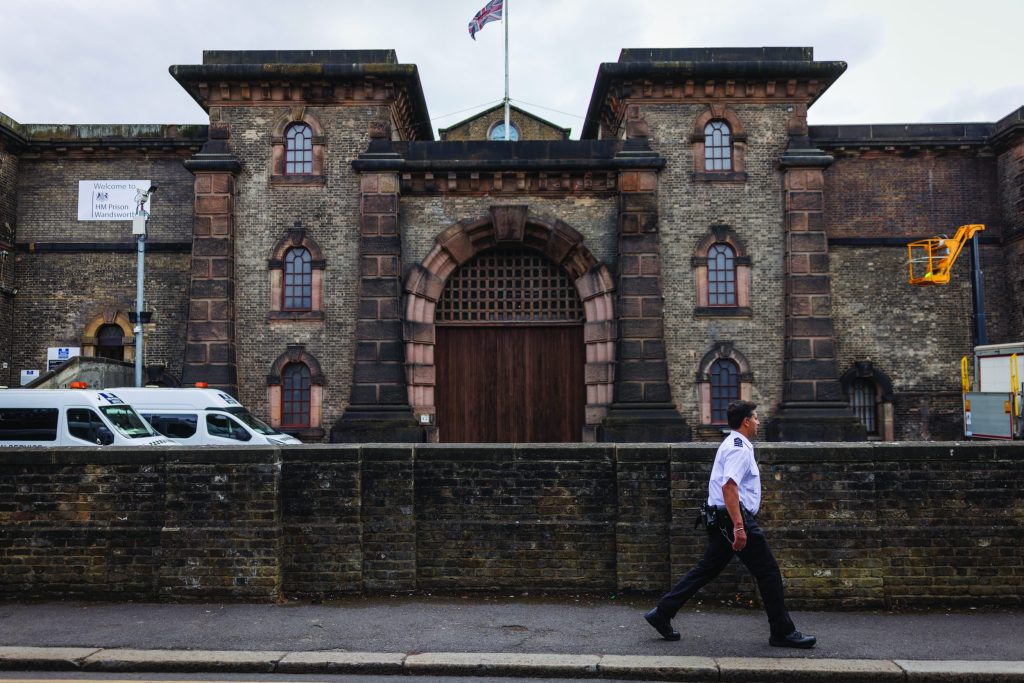
A guard walks past HMP Wandsworth prison in London on 12th July 2024, the day justice secretary Shabana Mahmood says that “if we fail to act now, we face the collapse of the criminal justice system”
With the wait times for their trials likely to start growing ever longer, lawyers warn that some remand detainees are pleading guilty just to get an earlier release. “We will never advise someone to enter a guilty plea if they say they didn’t commit the offence. But the reality is that you have defendants who are on remand for offences that carry relatively short sentences, like burglary, and they know roughly how long they will get if they are found guilty,” explains criminal barrister Oliveira-Agnew. “When they do the calculations, the sentence they will receive with an early guilty plea can be shorter than the time they will spend on remand waiting to go to trial… If their main concern is getting out [of prison] as quickly as possible then pleading guilty might be the way to achieve that. ”
As the time between an alleged offence taking place and a court date grows ever longer, cases also risk being derailed by witnesses who can no longer be contacted or whose memories fade. “We’re now asking people to recall events that took place, not months, but years prior. Witnesses get on the stand and say: ‘I don’t know. This happened three years ago. I can’t remember the details, but if I said that in my police statement at the time then that must be what happened,’” says Oliveira-Agnew. “For juries this creates an element of doubt… and that makes prosecuting cases, especially those that depend heavily on testimony, a lot harder.”
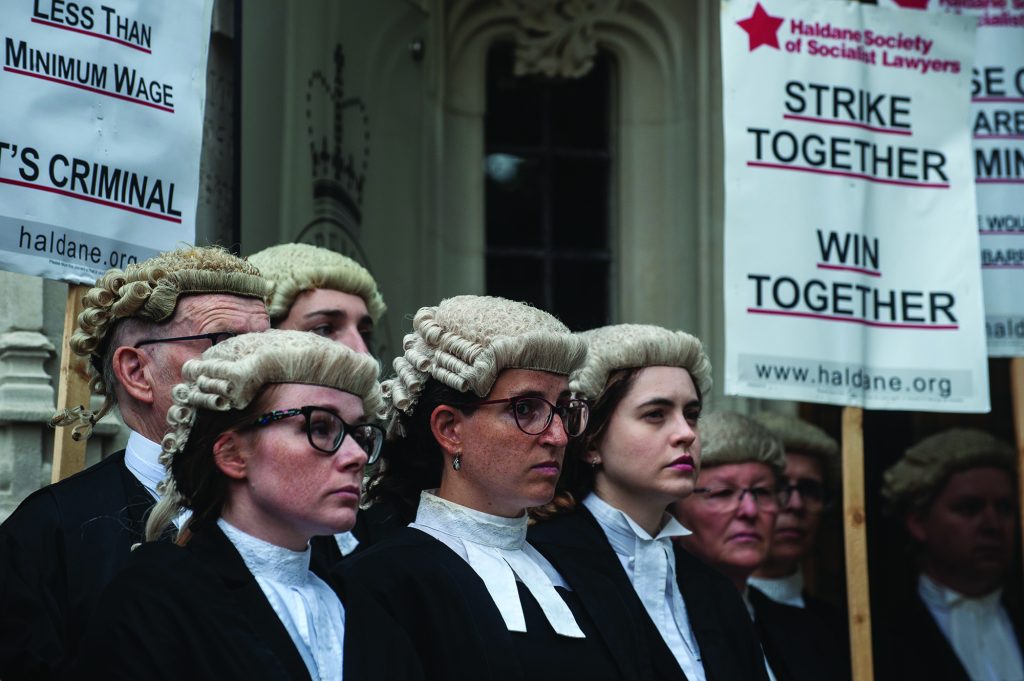
Criminal barristers protest at the Supreme Court in London on 6th September 2022. Their strike ended a month later after the government offered a pay rise of 15 percent on legal aid fees for most crown court cases
Conservative politicians have been keen to blame the backlog on court closures and social distancing measures during the pandemic and a strike by barristers in 2022. “It’s convenient to point the finger at Covid and the criminal bar strike but the underlying problems pre-date that and have continued subsequently,” says Law Society president Richard Atkinson. “As we have warned for years, the system has been neglected and is operating well beyond capacity, so when there is a shock to it, like the pandemic, then it cannot cope.”
From 2009 to 2023 successive governments cut the justice budget, which fell by 22 percent in real terms even as government spending rose by 10 percent overall. Between 2012 and 2023, funding for criminal legal aid – the pot of money that finances publicly-funded defence work and legal advice – fell in real terms by nearly 30 percent. Meanwhile, between 2010 and 2019, the allocation of all-important ‘sitting days’ – a budgetary metric used by the government to determine how many working days courts are allowed to ‘sit’ for in a given financial year – dropped by more than a quarter.
Even judicial buildings have been subject to austerity measures. Between 2010 and 2019, some 295 courthouses and tribunals were shut down, including 162 magistrates’ courts and eight crown courts, in a bid to save money when crime appeared to be falling (it later rose again). Around £223 million was raised from the sale of the buildings. Meanwhile, the remainder are increasingly falling into a state of disrepair due to a lack of budget for maintenance work. The National Audit Office estimated that as of October 2024 the bill for outstanding repairs to courts and tribunals stood at £1.3 billion.“We’ve become used to the fact that everything is, quite literally, falling apart,” says barrister Oliveira-Agnew. “There’s a court in Kent where, famously, if it rains heavily then water pours through the ceiling and cascades down the stairs.”
In a 2022 survey of 500 solicitors the Law Society found that nearly two thirds had experienced delays to their cases in the last year due to problems with a court’s infrastructure. Among the issues reported were chairs held together with gaffer tape, leaking ceilings, broken floors and windows, air-conditioning units and heating systems not working, no private consultation spaces, broken toilets, out-of-order lifts, a lack of disabled access, mould growing on walls and sewage flooding custody cells.
“The physical condition of the court estate is terrible; it’s quite literally crumbling around us – much like our justice system is – and that lack of maintenance is costing us dearly in wasted time and resources when cases are delayed and courtrooms sit empty because they are not fit for purpose,” Atkinson tells me. A case in point, he says, is Victoria Law Courts in Birmingham. Between 2022 and 2024 a faulty fire alarm system led to more than 4,000 sitting days being lost at the grand terracotta and red brick fronted courthouse, which has been in operation since the start of the 19th century.
There’s a court in Kent where if it rains heavily, water pours through the ceiling and cascades down the stairs” — James Oliveira-Agnew, barrister
Problems are compounding in other areas too. Repeated reductions in legal aid funding have led to solicitors and barristers leaving criminal law in droves as wages fell in real terms. “For the best part of three decades there has been no increase in fees for [publicly funded] criminal lawyers… it’s become one of the worst paid areas of law,” says Atkinson. “Heads of law schools at universities are telling me that they advise students not to do publicly-funded work because it’s just not financially viable.”
Although strikes by barristers and legal action by solicitors did force pay increases of 15 percent and 12 percent in 2022 and 2024 respectively, professional bodies warn that the fee hikes, particularly without longer-term guarantees of future inflation proofing, are not enough to lure lawyers back into criminal practice.
Between 2018 and 2023, the number of duty solicitors fell by around a quarter and the profession is failing to attract young people – less than four percent of duty solicitors are under 35 years old. Meanwhile, the number of firms carrying out legal aid work has dropped from 1,212 to 916. Those that continue to work in the field face working longer hours and more gruelling night shifts as fewer solicitors struggle to provide round-the-clock coverage. “We are being contacted by police forces who report that they can no longer get duty solicitors to the station in sufficient time and, as a result, they are having to bail suspects. That’s extra work for the police and, of course, think about the impact that has on a complainant who is told the suspect wasn’t even interviewed, that they’ve been released because it wasn’t possible to get a lawyer to the police station,” says Atkinson.
Barristers too say that growing work pressures have led many to quit the field for good. “Since I joined [the bar] in 2018, I know of about 20 barristers that have left [criminal practice]. They’ve gone to family courts or litigation. The workload has increased and the money has stagnated so it’s just not worth it for a lot of people,” says Ahmed. With lawyers leaving publicly-funded criminal work en masse, trials are being delayed because there simply isn’t a barrister available to work. In 2023, more than 1,400 crown court trials were postponed due to either the defence or prosecution advocate being unavailable – a six-fold increase on 2014.
For barristers, last-minute trial cancellations mean reduced or even no pay. “We only get paid when the case goes ahead,” explains Ahmed. “It doesn’t matter that you’ve done all the work to prepare, if the trial doesn’t happen, for whatever reason, then you don’t get paid… And if it’s rescheduled you might not be able to keep it if you already have another trial on those dates, so in that scenario the time you spent preparing is unpaid and wasted – it’s just grossly inefficient and short-sighted.” Failure to recruit and to retain lawyers in criminal practice also has a knock-on effect on recruitment of judges, who are drawn from the ranks of criminal solicitors and barristers.
Retired crown court judge Peter Collier says that restoring the justice system can’t be done overnight. “When you have a sustained period of fewer barristers, fewer courtrooms and fewer judges then you can’t just suddenly take the cap off and increase the number of sitting days because you’ll find there’s no one showing up to try the cases,” he tells me. “You’ve got to build up the core of people with experience and training and then you can increase the number of cases being tried… I think it’s a very long-term objective right now.”
If people don’t believe they can get justice through the court system, then they will look to get justice themselves”— Richard Atkinson, president of the Law Society
In a bid to battle the backlog, the new Labour justice secretary, Shabana Mahmood, announced in December 2024 that the government had commissioned a comprehensive review of the court system in which “no reform is off the table”. The review, spearheaded by retired judge Sir Brian Leveson, who previously led the 2012 Leveson inquiry into press ethics and standards – as well as a 2015 report into how to increase efficiency in the criminal justice system – will consider an array of “ambitious” measures to “challenge current thinking”. Announcing the review, Mahmood said that “The scale of the crown court crisis inherited by this government is unprecedented… we simply cannot continue with the status quo. [To] make our streets safer, we require once-in-a-generation reform of a courts system stretched to breaking point.”
Ultimately both the root of the problem, and the solution to it, criminal justice practitioners say, is relatively straightforward. “More money,” says Atkinson. “There are many out there that are desperate for a different answer because budgets are constrained, but unfortunately there isn’t one. I am sympathetic to this government, I appreciate the difficulties that have been visited upon them, they are faced with a criminal justice system that has been underfunded for decades, but that can’t just be magicked away. Whatever else they do the government must increase spending on the criminal justice system.” Failure to do so, Atkinson warns, risks fatally undermining public confidence. “If people don’t believe they can get justice through the court system, then they will look to get justice themselves and that is a deeply alarming thought and a road we do not want to go down,” he says.
In mid-2024 the man who assaulted Naomi Wilson’s brother was found guilty and sentenced to 18 months in prison but was released shortly after due to the time he’d spent on remand. “The whole time waiting for the trial to happen was terrible for our family, really difficult… We were also in our own kind of psychological prison,” she tells me. “So no, it doesn’t feel like we got justice because we, the victims, were suffering all that time and then, even though we got a guilty verdict, the criminal just walked out of prison a free man on almost the same day.”
*Name changed at interviewee’s request to protect her identity
Slow Journalism in your inbox, plus infographics, offers and more: sign up for the free DG newsletter. Sign me up
Thanks for signing up.