“The sky fell on us Valencians”
October 2024 saw massive flooding around the Spanish city of Valencia, with devastating consequences. Lluís Vila Soriano reports on the aftermath of a disaster that unleashed a powerful wave of citizen solidarity – and exposed major dysfunction in the political class
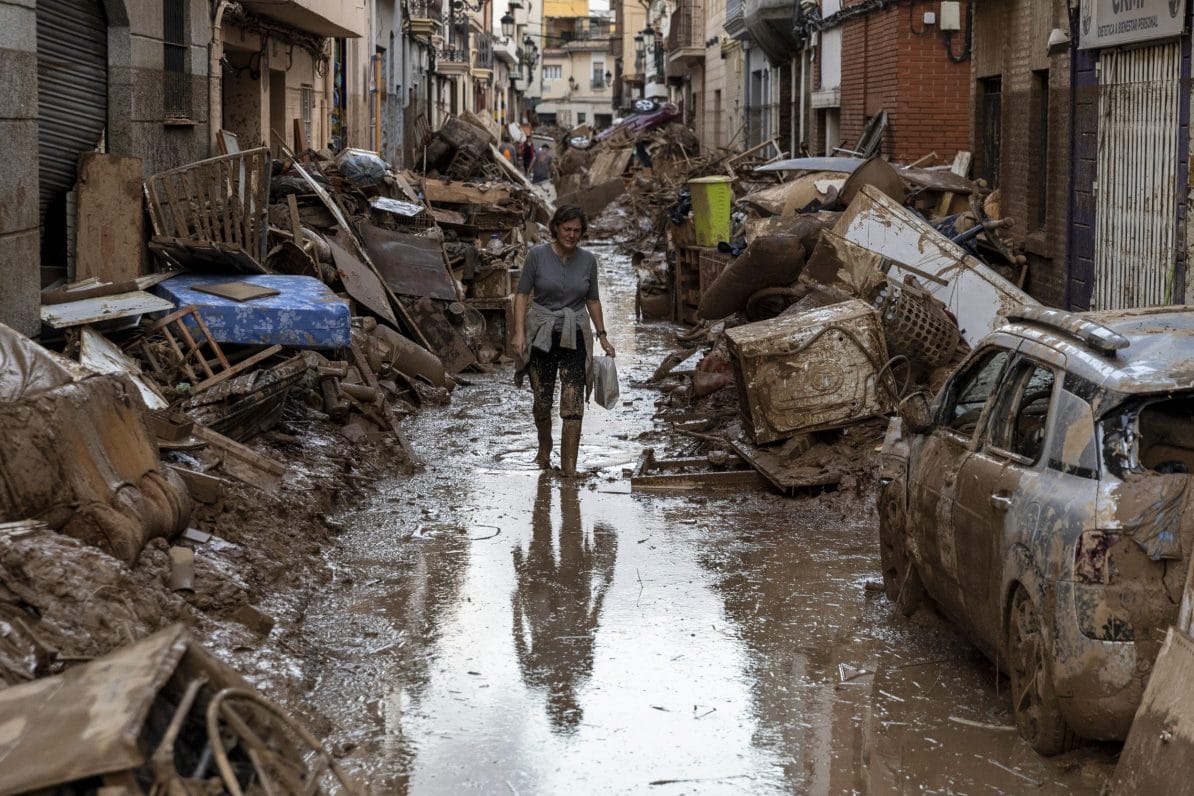
A woman walks along a street filled with mud and waste left behind by flooding in Paiporta on 2nd November 2024
Published March 2025 (Taken from: #57)
Just after 6pm on Tuesday 29th October, Alfons Lloret and his partner Anna Piedra Carbonell set out for the ten-minute drive from the centre of Valencia to the village of Massanassa. In the car with them were his six-year-old boy, nine-year-old girl and their dog. It was a journey they took together each week, to drop his kids off with his ex-wife, with whom he shares custody. “We left like any Tuesday or Thursday, when we do the handover,” he tells me two months later. “We looked at the forecast and saw the amount of rain that was falling west of Valencia, in Requena and Utiel, and that it was coming this way. So we decided to go earlier to avoid driving in the rain.”
Everything seemed normal. “No one told us not to leave Valencia,” Lloret continues. “As we drove out, there were people loading their cars in the shopping centre, going about their normal lives. We entered Massanassa, and when we approached the narrower streets of the centre, I said to Anna: ‘What’s that? It looks like water.’ We turned a corner and a man shouted at me: ‘Go back, go back! The ravine has burst!’ I went a little further and we saw three feet of water heading towards us.” A muddy tide was moving inexorably through the town centre. Lloret tried to head for higher ground, looking anxiously for a safe place to stop. “It was very strange, we passed a gym with a glass front and saw people still working out as if nothing was happening.”
Things quickly got worse. “We drove onto a wider avenue but there was also a lot of water there, which began to rise rapidly. People started taking cars out of their basement garages, which added to the traffic, creating a bottleneck.” They were trapped. “The water rose very quickly then and I was scared because of the children,” says Lloret. “Huge dumpsters began to float towards us. One hit us and I had to lower the window to try to move it away. The children were frozen with fear.”
A gap opened up in the traffic and they were able to reach a dead end street and park the car. “But then we saw a tsunami of water, reeds and junk coming along the street, like a wave breaking,” says Piedra Carbonell. “A woman was looking out of her front door and we asked her if we could come in. We got the children inside her house, closed the door and tried to calm them down. Then the water started to come in under the front door. The children became hysterical, we took them up to the next floor and we didn’t let them come down again.”
Lloret’s family and their dog spent the night on the second floor of their rescuer’s house. They were joined by a man whose elderly mother lived on the same street and had taken refuge after being caught out by the rising waters. Lloret eventually managed to get his children to sleep and then he and the other adults watched through the window as his car was swept away and destroyed. The man who was sheltering with them could only look on, helpless, as his mother’s house, visible at the end of the street, began to fill with water. Mobile phone masts had been knocked out, so he was unable to contact her to see if she was okay.
There was a constant thundering sound throughout the night, as the floodwaters continued to rise, wreaking havoc throughout the village. “The water folded up everything and washed it away, we saw it pull down a giant billboard like it was nothing,” says Lloret. At one point they heard the whistle of the last train that passed through Massanassa without stopping at the station, just before the water overflowed the dam formed by the tracks.
Then, at around five o’clock in the morning, came the silence. “That moment was actually the most distressing,” recalls Piedra Carbonell. “The silence and darkness were absolute.” The moment of eerie calm was broken when people began to go out to look for loved ones who had not returned home. “You could hear voices shouting out names as loud as they could,” says Piedra Carbonell.
When the sun came up, the scene outside was apocalyptic. “We went out into the street and it was like The Walking Dead but we were the zombies, we couldn’t understand how the water could have done what it did,” says Lloret. “I went to the railway and the tracks were covered in cars, trucks, furniture. There was the interior of a pub: the bar, the tables, the chairs, the bottles… a whole pub on the train tracks. Two days later they were still pulling people out of its rubble.”
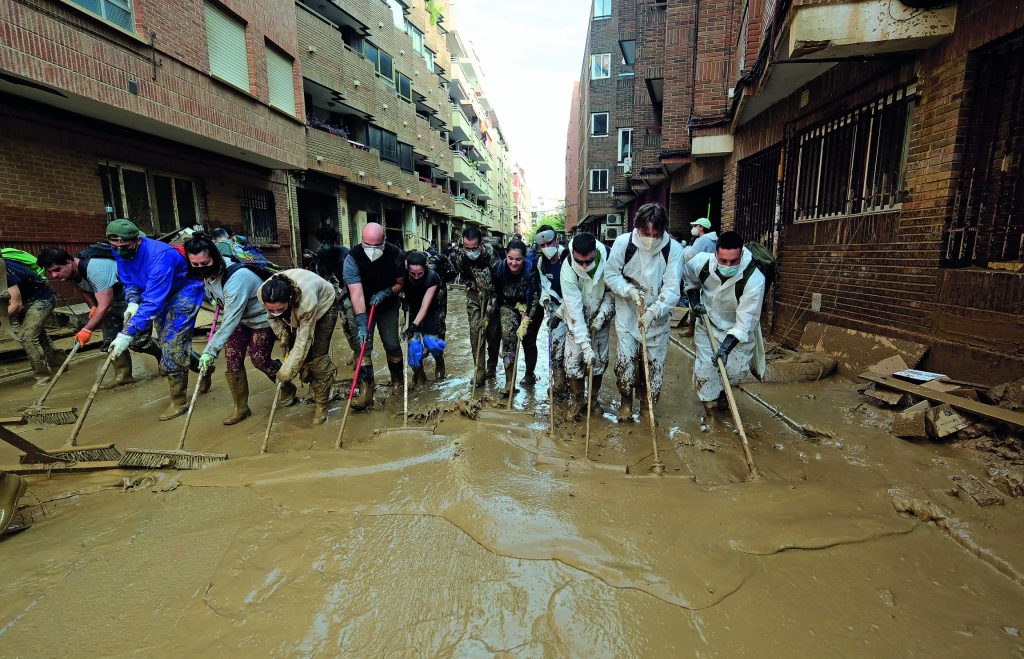
Volunteers clear out muddy water with rakes and brooms in Massanassa, Valencia, on 8th November 2024, in the aftermath of the deadly floods
What they didn’t yet know was that the catastrophe in which they had been swept up didn’t start and end in Massanassa. The Poyo ravine, a normally dry channel, had overflowed, flooding the towns to the south of the city of Valencia. The ravine is 40 kilometres long with a 1,000-metre drop, and its steep slope and impermeable basin combined with the extraordinary amounts of rain on 29th October – with 491 mm of water, more than the annual average, falling in eight hours in some places – led to peak flows of more than 3,500 cubic meters per second, greater than that of the Nile. Rivers across the Júcar basin had also burst their banks.
We saw a tsunami of water, reeds and junk coming along the street, like a wave breaking”
A total of 75 towns and more than 800,000 people had been affected. More than 230 had died, almost 20 percent of whom drowned in their basement garages as they were trying to get their cars out to flee to higher ground. Over 25,000 hectares of land – the equivalent of around 50,000 football fields – had been completely flooded, 600,000 people left without drinking water and 120,000 vehicles destroyed. The Valencian government would later request €31.4 billion from the national government to deal with the damage.
Lloret asked the police for help getting his family out of Massanassa. The children were exhausted and Piedra Carbonell, who is diabetic, needed insulin as her blood sugar levels were dangerously high. The police told them they couldn’t help and that the only way to get to Valencia, ten kilometres away, was on foot through a flood-ravaged landscape – a near impossible task. Luckily that afternoon they found a man who was able to drive them home in his 4×4. “When we left Massanassa on the road that connects the southern towns with Valencia, we saw the scale of what had happened,” says Lloret. They witnessed dozens of overturned trucks, their loads scattered, cars piled up on top of one another, a shopping centre destroyed. They saw an Audi dealership stripped of all its vehicles, washed away by the water, and vast expanses of mud lying before them as if the highway had never existed. “We thought, ‘Thank god the flood didn’t catch us here on the road, because if it had, I don’t know how we would have survived.’”
President of the Valencian government Carlos Mazón had disbanded the Valencian Emergency Unit shortly after he came to power”
Arriving back in Valencia was a shock. “The lights were on, the cars were driving around, the shops were open, everything was normal, as if nothing had happened,” recalls Lloret. “And there we were, covered in mud, with rubbish bags on our feet, it was crazy.”
In the following days, Lloret and Piedra Carbonell asked themselves the same questions over and over again. How could this have happened? Why were the roads around Valencia not closed, given that, as they later discovered, water levels in rivers and ravines had been rising rapidly throughout the day on 29th October? Why was no advance warning given of the impending flood? It wouldn’t have prevented all the damage, but it would have been enough to stop Lloret and Piedra from putting their lives – and those of Lloret’s children – in danger.
A warning message was in fact transmitted by the Valencian authorities through its Es-Alert system to all mobile phones in the region, advising people not to leave home due to the flooding. But it was not sent until 8.11pm on 29th October, two hours after the tragedy began in earnest, and most people did not receive it as by that stage the mobile phone networks were down. “Many people were sent that message when they were already dead,” laments Lloret.
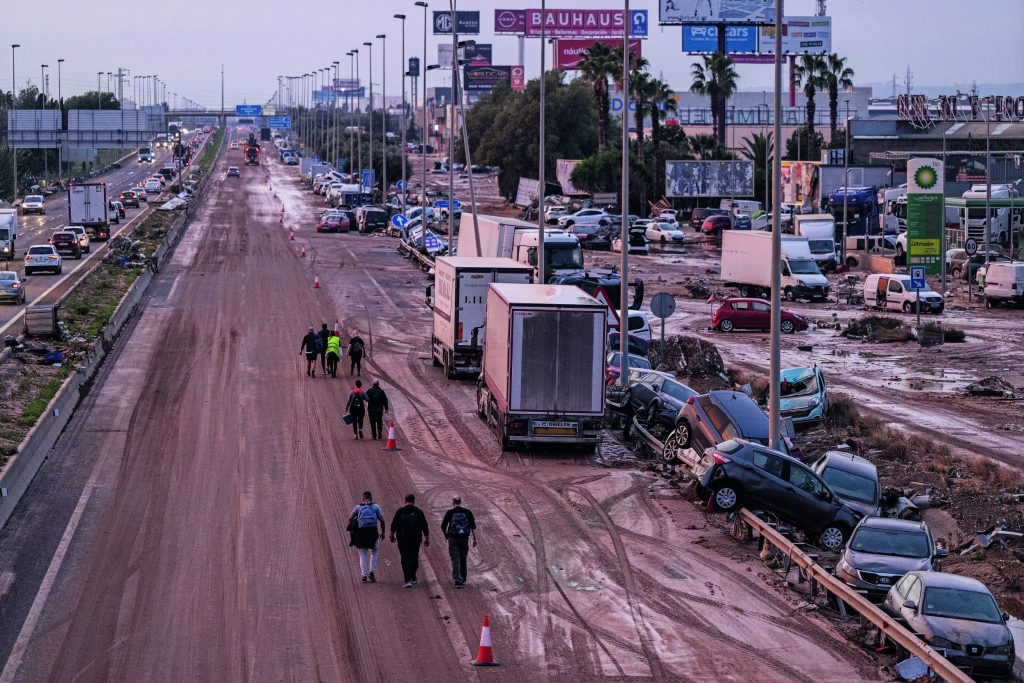
People walk past cars and trucks swept away by the flash floods on the V-31 highway near Massanassa, 1st November
Over the following weeks the performance of regional and national political leaders came under widespread criticism, both for the failure of the flood warning systems and for what were perceived as sluggish aid efforts in the aftermath.
In many affected towns and villages, official help from the police, army and fire brigade did not arrive for up to five days. In one case, a group of firefighters from France arrived in Alfafar on 1st November to help, only to discover that they were the first professional relief force to reach the village.
It was widely reported in the Spanish press that the slow response was not due to the reticence of the individual officers, but because of a political fight between the regional and central governments about who should assume responsibility for disaster relief. This was further complicated by the fact that the president of the Valencian government, Carlos Mazón, had disbanded the Valencian Emergency Unit, a short-lived body charged with “reaction capacity, efficiency in response and public protection” in emergency situations, in November 2023, shortly after he came to power.
Mazón, while accepting that “I am not going to deny failures nor is it possible to do so,” pointed the finger of blame at the Júcar Hydrographic Confederation (JHC) which is charged with tracking rising water levels in rivers and ravines. Mazón accused the organisation and its president, Miguel Polo, for failing to give updates on 29th October that could have triggered the alerts, and for sending information by email rather than calling: Polo said that multiple automated warnings had been sent, and that triggering alarms was not his organisation’s remit. “We are clear that we are not responsible,” he would later tell the media on 29th January. The JHC is a national organisation that reports directly to the Ministry for Ecological Transition in Madrid, under socialist control. Mazón, meanwhile, is from the right-of-centre Partido Popular and was formerly in coalition with the far-right Vox party.
Anger at the authorities became so widespread that when King Felipe and Queen Letizia visited Paiporta, one of the worst affected towns, with Mazón and prime minister Pedro Sanchez on 3rd November, they were met by enraged residents who threw mud and shouted “shame!” and “murderers!” at them. Sanchez was rapidly removed from the scene by his minders: Mazón stayed, surrounded by the bodyguards of the king and queen. The royal couple, by contrast, stepped out of their security cordon, engaging with the furious residents, listening to their experiences and commiserating with them, their faces stained with mud.
Into the vacuum left by the official rescue response marched an army of civilians, who flocked to the affected towns to help. In the first two days alone, it is estimated that more than 50,000 volunteers came to the Horta Sur region, from all over Spain. Local students joined the efforts: during the days following the tragedy, schools and universities were closed and many young people donned wellies, armed themselves with shovels and brooms and headed on foot to the affected towns.
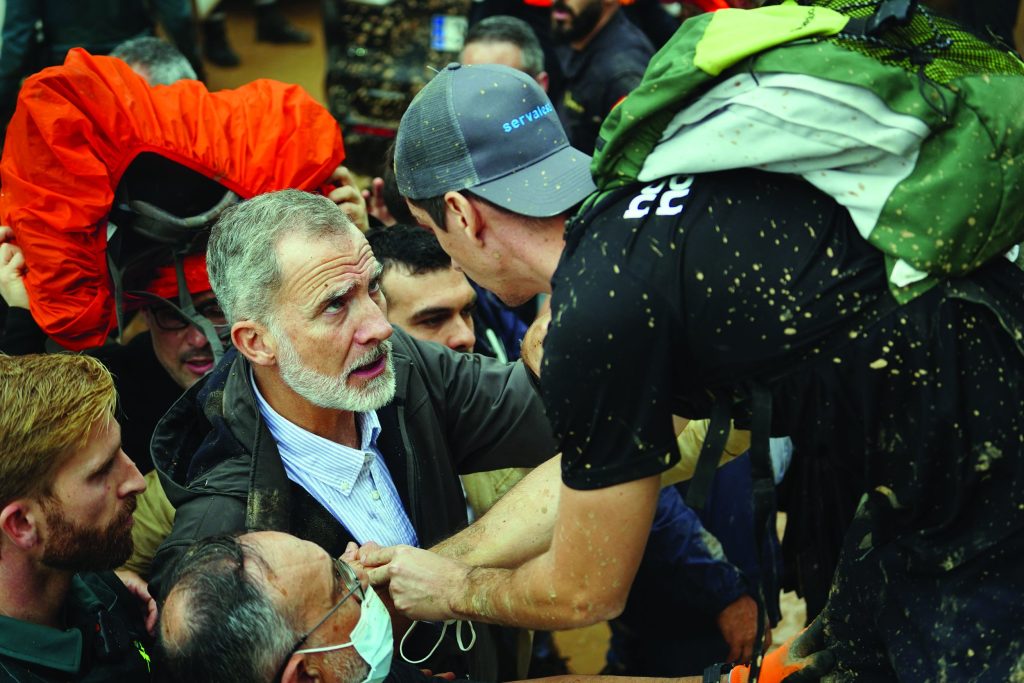
King Felipe VI of Spain talks with a resident during his visit to Paiporta, Valencia, on 3rd November 2024. The king and his party were heckled by some locals, who screamed “murderers!” and threw mud at them
Among all the initiatives that arose after the flood, one of the most effective was led by Lluch Escudero and María Pere in Algemesí, a town 40 kilometres from Valencia that was devastated by the flooding of the Magro River, a tributary of the Júcar.
Pere, a primary school teacher in the village of Barxeta, near Algemesí, met Escudero on Instagram as they both looked for ways to help in the wake of the flood. They set up a WhatsApp group together to coordinate the work of volunteers which gained 300 members on its first day and swiftly went up to 900. “Every morning we met up in person at 8am and we organised the activities, allocating the tasks that had emerged the previous day,” says Pere.
The first few days were spent clearing away mud. “The streets were half a metre deep in the stuff, which was stopping doors from being opened and flooded houses from draining,” adds Escudero. “We had to make pathways through the mud so that people could get out of their houses. We did not gain access to many of the houses until the third day.” The drains were blocked with mud too, making many toilets unusable.
Over the next few weeks, Pere and Escudero’s group went from house to house, taking note of residents’ specific needs and organising lists of tasks. Their help was especially needed in the working class Raval neighbourhood of Algemesí. “In Raval there are many families who were struggling even before the flood,” says Escudero. “These people lost everything. On the Avenida Carlet, which runs from the school to the railway line, the water punched a hole through all the houses. You can walk into the first house and continue all the way through and out of the last one.”
The volunteers encountered many desperate situations – people with reduced mobility stuck in their flooded homes, chronically ill people lacking medication, children left in unacceptable, unsanitary conditions. The clean-up work itself took a toll. “Five days after the flood, many people who had spent their time removing mud in wet boots with wounds on their feet had developed infections,” says Escudero. “We put up a post asking for volunteer nurses, and that day we had one going from house to house carrying out treatments, cleaning and stitching wounds.”
Pere started WhatsApp groups dedicated to individual tasks like collecting furniture, coordinating clean-up operations, meeting pharmaceutical needs and providing mattresses to homes where they had been damaged. She shows me her mobile phone: she has 208 separate WhatsApp groups relating to the flood. “What I keep thinking is, how could we, with our simple phones, have managed to make all this happen, and how could the authorities, who you expect to have all the knowledge, have responded so poorly?” says Pere. “We were contacting companies that wanted to help out… we were coordinating everything.” The authorities, she says, “should have organised all this, they have all the information and all the skills to do it. They could have organised vouchers to cover basic needs, beds, mattresses… In Raval there were children sleeping on floors covered in mud.”
For Escudero, the official response to the crisis across the region has been beyond negligent. “What the authorities have done is a crime,” she says.
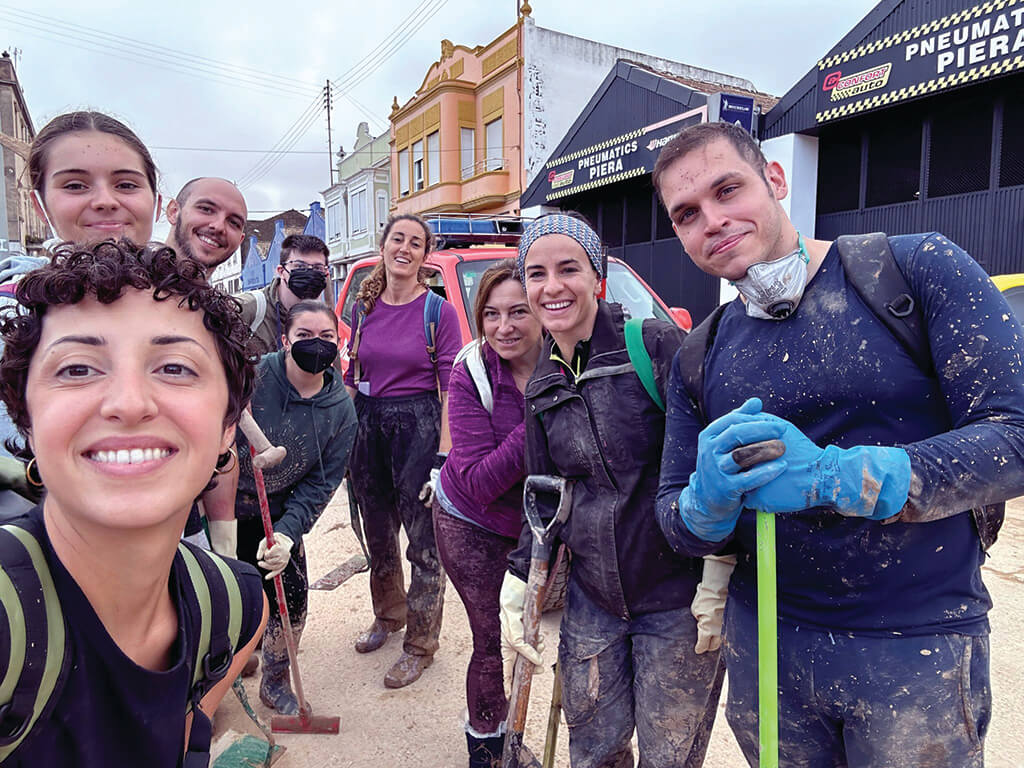
A clean-up team led by Lluch Escudero (front, left) and María Pere (second from right) in Algemesí, Valencia
Valencian society reacted to official failures with a demonstration on 9th November that brought together an estimated 130,000 people at the gates of the palace of the Generalitat, the government of the Valencian Community. They called for the resignation of Carlos Mazón, and demanded that Pedro Sánchez, the socialist prime minister of the national government, take responsibility for the response to the disaster.
At the end of the march, three people affected by the floods read out a manifesto. “On Tuesday 29th October, the sky fell on us Valencians. It was not only because of the… rain, but also because of the worst episode in the history of political ignominy and human tragedy on this land. Instead of protecting the population, the government of the Generalitat limited itself to trying to cover up its negligence of this crisis… The people of Valencia were abandoned to their fate for five days and forced to work in solidarity to do tasks that are the responsibility of the emergency services.”
The reading of the manifesto was followed by chants of “mentres sopaba, la gent s’ofegaba” (“while he was eating, the people were drowning”). This referred to reports in the national press that at 6pm on 29th October, after the emergency managers of the Integrated Operational Coordination Centre had already been in a meeting to address the flooding for an hour, Mazón was just finishing a long lunch with a female journalist in Ventorro, a smart Valencian restaurant, not arriving at the Emergency Coordination Centre meeting until 7.30pm. (Ventorro’s Google ratings have since been hijacked by angry citizens, posting darkly satirical one-star reviews describing it as an “epicentre of Valencian corruption” and a “meeting place for undesirables” and noting that “There is very little phone reception… you can be totally cut off for hours.”)
The manifesto also highlighted the apparent inaction of Sánchez, “who should have put immediate and forceful pressure on the Valencian government in the face of its inaction to intervene with all available personnel and help citizens rebuild their lives.” Further mass demonstrations took place on 30th November and 30th December.
But beyond the political failure lies the story of extraordinarily torrential rains falling on an extremely vulnerable population.
“We have seen massive and unregulated urbanisation, with basements and garages built in flood zones”
It was widely reported in the aftermath of the flooding that climate change was to blame for the huge levels of mortality and destruction. Water had been evaporating at astonishing rates from an overheated Mediterranean, which is four degrees warmer than in pre-industrial times. When it came up over the land it almost immediately met a cold front, which converted it into torrential downpours: a huge volume of seawater was effectively just scooped from the ocean and dumped on a sprawling conurbation, setting multiple new rainfall records.
But episodes of torrential rain in this area and at this time of year are not unusual – there have been three in the last 70 years alone: in 1957, 1982 and 1996. However, the level of destruction wrought by October’s flood is unprecedented. In the major floods of 1957, 80 people died. In 1982 eight people died and in 1996 there were no fatalities. October’s death toll of 230 and the material damage left behind dwarfs them all.
Carme Melo, professor in the Faculty of Geography at the University of Valencia, believes that this flood was the most catastrophic in Spanish history not because of the size of the downpour, but the greater vulnerability of the citizens.
“Valencian society, especially in the southern towns, has traditionally been dedicated to the cultivation of fruit trees and vegetables, what is known as the huerta,” she says. “But in the last 70 years, since the last big flood in 1957, the region has replaced an economy perfectly adapted to the natural conditions of its terrain by one based on industry and tourism. We have seen massive and unregulated urbanisation, with almost the entire metropolitan area sealed off with roads, industrial estates and new residential neighbourhoods, with basements and garages built in flood zones.”
Cultivated land, she points out, is much more resilient to large floods than concrete, and densely populated conurbations are at much greater risk from flooding than sparsely occupied farming land. The structural changes, she says “have happened despite the fact that there has been a territorial plan on flood risk prevention since 2003, which specifies the areas at risk of flooding, as well as regulations to limit construction on the coast. But political parties on both sides, when they are in power, ignore or try to circumvent these barriers to uncontrolled urban development. Although climate change worsens the situation, the size of the tragedy was increased by the replacement of the permeable soil of the huerta with tarmac.”
Alongside the urbanisation, says Melo, is increased social vulnerability. “Knowledge about nature and the terrain has been lost,” she says. “A century ago, when ravines overflowed, society knew where to flee and where the water would flow. That knowledge has been diluted, and today a large part of the population does not know which places are safe, or even that, in a flood, running to your basement garage to get your car is the most dangerous thing you can do.”
Agriculture has been affected alongside homes and industry. Jordi and Maria Viana, farmers from Pinedo, one of the southern villages affected by the floods, lost six tonnes of pumpkins and all the machinery that they had in their warehouse, including a new tractor. But they still consider themselves lucky compared to their fellow farmers. “One big tragedy is the rice cooperative in Massanassa which is next to the motorway and lost all of its summer harvest,” says Maria. “Two thousand tonnes of rice have been lost.”
It was the much-diminished farming community that still remains in the region that mounted some of the most effective responses to the flooding, because farmers have such a strong knowledge of the local terrain as well as the equipment needed to traverse it. “All those tractors that were not destroyed were the first ones to go to help, removing cars from the roads and cleaning the paths. There were farmers who spent ten days straight cleaning and clearing streets with their tractors,” says Jordi. As with Escudero and Pere in Algemesí, volunteer aid groups were organised over social media. “The WhatsApp group that had been formed to coordinate the latest protests against the government’s agricultural policy was the first to react to coordinate the farmers,” says Jordi.
The Vianas believe the region will only become more vulnerable to fatal floods if the environmental and social functions of the countryside aren’t recognised. “The infrastructure, the urban planning and most of the policies of recent years have gone against small farmers, they have not taken into account our territory, the drainage networks, irrigation and land conditions,” says María. “And then the flood came. If reconstruction is not carried out with a different vision, we will only be making things worse.”
Three months later, in February 2025, rescue teams were still deployed on the ground in search for the remaining missing people, some of whose bodies have been found as far as 44 miles away from the place where they were last seen. For weeks after the floods, social media was full of the stories of people who had suffered unimaginable horrors on the night of 29th October, including those trapped in flooded homes for days with the bodies of loved ones who had drowned.
Three out of five affected businesses have not resumed activity and the damage to local infrastructure is overwhelming. In Algemesí, just one of the 75 affected towns, 6,000 homes and 12,000 vehicles have been damaged, along with 200 warehouses, 90 kilometres of sewage infrastructure, two theatres, the police station and the town hall.
Aid has arrived in dribs and drabs. The most immediate help came from the Insurance Compensation Consortium, a public body that takes a percentage of all private insurance to compensate people in the event of damage caused by extraordinary risks such as floods. But the procedures to claim are so complicated and the aid on offer so relatively small that many have given up on their applications. Dealing with the regular insurance companies is also proving difficult. In order to make a claim against a car lost in the flood, you have to send your insurer a photo of that car. But finding it – when it could be miles away, smashed up and buried under rubble, is challenging. “I only happened to find my car by chance,” says Lloret. “I was walking with my kids past a cementerio de coches (car graveyard) and my daughter happened to spot it, behind a pile of broken vehicles. She said ‘Daddy, it’s our car, I can see my car seat!’ I said ‘Don’t be silly!’ But it was, and so I got the picture I needed.” Many have not been so lucky.
The sea of mud has gone from affected towns but there are still queues at the aid distribution points. The main problem today is that the flooding of basements has weakened the foundations of some buildings, putting them at risk of collapse. In February, 150 people were evicted from a block of 50 apartments in Catarroja out of fears it wasn’t safe. Such evictions are taking place across the region. Pere and Escudero continued running their groups for weeks, helping with the aftermath. “I saw such suffering in that time,” says Escudero. “It will take people years to come back from this experience.”
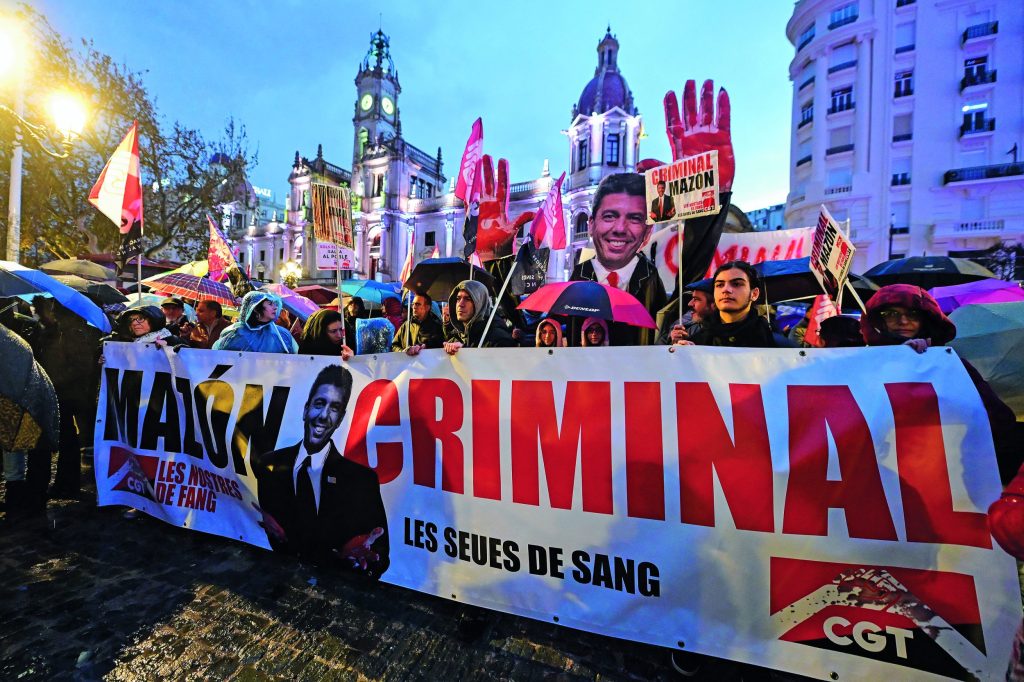
A demonstration on 1st February 2025 to protest against the Valencian government’s handling of the deadly October floods
On 29th January, a new group was launched, formed from the citizen organisations that sprang up to provide disaster relief after the flood. The non-partisan Local Emergency and Reconstruction Committees, with representation from eight of the most severely affected towns, are demanding a voice to defend the interests of the victims and to shape the decisions made over how their towns and their lives are rebuilt.
The political blame game has continued. On 6th February, El Diario reported that on the night of 29th October, the Valencian government suspended its Emergency Coordination Centre meeting between 6pm and 7.03pm to “reflect on what was happening” and formulate a response to citizens. The government refutes this. On 7th February Mazón told journalists that there had been an “information blackout” from the Júcar Hydrographic Confederation (JHC) for several crucial hours on the day of the floods and that the central government has run an “atrocious and inhuman” smear campaign against him in the months since. And then on 15th February a new report signed by Miguel Polo was published by the JHC, which laid out the series of automatic notifications about rapidly rising water levels it says that it sent to the Valencian government on 29th October, but which did not result in a stay-at-home warning being sent out.
While new evidence about what happened on the night of the flooding continues to appear, the only political consequence so far has been the dismissal of Salomé Pradas, Valencia’s counsellor of the interior, by Mazón. Pradas had admitted that she had only discovered the existence of the Es-Alert system on the night of 29th October.
Meanwhile, the ‘Mai més’ (Never Again) group has been created, with the aim of “putting those responsible for the deaths due to the floods in jail.” A large group of activists has banded together to prepare a lawsuit against the Valencian government, five of whose members it accuses of homicide by negligence, prevarication and failure to provide assistance. Among them are Mazón, Emilio Argüeso, the Valencian counsellor in charge of emergencies and Salomé Pradas.
Valencians hope that the lawsuit will help to unpick the chains of culpability that led to the lack of alarms on 29th October, and to the slow and insufficient disaster response afterwards. But alongside the push for justice, there is widespread disillusionment and resignation in the region. “The whole experience has left me with so little trust in the authorities,” says Lloret. “My family came so close to disaster, but the story is now fading away. I don’t see any reason that we will be better prepared the next time it happens.”
Slow Journalism in your inbox, plus infographics, offers and more: sign up for the free DG newsletter. Sign me up
Thanks for signing up.