On the cover: Shepard Fairey
A Q&A with Shepard Fairey, whose cover art graces issue 60 of Delayed Gratification
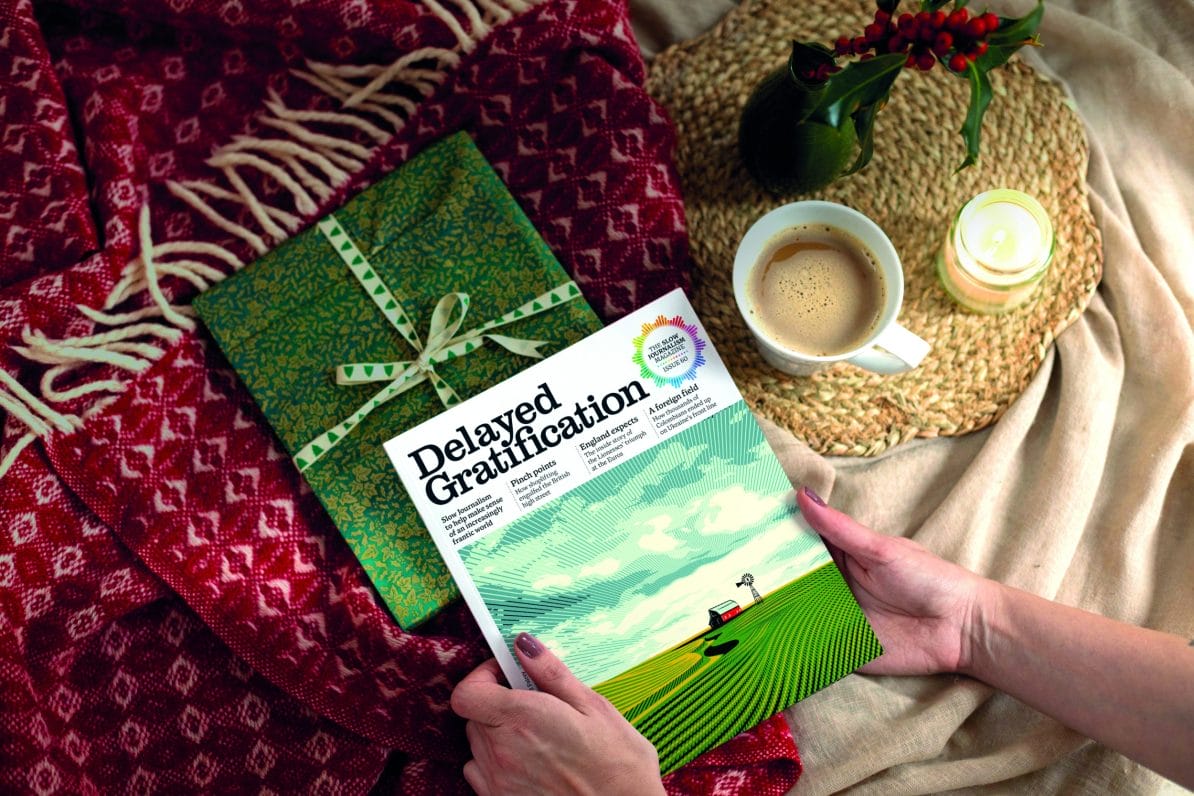
The 60th issue of Delayed Gratification features beautiful cover art by Shepard Fairey. Fairey is the only artist whose work has appeared on the cover more than once, with ‘Freedom of the Press’ on our launch issue, ‘Water is the New Black’ on our five-year anniversary issue and ‘Lotus Angel’ on our tenth. To celebrate our 15th birthday, we are delighted to have ‘Farms, not Factories’ on the cover. We caught up with the LA-based artist to discuss Donald Trump, longevity and the power of hope
It’s been 15 years since ‘Freedom of the Press’ featured on our first cover – how has freedom of speech changed in the US over that period?
Before the second Trump term, freedom of speech was largely the same for the last 15 years, with the exception of cancel culture descending upon people who said certain things. I’m a big believer in being sensitive to the evolution of standards and language, but cancel culture is counterproductive. However, since Trump began his second term, the attacks on freedom of speech from his end of the political spectrum versus the progressive end have been relentlessly brutal, creating fear and severe consequences for educators, legislators and many notable people in the public sphere. When people are afraid, they often censor themselves, which makes anyone who does speak out a more likely target, creating a slippery slope toward a society filled with censorship and persecution. In other words, freedom of speech is in a tough spot.
Is there still cause for hope in US politics?
There’s always cause for hope because hope is the only fuel for action. Things can feel very intractable and lead to pessimism, but I’m able to take a deep breath and look at how Germany recovered from the Third Reich and the devastation of the second world war. Germany is facing issues with the far right now, but it is still more progressive than the United States in terms of social programmes, education, healthcare and renewable energy. If Germany could do it, we can do it, and hopefully before things get as bad in the US as they did there. The evidence of the US moving in that direction hits us in the face daily, and yet many people seem either gleeful or apathetic. The inability to recognise how dire the situation is concerns me greatly.
How has your work evolved over the last 15 years?
Generally speaking it has become more positive and aspirational, although I do still critique problems and call out villains. From an aesthetic standpoint, I’ve incorporated shades of blue into my [main] palette of black, red, gold and cream, which I think gives the work a more friendly feel that connects with natural beauty. We all need air and water, which I often represent with shades of blue.
Over the years, we’ve asked you about the state of the media. Five years ago you were anxious about the ‘two realities’ syndrome enabled by social media. How do you feel about what’s happened since?
The ‘two realities’ syndrome has only become worse, and the concept of reality itself is becoming hard to pin down, with AI generating deep fakes that are very difficult to distinguish from reality. We need people to search for credible sources that vet their content so we can all avoid being easily manipulated by disinformation. Unfortunately, I think a lot of people want to ignore reality if it doesn’t align with their fantasy, or they’re just simply looking for entertainment, not facts.
‘Farms, Not Factories’, the piece we are running on the cover of this issue, celebrates another anniversary – 40 years of Farm Aid, a charity which fosters connections between independent farmers and the public. What is it about their work that appeals to you?
I always root for the underdog. Family farms are an essential part of community ecosystems, as opposed to industrial conglomerates that are often less tied to community interests or community health and are driven more by profits. My grandfather was an independent farmer after he retired from academia, and I know that it is incredibly hard work that should be respected.
You are part of the Triple Trouble exhibition that is currently taking place in London, alongside Damien Hirst and Invader. What can you tell us about the works you created together for it?
I respect and admire both artists, but our styles are very different, so it required true collaboration and lots of experimentation to find ways to combine our styles. I like a challenge, so when I met Damien and he suggested that we all collaborate, I thought to myself, “I’ll be more upset if I don’t try than if I try and fail.” Sometimes unexpected things can be initially disorientating but ultimately exhilarating. Many of the people who have seen Triple Trouble in person summed it up as “joyful”, which is a word I don’t use that often, but I genuinely think describes the show accurately.
Can we book you in now for our 20th anniversary in 2030, please?
If Delayed Gratification can prove that print is important and that delayed gratification itself is important for another five years, I’ll do whatever you need, because I’m with you one hundred percent.
The Triple Trouble exhibition is showing at London’s Newport Street Gallery until 29th March 2026. For more details see here. To find out more about the work carried out by Farm Aid, visit farmaid.org
A brief history of Delayed Gratification in Shepard Fairey covers
2010: Issue one feat. ‘Freedom of the Press’
 The first issue of Delayed Gratification came out with David Cameron recently installed in Downing Street, Barack Obama in the White House and the work of one America’s most prominent political artists on the cover. The reason Fairey agreed to let us use ‘Freedom of the Press’, he explained in our first interview, is that he liked both the medium (“Print means that you took the time to make something that you thought was worth making”) and our Slow Journalism message (“When it comes to the tortoise and the hare, I’m with the tortoise”). Inside, the magazine covered events that both seem like a world away (an explainer about the WikiLeaks scandal, an X Factor infographic) and very current (a story on the rise of nationalism in the UK, a celebration of Europe winning the Ryder Cup).
2015: Issue 20 feat. ‘Water is the New Black’
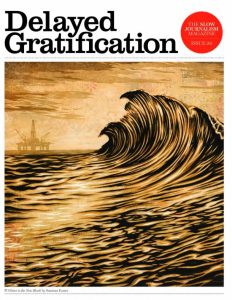
Fast forward five years and Fairey returned to our cover with a piece highlighting growing threats to the environment, which he identified as the defining news story of the time. We discussed the upcoming end of Obama’s presidency (“My biggest disappointment is that he seemed to lose the fire and conviction that he once demonstrated”) and his fears for what the future had in store for US politics (“I’m not sure what it’s going to take to wake up the average American”). Inside we had pieces on the start of Europe’s migration crisis in the wake of the Arab Spring, Jeremy Corbyn’s rise to become leader of the Labour party and, in one of our favourite pieces of offbeat reporting, the story of the Game of Thrones-like battle between two men attempting to claim a slice of North African desert and install themselves as king.
2020: Issue 40 feat. ‘Lotus Angel’
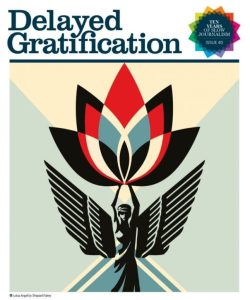 As DG turned ten years old, we found Fairey reflecting on Biden’s victory (“A relief but there’s a lot more to do”), the Trump presidency (“There are 70 million Americans that witnessed the first four years of Trump and said ‘we want more of that’”) and his pleasant surprise that the magazine was still going (“I really didn’t have high hopes for the viability of your project”). Inside Covid-19 naturally dominated, with stories on the attempts to find the root cause of the virus and the UK’s lockdown-busting illegal rave scene. We visited the final frontier with a fascinating photo feature from within the International Space Station and used data to determine the greatest sportsperson of all time (hint: it’s a swimmer).
2025: Issue 60 feat. ‘Farms, not Factories’
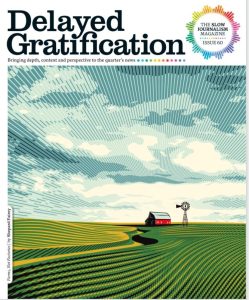 After a further half decade covering political earthquakes, actual earthquakes, wars, medical advances, financial instability, technological breakthroughs and social trends, we are so happy to have Fairey’s work on the cover once again. We now have 15 years of issues telling the story of our age, which subscribers can read in full here. Having coaxed a promise from Fairey that he’ll adorn our 20-year birthday edition for us, we can only wonder what Earth-shaking events we’ll be looking back on in 2030…
Slow Journalism in your inbox, plus infographics, offers and more: sign up for the free DG newsletter. Sign me up
Thanks for signing up.