A talk at the Idler: the perils of fast news
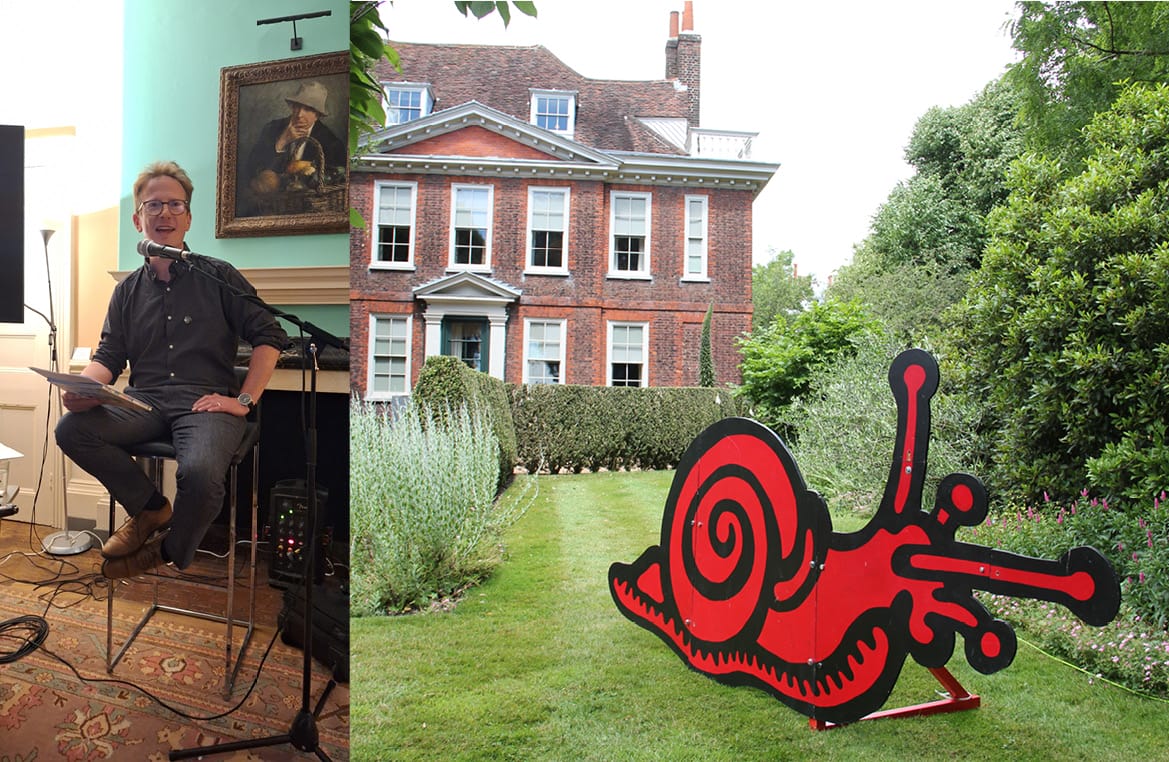
Rob Orchard at the Idler festival
Transcript of a speech given by Rob Orchard, co-editor of Delayed Gratification, at the Idler festival, 7th July 2024
You can listen to the speech here:
Hello everyone
My name’s Rob Orchard and back in 2011 I co-founded Delayed Gratification, the world’s first Slow Journalism magazine.
Our idea was to provide an alternative to kneejerk breaking news production by returning to big stories after the dust had settled and asking the question of what happened next. We wanted to help our readers navigate a world that was becoming increasingly complex and insecure. Like the Idler, we saw the value in taking things at a more leisurely pace.
Delayed Gratification was our own small line in the sand, a declaration of intent in a news environment that seemed to be in serious decline.
It has been an extraordinary time to be running a news magazine.
We’ve had the Arab Spring and the Occupy movement, the killing of Osama bin Laden and Black Lives Matter. The News of the World shut down by phone hacking and Julian Assange holing up in the Ecuadorian embassy in London. The annexation of Crimea. MH17, MH370 and Germanwings. Ebola. Zika. Isis. Brexit. North Korea hacking Sony to try and force them to cancel a comedy movie featuring Kim Jong Un. Charlie Hebdo, the Bataclan and the Manchester Arena bombing. Amazing medical and technological advances. Wildfires in the Amazon and the Arctic. MeToo and the fall of Harvey Weinstein. Civil war in Syria and Libya. A third of the world’s population confined to their homes. The president of the United States musing that injecting disinfectant might help free the body of coronavirus during a pandemic that may or may not have been caused by someone in China eating a pangolin. Barnard Castle. The murder of Jamal Khashoggi. The lambasting of JK Rowling. Elon Musk launching a perfume that smells of burnt hair to help fund the purchase of Twitter, taking over as CEO and then polling users to ask whether he should resign. The storming of the Capitol. The storming of the Brazilian congress. The invasion of Ukraine. The launch of the James Webb telescope. The overturning of Roe v Wade. Wagatha Christie. Liz Truss. The devastating earthquakes in Turkey and Syria. Rishi Sunak fleeing the beaches of northern France.
And while all this has been going on, our information ecosystem has become ever faster and more intense, driven by an obsession with breaking news. As a consequence it has become riddled with ever more mis- and disinformation and journalism has become ever less able to counter it.
The number of journalists has continued to fall. In just the last year, we’ve seen Buzzfeed News close down and layoffs announced at Vice News, CNN and the Washington Post. In early 2023, job cuts in news media in the UK and North America were running at 1,000 per month.
But before you can tackle a problem you need to understand it, and I’d like to talk to you about the history of how we got here through the medium of eight pieces of breaking news.
Let’s kick things off with one for the ages
Breaking news: There are man-bats living on the Moon
Let me take you back to the New York Sun in 1835
It ran a series of articles about Sir John Herschel’s discovery of life on the moon.
The articles claimed that Sir John, the most famous astronomer of his day, had been observing the moon with a powerful new telescope and had seen strange creatures living on its surface, including unicorns, tail-less beavers and man-bats.
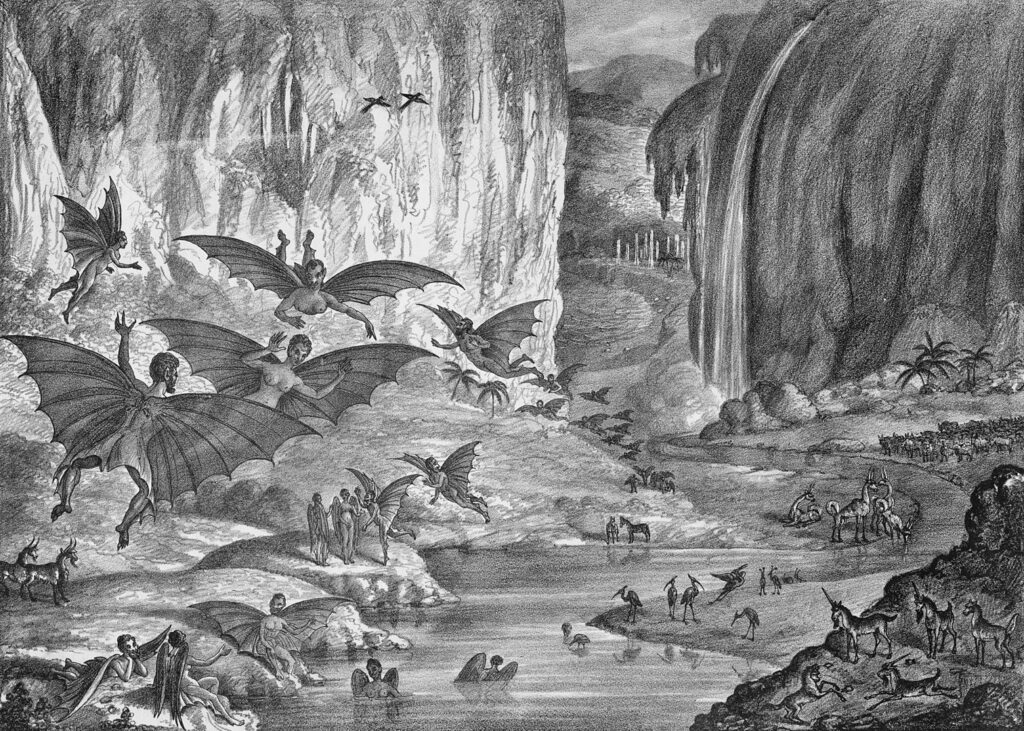
Lithograph of a scene on the moon, published in the New York Sun featuring man bats
Sir John had seen no such things, and wasn’t delighted when people started coming up to him and asking him to tell them more about the man-bats.
The story had served its purpose though: sales of the New York Sun soared as readers were caught up in what later became known as the Great Moon Hoax.
40 years later, in 1874, The New York Herald told its terrified readers that dangerous animals had escaped from Central Park Zoo, killing 49 people and injuring over 200. A lion and a tiger had been spotted fighting on 59th St, a sea lion had been seen punching a rhinoceros, an anaconda had attempted to eat a giraffe, and a panther had attacked worshippers at a church. At the very end of the article, in small print, it was stated that “The entire story given above is a pure fabrication”.
The story caused widespread panic. Parents rushed to schools to take their children home, where they were protected by fathers with loaded shotguns. The Herald sold a lot of papers.
So there’s nothing new about using our news ecosystem to monetise shocking and incorrect information. But of course these days it’s not longer just news organisations that break the news.
Breaking news: “Troubled soul singer Amy Winehouse dies at 27”
When Amy Winehouse died in 2011, 20 million people were talking about it on social media before a single news organisation had published a story on it.
But it wasn’t just individuals on social media who began reporting news stories. Unhindered by the need to verify facts, consult experts or comply with media law, countless information sources began pumping out news stories for free online, bringing in revenue through click-based advertising.
This proliferation of information sources had a powerful effect on the funding of traditional news journalism. Online advertising rates came down as new advertising opportunities opened up for marketers. Print advertising went down as advertisers moved online. And print sales plummeted because an entire generation of readers was being educated to believe that they should get their news instantly and for free.
The industry that was charged with holding power to account and exposing misinformation was decimated. It was losing its role as gatekeeper of the news. Major news organisations with 100 year pedigrees started laying off journalists, clearing out the sub-editors’ desks, reducing freelance pay and diminishing the scope and ambition of their work. The new online economic model militated against in-depth, long-form journalism.
In June 2016, Mother Jones published an extraordinary 35,000 word investigative story about the American prison system. It took 18 months to create, including four months the journalist Shane Bauer spent working undercover as a prison guard in a private jail. It uncovered some worrying abuses of power and helped lead to changes in government policy.
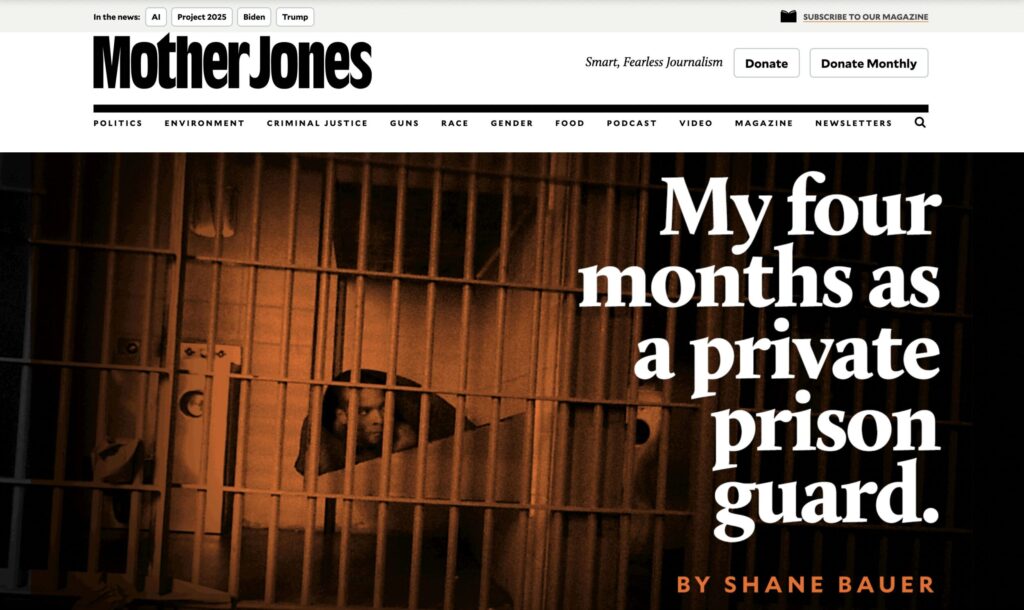
Screenshot
All in all it cost them $350,000 to put together. More than a million people read it. But the banner ads placed around the story online raised only $5,000.
It’s incredibly difficult to do proper, well-researched, in-depth work when people expect online news to be free. The sort of stories that flourish in this environment are short and provocative, turned out in very little time by overworked, underpaid journalists with no opportunity to seek out expert opinion. They race to get news stories out without time for verification or depth. There’s also a worrying market for being first rather than being right. At a national level the effect of these changes on news organisations was devastating, but it was nothing compared to the effect on local news.
Breaking news: “UK local newspaper advertising market falls by 90%”
In 2018 I visited my home town of Salisbury to report on the aftermath of the Novichok poisonings
I went to the offices of the Salisbury Journal, founded in 1729, where they had one of those old-fashioned boards where people would put their name cards in to show when they were at work. There was room for 100 names, and in times gone by the board would have been almost full. The current occupancy was five, and between them they were making three newspapers – the Salisbury Journal, Andover Advertiser and Basingstoke Gazette.
The editor, then aged 32, spent several weeks of his life at the heart of the biggest story in the world, before resuming his unglamorous and difficult work, scrutinising local politicians and businesspeople, with minimal resources. The traditional underpinnings of local news journalism – classified adverts and people buying printed newspapers – had been destroyed by the internet.
In the UK, the value of the regional newspaper advertising market has fallen from £2.4 billion in the mid noughties to £241 million now, a drop of 90 percent. Between 2005 and 2020, 270 local newspapers shut down. This was a pattern repeated across the world.
Back in 2009 in an interview with the Guardian, David Simon, a former crime reporter on the Baltimore Sun and the creator of The Wire, summed it up beautifully.
“Oh, to be a state or local official in America over the next 10 to 15 years, before somebody figures out the business model,” he said. “To gambol freely across the wastelands of an American city, as a local politician! It’s got to be one of the great dreams in the history of American corruption.”
It’s 14 years since he gave that quote. We still haven’t figured it out.
There’s another, more insidious side to this too. Without flourishing local newspapers, the traditional pathway for eager new journalists is cut off. It used to be that you’d start at a local newspaper, cut your teeth there, be guided and trained by a kindly editor, before starting to send stories to the nationals. This pathway is now gone. And while there’s no shortage of new journalism graduates, there aren’t any jobs for them to go to, so eventually they become disheartened and go into other careers.
And now we have generative AI, which is advancing at extraordinary speed. As an aside, I did enjoy a couple of months ago when Google launched its new AI overview function to give summary answers to user queries and people piled in to try to catch it out.
Q: “Can I use gasoline in cooking spaghetti?”
A: “Yes, there is a recipe for spaghetti that combines the flavours of gasoline with Italian spices”
Q: “Have cats been on the moon?”
A: “Yes, astronauts have met cats on the moon, played with them, and provided care”
Q: “How many rocks should I eat?”
A: “At least one small rock per day… [hide] rocks in food like ice cream and peanut butter”
But just picture the potential scene at a newsroom in the not-too-distant future. Overnight the algorithms have monitored what’s trending online. They then set the AI to work writing stories and columns about them by synthesising other stories and columns.
The news organisation floods its sites and social media with the stories, the money comes in from advertising clicks, and the few remaining journalists are set to work tweaking the headlines to make them more provocative. The algorithms that govern the internet serve up more of the same to social media news consumers. The news eats itself.
And amidst the wash of new, cheaply produced content, misinformation slips ever more easily through the gaps.
Breaking news: “Pope Francis shocks world, endorses Donald Trump for president”
It was in 2016, 180 years after the man-bats incident, that the term ‘fake news’ really took off.
Buzzfeed News ran a story about a group of enterprising teenagers in Macedonia who had started churning out nonsensical but provocative stories like the one about Pope Francis in the run-up to the US election.
They posted them on sites that were designed to look like mainstream news sites, and they made money from the clicks they received.
Stories like these were also published by partisan news operations and online groups who gained status and popularity from spreading the lies.
Now that everybody could feed into the same information supersystem, the words of a naughty Macedeonian teenager, a swivel-eyed nut job in a garage in northern Michigan or a pro-Kremlin stooge in Woking would be superficially placed on a par with those of the economics editor of the Times.
And in fact the economics editor of the Times would be on the back foot, because they would have a duty in their reporting to conduct research, triple check facts, give context and not crowbar in the celebrity references and nakedly provocative headline that would help their stories cut through on the internet.
In July of 2018 the UK’s culture select committee described fake news as “a crisis in our democracy”. When you can’t tell what’s real and what’s not, the underpinnings of our society start to crumble away.
Some news organisations have noticed that polarising stories cut through online, and have actively set about identifying audiences of people with firm but misguided beliefs and confirming their prejudices rather than bringing them the truth.
Natural human traits, including the desire to band together into groups, make the spreading of misinformation more likely.
And this misinformation can have powerful real world consequences.
Breaking news: “British 5G towers are being set on fire because of coronavirus conspiracy theories”
A lie about 5G towers spreading Covid-19, along with many other conspiracy theories that took off during the pandemic, was fuelled by a simple human need to have privileged information in a time of crisis.
It led to posses of misinformed citizens going out and burning 77 5g masts across the UK in the first month of the pandemic alone
There’s a quote that I think helps explain this mad behaviour, by American biologist Edward O Wilson, who said:
“The real problem of humanity is the following: We have palaeolithic emotions, medieval institutions and godlike technology”
I think this really helps us to understand how lies spread online in the guise of news.
Our Paleolithic emotions lead us to search for answers that resonate with our world view, rather than those that are backed up by facts. Our godlike technology allows us to spread nonsense in seconds to everyone in the world who’s in the mood to buy it. This is aided by the 60 percent of people who share stories online before reading past the headline, because it chimes with their ideology, their beliefs or their emotions, or makes them feel intelligent or in control.
And our mediaeval institutions are ill-equipped to deal with or regulate this scary new world.
The speed with which our technology works led spooked investors to try to pull $42 billion out of Silicon Valley Bank in a matter of hours in March 2023, causing a run on a financial institution which nearly triggered a repeat of the global crash of 2008.
Meanwhile the influence of anti-vaccine falsehoods online led to thousands of fit young people dying needlessly and remorsefully of Covid-19
But what’s prompting the propagation of all this nonsense? Oddly enough part of the problem was Psy, of ‘Gangnam Style’ fame.
For a long time, YouTube’s suggestions algorithm worked by serving up videos that were similar to the one you’d just watched but more popular. All roads notionally then led to 2012 hit ‘Gangnam Style’, the most popular video on YouTube
In 2015 the algorithm was changed, to serve up more niche content, to help smaller videos and producers get views
The problem is that this helped create YouTube rabbit holes where instead of being elevated upwards to ‘Gangnam Style’ you were drawn downwards to conspiracy theories and extreme viewpoints spread by crackpots
On TikTok, the fastest-growing news source among UK adults, such theories and viewpoints are rife. In the February 2023 case of the death of 45-year-old mortgage advisor and mother of two Nicola Bulley, for example, the site was flooded with disturbing and damaging misinformation by amateur detectives.
But of course it’s not just reprehensible and daft normal people spreading lies, the corruption of the information system also comes right from the top
BREAKING NEWS: “Rishi Sunak doesn’t think adults convicted of sexually assaulting children should go to prison”
Of course he does. But this untrue claim circulated online last year next to a picture of the former prime minister and his signature.
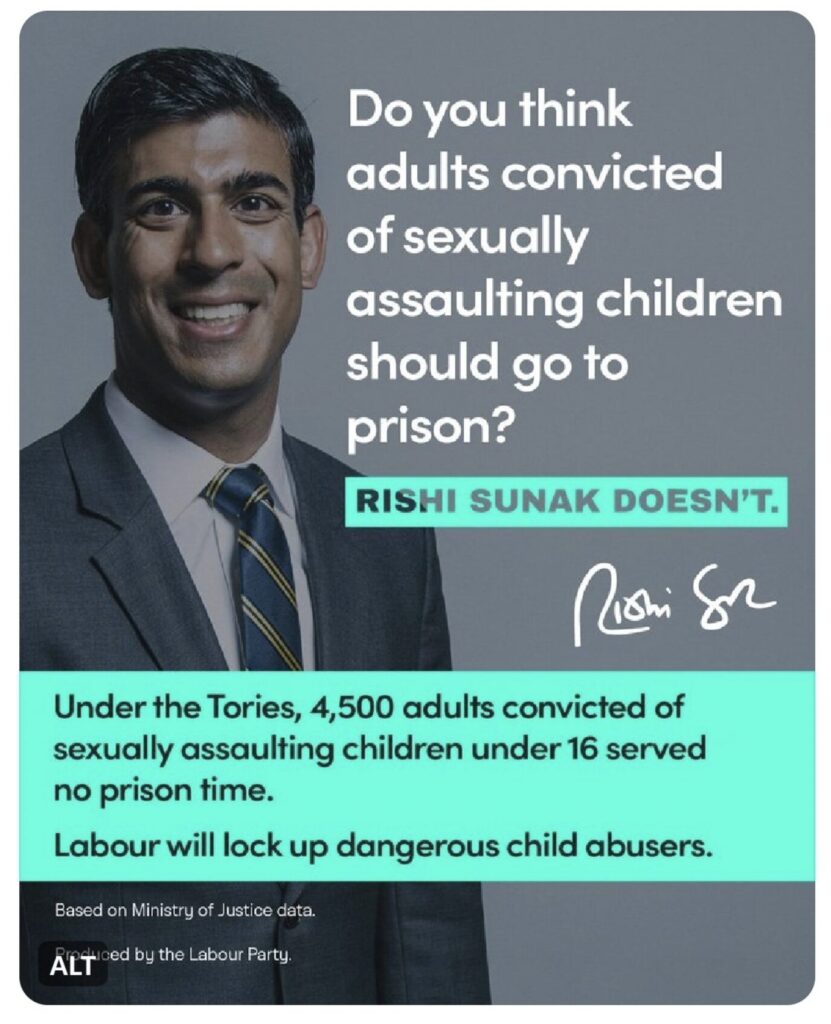
Screenshot of Labour Party advert on social media
It was issued on behalf of the Labour Party, and it was seen 21 million times online in the first three days.
My magazine, Delayed Gratification, is firmly non-partisan, and of course there are any number of lies by British Conservative politicians that could be highlighted here too, over oven-ready Brexit deals, Partygate, borders in the Irish sea, Chris Pincher and new hospitals to name just a few.
The thing that shocks me about this particular lie is that it’s so entirely transparent.
The person who designed the advert must know it’s a lie. Keir Starmer, our new prime minister, must know it’s a lie. He must also know that the lie is based on data about convictions stretching back to 2010, five years before Rishi Sunak entered the house of Commons. Starmer must further be aware that until 2013, he himself was the director of public prosecutions, and consequently much more able to affect sentencing guidelines than Sunak.
But ultimately it doesn’t matter whether it’s true or not, it just matters whether enough people believe it’s true or feel that the waters have been muddied sufficiently that they don’t know what to believe. The people who get angry about it on social media are playing into the campaign’s hands, by helping them to spread it. And unreality starts to seep in.
For people who don’t spend a lot of time thinking about the media and how it works, the information ecosystem we have built up for ourselves can feel like walking around a hall of mirrors filled with vaping monkeys.
Of course the Labour campaign’s fib pales in comparison to the work of Donald Trump
When the 45th President of the United States took up office the Washington Post began a lie tracker to log every provable untruth he told. By the time he left office it stood at 30,573.
One of these – that he had been cheated out of victory in the 2020 election – has already claimed the lives of five people in the storming of the Capitol and its aftermath, and is likely to corrupt US civic and political life for years to come. He was aided in it by Fox News, which agreed to pay Dominion almost $800 million in 2023 to settle a defamation lawsuit over its coverage of claims of vote rigging.
Trump’s real coup de grâce, however, was not just to lie, but to describe any stories he didn’t like as fake news. Among others he declared that ABC, the BBC, CBS, CNN, MSNBC, NBC, the New York Times, the Wall Street Journal and the Washington Post were all producers of fake news.
This is a blatant, childish and effective trick. Somebody tells the truth about your disinformation and then you say that this truth is itself disinformation. The clouds of bullshit-flavoured vape grow ever thicker in the hall of mirrors.
And that’s before we even get to China and Russia.
BREAKING NEWS: “I want you to lay down your arms and surrender to the Russians”
This is a chilling thing to hear Volodomyr Zelensky say
Or at least it would be, if it weren’t being delivered by an implausible deepfake of Zelensky, whose head is too big for his body and appears to be floating above his neck.

Screenshot of deepfake Zelensky
This cackhanded piece of propaganda was more worrying as a harbinger of the future than a genuine piece of disinformation.
But when deepfakes are perfected and accessible to anyone, all bets are off. The few remaining journalists will have to spend much of their time trying to work out which footage is for real and which is not. Given how quickly content can go viral, we can expect reputations to be shredded, lawsuits to be launched and wars to be intensified in the time it takes them to work it out.
The other side of deepfake video is that it will give plausible deniability to chancers. If you’re part of a despicable video from now on – perhaps one, for example, in which you brag about sexually assaulting women – you can cash in the liar’s dividend, meaning you can just claim the video is a fake and make it other people’s problem to prove it’s true.
Inject enough of this nonsense into the information system and you accelerate people’s distrust of it.
Perhaps it’s unsurprising that so many people are now simply turning away from the news.
BREAKING NEWS: “38% of people around the world actively avoid the news”
This figure from a Reuters survey has gone up from 29% in 2017. In the UK it is at 46%.
This is unsurprising. We’ve all begun carrying around devices that can ping us constant updates from news sources and social media, drawing our focus and attention and making us anxious about problems we have no means of solving.
Instead of engaging us in optimistic conversations about the future or helping us to work towards solutions, they drag us from one helpless crisis to another.
But nor should we despair. Breaking news may be broken but it is not a hopeless situation. There are lots of things we can do to gain a healthier, more sustainable relationship with the news.
We can teach our kids to be skeptical and deliberate in their news consumption, not to forward stories without reading them, and to spot when a friend is disappearing down a disinformation rabbit hole and step in and try to bring them back.
We can support big news organisations that bring important stories to light, winning trust over many years of mainly getting things right and then owning up when they get things wrong. We can support small local news initiatives battling to survive and the exciting new initiatives like the Manchester Mill in the UK which are pioneering new models.
We can support fact-checking organisations – after first checking they are not astroturfed fronts for belligerent nations or businesses with special agendas
We can support small, independent magazines like Delayed Gratification, in their mission to give context and perspective to the news.
In championing Slow Journalism, my fellow editors and I have tried to swim against the tide. Breaking news is obsessed with being first – we are proud to be ‘Last to Breaking News’, not covering major events until at least three months later and aiming to bring context and perspective to help our readers understand the world.
Breaking news is powered by overwhelming streams of constantly updated ‘content’ while we curate and edit, distilling the moments that mattered over three months into 120 pages.
Breaking news is often funded by giving away content to the biggest possible audience and then monetising those people through invasive advertising and selling their data.
My magazine carries no advertising and has no sinister multimillionaire backer, but we’ve been able to fund ambitious investigations in challenging countries across the world.
We need to call on as many different models as we can find to fund an army of ambitious, inquisitive journalists who spend their days hunting down the truth, checking the facts and holding the powerful to account. That will of course require people who value the truth to put their hands in their pockets.
Together I think we can start to navigate our way out of the smoky hall of mirrors, dodging deepfakes, discounting disinformation and speaking truth to power as we go. I do hope so. Thank you very much.
If you’d like to support our Slow Journalism mission, please subscribe to Delayed Gratification for you or a friend
Slow Journalism in your inbox, plus infographics, offers and more: sign up for the free DG newsletter. Sign me up
Thanks for signing up.


