
Inside DG #61: Europe’s unexplained drone incidents
A Q&A with the writer of our story on Europe's mysterious drone sightings from issue 61 of Delayed Gratification
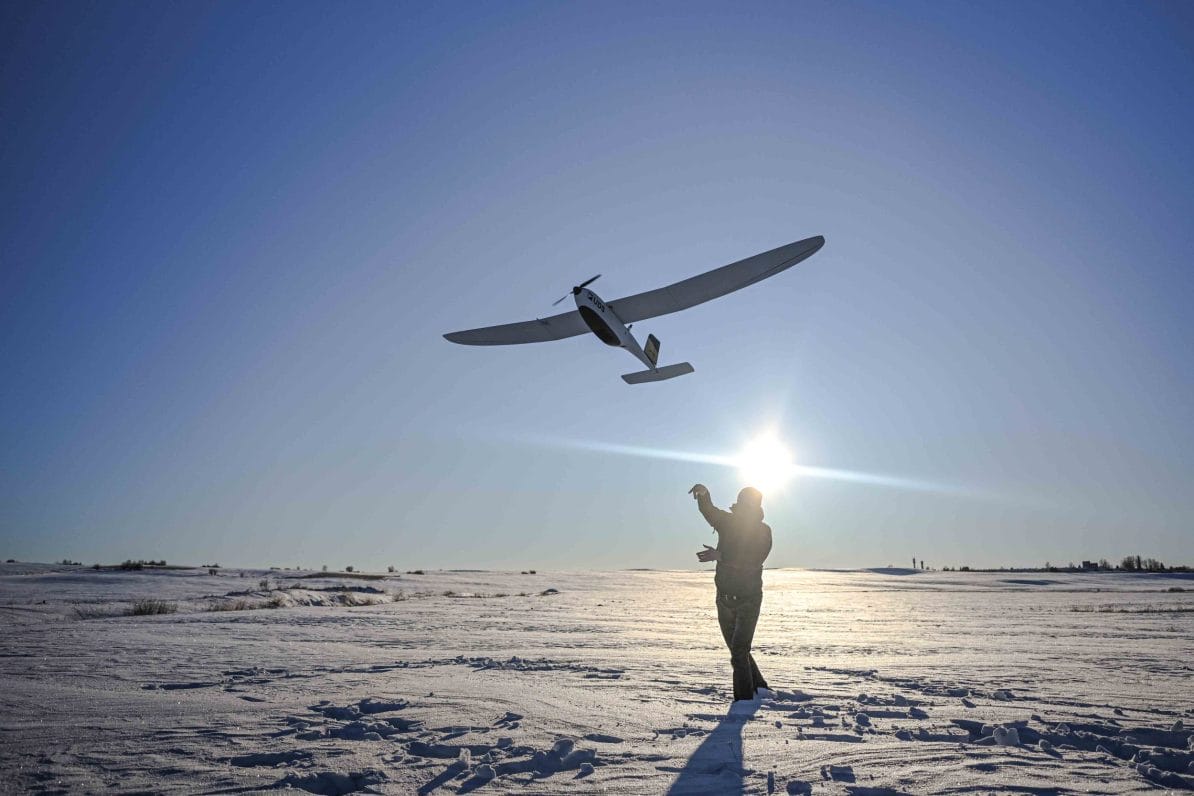
Photo: Denis Vėjas
The 61st issue of Delayed Gratification features a piece by Harriet Salem about a series of mysterious drone sightings over Europe in late 2025. Delayed Gratification associate editor Matthew Lee spoke to Harriet about her work on the story…
Matthew Lee: In a nutshell, what’s the article about?
Harriet Salem: Across mainland Europe and the UK there have been mysterious drone sightings above critical infrastructure – for example, nuclear power plants, fertiliser factories and military bases. Politicians have said that Russia is likely behind the incursions (Moscow denies the claims). The piece looks at how much evidence there is for these claims, what the purpose of these drone incursions could be, how worried we should be and why we apparently can’t seem to stop a hostile state allegedly flying drones over such sensitive sites.
ML: Why were you keen to write about this topic – what appealed to you personally about this story?
HS: I’ve reported on Russia’s war against Ukraine since 2014. One of the things that really fascinates me is how Russia is good at slowly upping the ante in a way that people seem to acclimatise to it. Moscow’s strategy is to poke and retreat to see how much they can get away with and this, in my view, often leads to a lack of action on the threat. If you think about Ukraine, the war started with Russian-backed separatist groups in the Donbas and the annexation of Crimea. Europe barely responded to this and then in 2022 we saw the whole-scale invasion of Ukraine. In recent years we’ve also witnessed an increase in Russian hybrid warfare in Europe – just some examples include the brazen attempted murder of Sergei Skripal by Russian agents in the UK in 2018, channelling asylum seekers into the EU via Belarus in 2021 and blowing up a train line in Poland in November 2025. The drone incursions are another example of this. There’s often a plausible deniability aspect involved, which is 101 in the Kremlin’s playbook, and when you look at the big picture I think it’s pretty worrying. It’s a kind of a frog in the pot strategy and the temperature of the water is pretty hot right now. We’ve just become inured to it.
ML: What was the mood like when you visited Lithuania? Are people there seriously concerned about the drones and balloons flying over their airspace?
HS: Living in a country that is on the EU’s eastern flank, people in Lithuania are more concerned in general about the possibility of war with Russia than we are in Western Europe. It’s partly about geography. Lithuania borders Kaliningrad (a Russian exclave surrounded by EU countries) and its capital, Vilnius, is within artillery range of its border with Kremlin ally Belarus, which allowed its territory to be used by Russian troops to launch the 2022 invasion of Ukraine. It’s also due to history. Lithuania was under Soviet occupation for more than four decades and that only ended in 1990, so it’s within living memory for a lot of people. So, yes, they are rightly quite concerned about drones and, more broadly, Russia. Indeed, I think they’re actually quite hopeful that the drone incursions which have happened across the continent will help wake up some Western European nations to the threat that they in Lithuania have long believed that Moscow poses to the EU and Nato.
ML: What was the most interesting thing you discovered while doing your research for this feature?
HS: The most interesting interview I did was with Dr Beryl Pong, the principal investigator at the Centre for Drones and Culture at the University of Cambridge. We talked about the psychology of drone incursions in Europe, which I think is an aspect that has been less reported on. What Dr Pong highlighted to me that was really fascinating is how the ambiguity of drones, which in themselves are a neutral technology that are used by civilians and militaries for good and bad and which are often incredibly hard to trace, make them such an ideal instrument for hybrid operations and psy-ops. As she told me: “Maybe it’s Russia. Maybe it isn’t. Maybe some are and others aren’t… The reality is we just don’t know… [but] the aim of psy-ops is exactly to generate these feelings of uncertainty and to menace a population.”
You can read the full story in issue 61 of Delayed Gratification, available from our online shop here.
Slow Journalism in your inbox, plus infographics, offers and more: sign up for the free DG newsletter. Sign me up
Thanks for signing up.